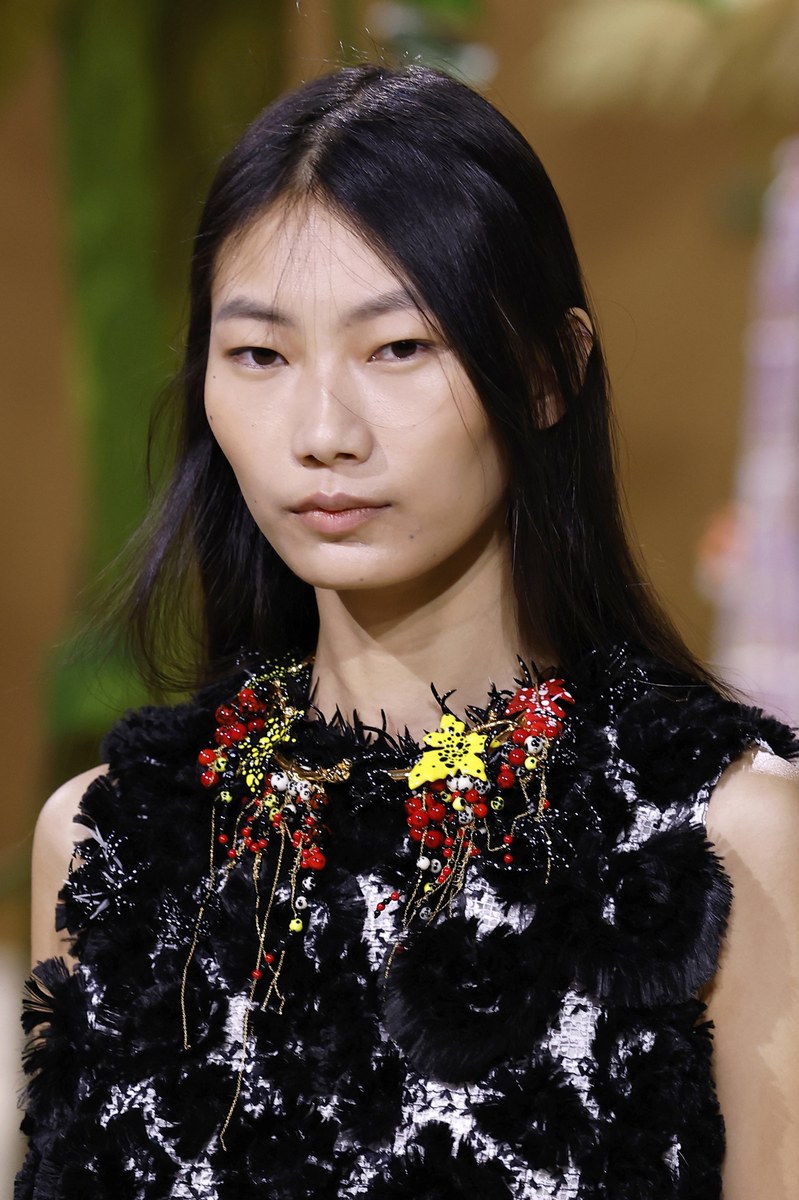
Issey Miyake FW26 Details

Issey Miyake FW26 Details
Issey Miyake FW26 Details Report

Accessories and garment details function as structural arguments in this collection, not decorative additions. Belts work as architectural closures. Fabric itself becomes the primary design material. For buyers and product managers, this signals a directional shift toward hardware-minimal, proportion-led accessory design that supports the growing demand for considered, craft-forward product.

Category Overview

Four categories define the collection: belts, dress details, and headwear, with dress details commanding the largest share of visual real estate. Belts operate as slim technical straps rather than statement pieces, always subordinate to the garment volume they cinch. Details 19 and 20 represent the headwear category and deliver the collection's most editorial gesture through sculptural felt constructions that read as wearable objects. Across all categories, the strategy is restraint in hardware paired with maximalism in cut and surface treatment.
Material and Construction

Leather belts in Details 3 and 4 are cut narrow, approximately two centimeters wide, with minimal taper and clean-edge finishing that suggests vegetable-tanned or semi-aniline hides. Each petal-like flap in Details 16 and 17 is pressed into a fixed three-dimensional form rather than sewn into shape, using Miyake's signature steam-set Pleats Please construction. Detail 5 presents a lacquered or coated corset bodice in ivory, its rigid shell construction distinct from the soft linen panels draped around it. A structured wool waistband with flat-front button tabs comprises Detail 8, behaving more like a separate belt component sewn onto the skirt than an integrated waistband.

Detail 5
Detail 5

Color and Finish Direction

Ivory, chalk white, and oyster dominate across Details 5, 7, 14, 15, 16, and 17, building a tonal white story that anchors the collection's quieter half. Charcoal pinstripe in Details 11 and 12, and navy in Details 3 and 10, provide the formal counterweight. Matte silver and brushed gold appear in equal measure across Details 1, 2, 3, and 4, with no bright or high-polish finishes present anywhere in the collection. Magenta and violet reserved specifically for Details 19 and 20 signal that color saturation belongs to outerwear and headwear rather than distributed across categories.

Key Pieces and Details

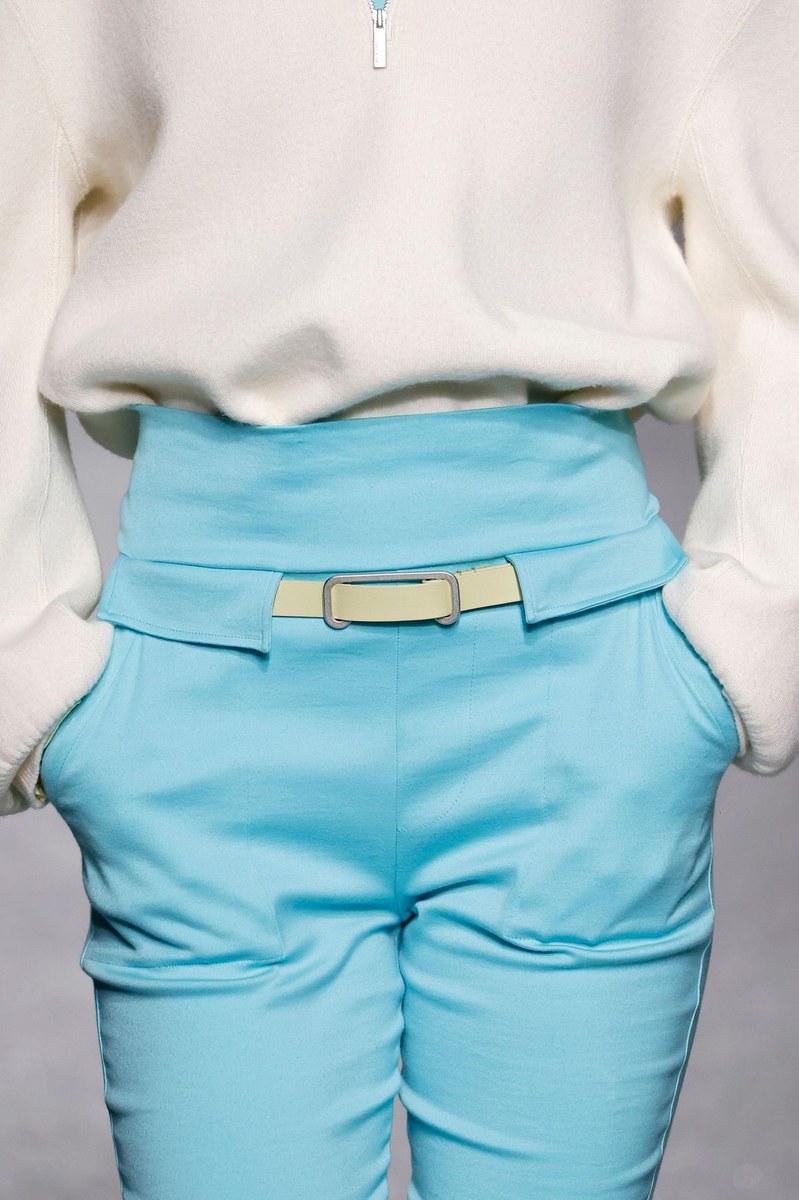
The narrow leather belt with a D-ring or rectangular buckle, seen across Details 2, 3, and 4, is the collection's most reproducible commercial accessory and translates across price points without losing its directional quality. Details 19 and 20 present sculptural felt hats with asymmetric folded brims and monochromatic body-to-hat color matching, representing the highest barrier to entry for most buyers but carrying strong editorial placement potential. Detail 1 demonstrates exactly how the belt category functions here: a cream leather belt with matte silver rectangular buckle worn over high-waist powder-blue trousers acts as a precision instrument defining a waistline rather than filling it. Production-intensive pleated white coat details in Details 16 and 17 are strongly differentiated and relevant for specialty retailers positioning against volume-driven competitors.

Detail 1
Detail 1

Detail by Detail Highlights

Detail 1 (Belt) A cream leather belt with a matte silver rectangular buckle sits precisely on the waistband of powder-blue high-rise trousers, acting as a structural seam rather than an ornament.

Detail 3 (Belt) A narrow brown leather strap with a brushed gold rectangular buckle threads through navy pinstripe trousers, its thinness amplifying rather than interrupting the vertical stripe rhythm.

Detail 3
Detail 3

Detail 5 (Dress Detail) A rigid ivory corset shell with a high-gloss lacquered surface sits inside a draped raw-linen outer layer, creating a hard-soft material dialogue built entirely from tonal white.

Detail 8 (Dress Detail) A wide wool waistband constructed from what reads as a repurposed jacket front, complete with button tabs and pocket flap, wraps the hip over a navy shell top and black skirt.

Detail 8
Detail 8

Detail 10 (Dress Detail) A navy ribbed knit top carries a large oval cutout at the chest, the aperture bordered by the knit structure itself without any applied trim or binding.

Detail 10
Detail 10

Detail 16 (Dress Detail) A white pleated coat renders its belt loops, patch pocket, and tie closure entirely in the same steam-set pleated fabric, so every functional element reads as continuous surface rather than construction.

Detail 16
Detail 16

Detail 19 (Headwear) A black wool felt hat with a dramatically asymmetric brim folds and lifts on one side to create a silhouette that mirrors the wide-shouldered collar beneath it.

Detail 19
Detail 19

Detail 20 (Headwear) A violet felt hat with a low rounded crown and a wide stiff brim matches the outerwear beneath it in both color and material, collapsing the boundary between garment and accessory entirely.

Detail 20
Detail 20

Operational Insights

Belt hardware specification: All buckles use rectangular or D-ring profiles with no prong or tongue mechanism, which reduces per-unit hardware cost and speeds production. Specify matte silver or brushed gold only, as high-polish finishes would break the tonal logic of the range.

Narrow belt sizing: The two-centimeter belt width visible in Details 3 and 4 requires precise skiving and edge-finishing to avoid a cheap read at retail. Build in additional margin for hand-finishing or a semi-automated edge-paint process when costing these styles.

Pleated fabric MOQ: Steam-set pleating requires dedicated machinery and typically carries high minimum order quantities from specialized mills. Initiate mill conversations immediately, as lead times for pleated fabric development typically run 16 to 20 weeks ahead of production.

Color strategy for headwear: Details 19 and 20 demonstrate that headwear performs best when matched precisely to the dominant outerwear color. Plan colorway development in lockstep with outerwear rather than treating hats as a standalone SKU group.

Dress detail as commercial differentiator: The waistband construction in Detail 8 and the cutout structure in Detail 10 require no additional materials and are achieved through pattern engineering alone. These details offer a high-visibility design return at relatively low incremental production cost for product managers working with mid-tier manufacturers.

More Details

Detail 2
Detail 2
Detail 4
Detail 4
Detail 6
Detail 6
Detail 7
Detail 7
Detail 9
Detail 9
Detail 11
Detail 11
Detail 12
Detail 12
Detail 13
Detail 13
Detail 14
Detail 14
Detail 15
Detail 15
Detail 17
Detail 17
Detail 18
Detail 18
Detail 21
Detail 21
Detail 22
Detail 22
Detail 23
Detail 23
Detail 24
Detail 24
Detail 25
Detail 25
Detail 26
Detail 26
Detail 27
Detail 27
Detail 28
Detail 28
Detail 29
Detail 29
Detail 30
Detail 30
Detail 31
Detail 31
Detail 32
Detail 32
Detail 33
Detail 33
Detail 34
Detail 34
Detail 35
Detail 35
Detail 36
Detail 36
Detail 37
Detail 37
Detail 38
Detail 38
Detail 39
Detail 39
Detail 40
Detail 40
Detail 41
Detail 41
Detail 42
Detail 42
Detail 43
Detail 43
Detail 44
Detail 44
Detail 45
Detail 45
Detail 46
Detail 46
Detail 47
Detail 47
Detail 48
Detail 48
Detail 49
Detail 49

✦ This report was generated with AI — combining human editorial vision with Claude by Anthropic. Because the future of fashion intelligence is already here.