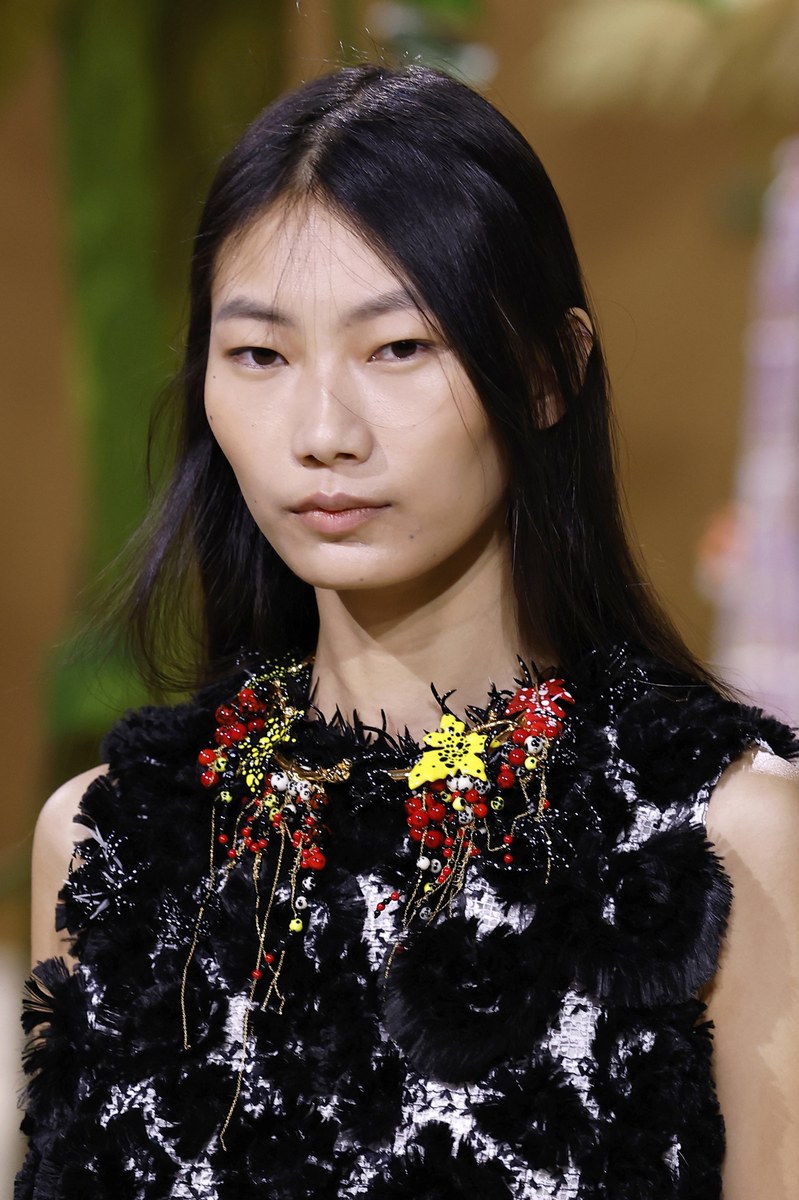
Issey Miyake FW26 Shoes

Issey Miyake FW26 Shoes
Issey Miyake FW26 Shoes Report

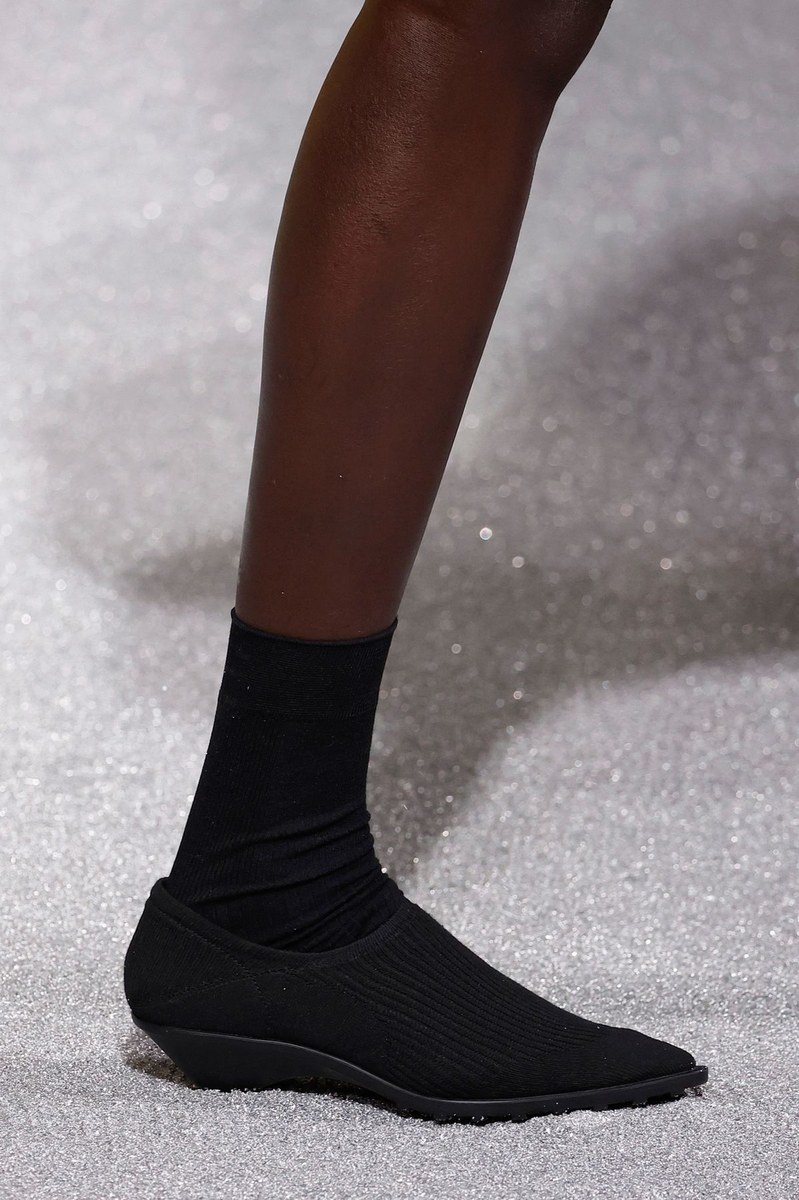
Issey Miyake FW26 plants its footwear identity firmly in the sock-shoe hybrid, with ribbed stretch uppers, pointed toes, and minimal wedge soles forming the backbone of an almost entirely seamless, slip-on aesthetic. For buyers and product managers, this signals a clear consumer shift away from structured footwear hardware toward body-conforming construction techniques that sit closer to hosiery than traditional shoemaking.

Silhouettes and Construction

A low-profile pointed-toe slip-on with a compressed wedge heel sits no higher than 3 to 4 centimeters across Shoes 1, 2, 4, 6, and 7. Each features a gathered, ruched ankle cuff that reads simultaneously as integrated sock and boot collar, eliminating any traditional topline construction. Shoe 3 breaks from this entirely by introducing a square toe and a stacked block heel of approximately 5 centimeters, built in smooth leather with a more conventional ankle boot cut. Shoe 5 departs with a flat boat shoe silhouette, a moccasin-style toe seam, and metal eyelet lace hardware.
Materials and Finishes

Fine-gauge ribbed knit or technical stretch fabric appears across Shoes 1, 4, and 6 for the entire upper and ankle cuff, with no visible seaming at the vamp. Shoes 2 and 7 employ the same ribbed stretch construction in an off-white or warm cream colorway, with the sole unit molded in a matching tone, suggesting mono-material production. Shoe 3 stands alone in smooth matte leather, with clean topstitching at the vamp line and a solid block heel in the same leather finish. Matte smooth leather forms the body of Shoe 5, paired with a tonal suede-effect toe panel and silver-tone metal eyelets as the only hardware detail in the collection.

Color Direction

Severe restraint defines the palette. Black dominates across five of the seven looks, appearing in Shoes 1, 3, 4, 5, and 6. Off-white and warm ecru hold the counter position in Shoes 2 and 7, with Shoe 2 leaning toward a slightly cooler ivory and Shoe 7 presenting a warmer, almost putty-toned cream. No accent colors, no metallics, and no tonal variation within individual pairs signal a deliberate direction toward colorway simplicity that reduces SKU complexity for retail buyers.

Key Models and Details

The ribbed sock-wedge repeats across at least four color and height variations, functioning as the collection's franchise silhouette. On all sock-wedge variants, the pointed toe is sharp but not extreme, landing at a practical 15 to 20 degree taper that broadens commercial appeal. Shoe 3 reads as a more accessible entry point, with its familiar block heel and smooth leather upper sitting closer to conventional ankle boot territory. No visible external branding, logos, or label placement appears on any shoe across the seven looks, consistent with Miyake's product language and making these viable for logo-averse wholesale channels.

Shoe by Shoe Highlights

Shoe 1 The black ribbed sock-wedge with ruched ankle cuff and approximately 3-centimeter compressed wedge sits as the purest expression of the collection's direction. Its all-black monochrome construction suggests a single-material upper that could simplify production costs.

Shoe 1
Shoe 1

Shoe 2 Tone-on-tone sole molding in a warm off-white distinguishes this ivory ribbed sock-wedge, making it the strongest candidate for a fashion-forward colorway buy alongside the black version.

Shoe 2
Shoe 2

Shoe 3 Most commercially conventional of the lineup, this square-toe black leather block heel speaks to buyers serving a broader, less avant-garde customer. Its clean vamp seam and stacked heel make translation straightforward.

Shoe 3
Shoe 3

Shoe 4 Worn under an open-weave mesh skirt, the all-black sock-wedge demonstrates how the silhouette functions as a background shoe. For buyers styling the model into coordinated head-to-toe sets, this matters considerably.

Shoe 4
Shoe 4

Shoe 5 The only hardware element in the collection appears here, metal eyelets on a black flat boat shoe with a cream-tone slouched sock layered over it. Its flat sole introduces the only non-wedged option, broadening the heel-height range for buying across comfort-focused segments.

Shoe 5
Shoe 5

Shoe 6 The higher ankle cuff on this black ribbed sock-wedge extends noticeably further up the leg than Shoe 1, functioning closer to a sock boot. That variation in shaft height suggests at least two distinct cuts exist within the same last and sole unit.

Shoe 6
Shoe 6

Shoe 7 Paired with a magenta skirt, the warm putty-cream sock-wedge proves the silhouette carries across bold garment colorways without competing. Its neutral sole unit reinforces versatility as a cross-category pairing shoe.

Shoe 7
Shoe 7

Operational Insights

Franchise Silhouette: The ribbed sock-wedge appears in enough variations to warrant treatment as a core franchise model. Buyers should plan depth, not breadth, securing black and off-white in both shaft heights rather than spreading open-to-buy across minor variations.

Material Sourcing: The stretch ribbed upper construction requires a circular knit or warp knit supplier capable of producing a structured enough fabric to hold shape at the ankle without collapsing. Knit-to-shape or cut-and-sew knit processes differ substantially from standard woven uppers, and lead times will vary accordingly from conventional leather footwear.

Sole Tooling: Shoes 1, 2, 4, 6, and 7 appear to share the same compressed wedge sole unit, indicating shared tooling. Product managers should confirm whether the cream sole on Shoes 2 and 7 uses a separate tool or a pigmented compound on the same base, as this directly affects minimum order quantities and reorder flexibility.

Color Architecture: With only black and off-white in the footwear palette, a two-colorway buy structure emerges naturally. This reduces markdown risk and simplifies seasonal planning, but buyers should assess whether a third neutral, such as taupe or stone, would extend sell-through in markets where pure off-white carries higher return rates.

Wholesale Positioning: Every model benefits from the complete absence of logos and external branding, making them viable for premium multi-brand retail without the displacement risk that branded footwear carries. Style directors should note this when placing in stores where brand-neutral product commands shelf priority.

✦ This report was generated with AI — combining human editorial vision with Claude by Anthropic. Because the future of fashion intelligence is already here.