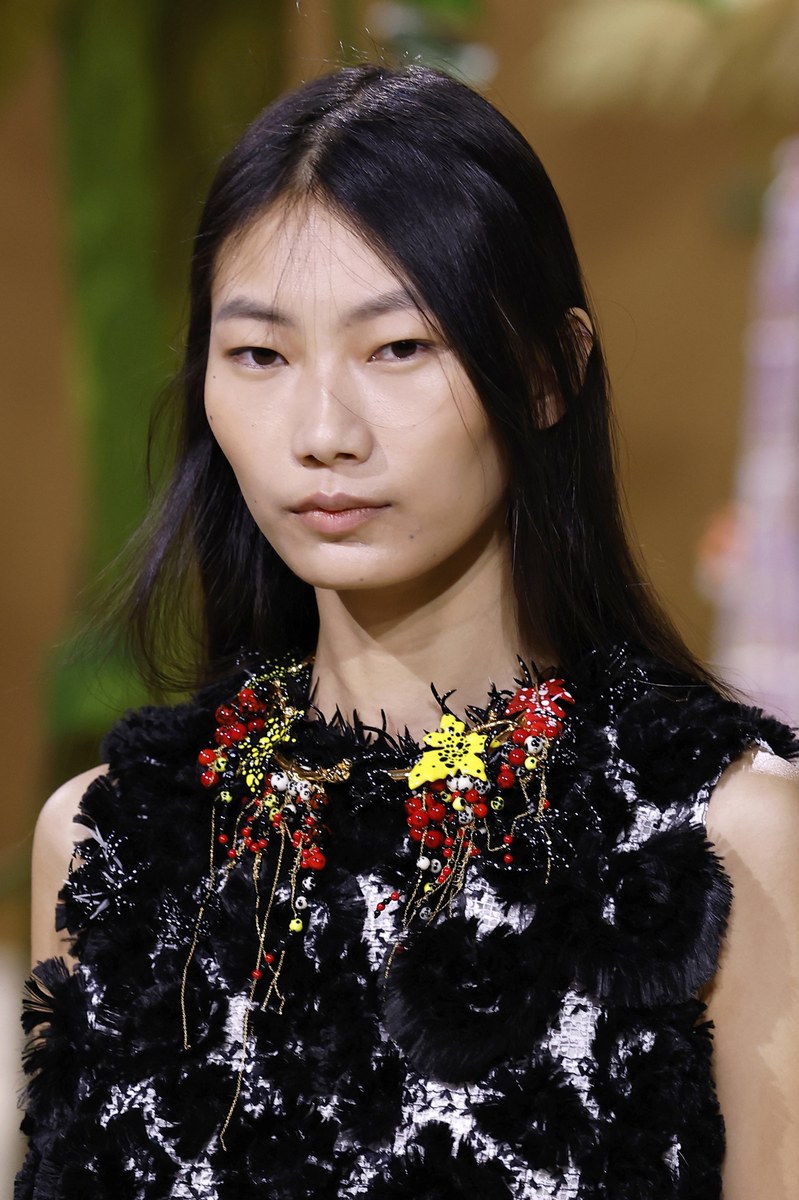
Issey Miyake FW26 Women Looks Report

Issey Miyake FW26 Women Looks Report
Issey Miyake FW26 Women Looks Report

Paris Fashion Week

Issey Miyake FW26 builds a collection around the tension between architectural restraint and fluid, almost ceremonial volume. Rigidly sculpted knitwear and tailoring give way to cascading pleated forms that dissolve the body entirely. For buyers and style directors, this arrives at precisely the right moment. Markets are actively seeking garments that read as statement pieces without relying on surface decoration or branding.

Silhouette and Volume

Compressed, body-skimming corset forms in Look 1 and Look 52 open the collection, then expand aggressively through the middle range into caped, winged and monastic silhouettes. Look 26 makes the most dramatic structural argument: a burgundy belted coat held wide open at the arms, its lapels forming a perfect geometric triangle that nearly doubles the model's visual width. Pleated volumes in Looks 39, 40, 41 abandon any structural pretense entirely, with fabric moving as a single rippling mass. Precision returns in the closing section, where Look 44 and Look 45 present tightly engineered asymmetric wrapping in sage-grey and black wool.
Look 1
Look 1

Color Palette

White and off-white open the collection. A long stretch of charcoal grey and navy follows, then breaks sharply into saturated color from Look 16 onward. Electric powder blue repeats in Looks 16 and 32, acid yellow-green in Looks 17 and 31, magenta-violet in Looks 34, 37, 46, 47, 48, and warm burgundy-brown in Looks 14, 18, 26, 40, 49. Deep wine-plum appears in the pleated section at Looks 41 and 42. Neutrals read severe and monastic. Saturates read almost sportswear-inflected, which creates a deliberate tonal whiplash that buyers should note as a merchandising tool across price tiers.

Look 16
Look 16

Materials and Textures

Three distinct material families carry the collection. Heavy, matte wool and wool-blend appears in tailored coats, belted wraps and sculpted tops across Looks 2, 5, 22, 26, 43, 44 and 45, its surface holding a sharp crease without stiffening into costuming. Signature Pleats Please technology emerges in Looks 29, 39, 40, 41 and 42, where fine parallel pleating creates fabrics with simultaneous weight and extreme mobility. Patent-finish corset inserts in Looks 1, 48, 49, 50, 51 and 52 show a lacquered surface that reads almost ceramic against the matte backgrounds. Chunky rib knit appears as a separate category in Looks 8, 9 and 10, thick enough to hold sculptural shape at the shoulder without internal structure.

Styling and Layering

Footwear runs almost exclusively to a fitted, sock-like ankle boot with a low block heel, appearing in black across most looks and in tonal off-white or taupe for lighter groups. Visual noise disappears at the hem, keeping focus on the garment architecture above. Layering follows a consistent pattern: a base layer in a contrasting fabric or color reveals itself only at the cuff, collar, or hemline, as seen in Looks 4, 7, 23 and 44, where white gloves or turtlenecks register against darker outer forms. Accessories remain minimal and deliberate. Soft drawstring leather bags in black and camel recur across Looks 17, 19, 20, 25 and 43, while sculptural wide-brimmed hats in matching fabrications appear in Looks 2, 6, 11, 24, 30 and 47 as extensions of the garment silhouette rather than separate styling choices.

Look by Look Highlights

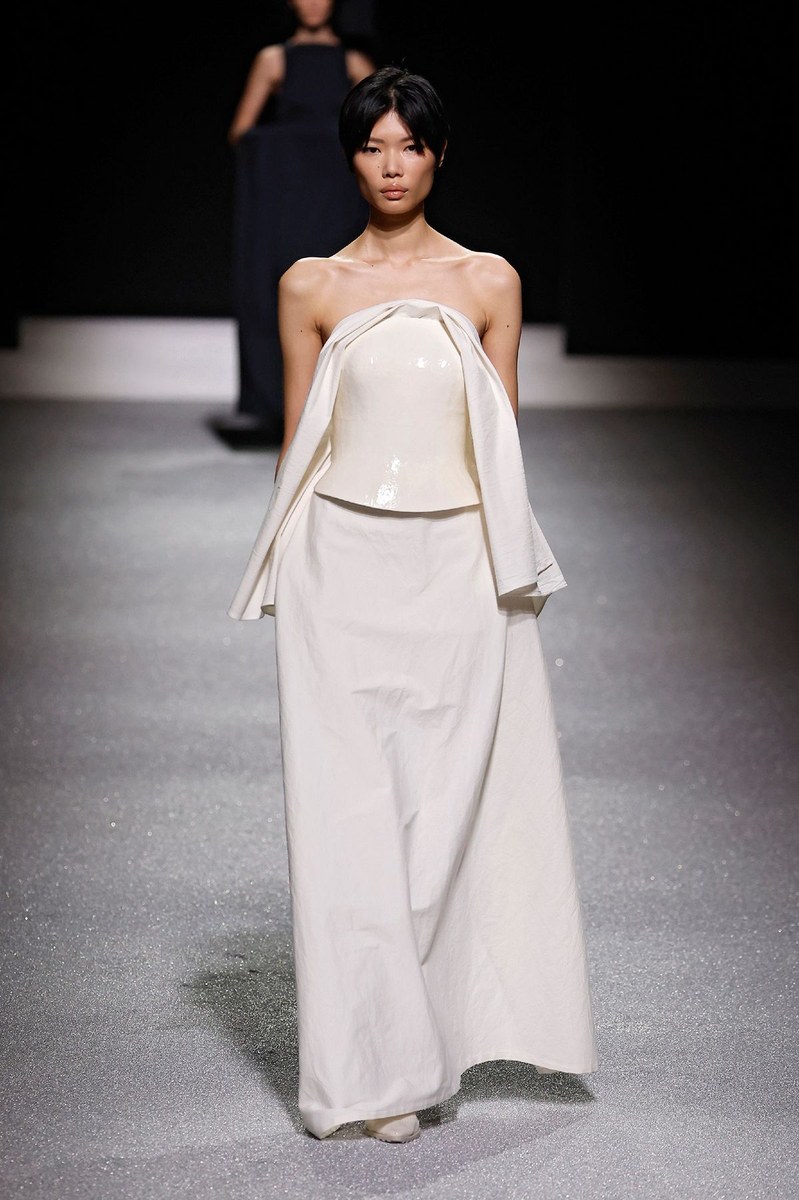
Look 1 The white strapless lacquered corset top with draped cape panels establishes the corset-as-architecture premise, and its contrast between rigid bodice and flowing cloth reads as a strong opening commercial statement for eveningwear buyers.

Look 6 A mid-length grey sculptural dress with an exaggerated draped collar-cowl paired with a wide-brimmed black felt hat demonstrates how the house turns a single-piece knit into a complete visual proposition requiring no additional layering.

Look 6
Look 6

Look 26 The open-armed burgundy belted coat, held aloft at the wrists to reveal its full wingspan, is the most theatrical silhouette in the collection and the one most likely to generate editorial coverage that drives brand heat for wholesale partners.

Look 26
Look 26

Look 31 A rigid pale yellow-green oversized trench coat with a squared, almost architectural shoulder line that extends well beyond the body reads as a direct wearable sculpture and targets buyers seeking traffic-driving statement outerwear with actual functional closure.

Look 31
Look 31

Look 39 The yellow pleated cape-and-skirt set with an orange pleated underskirt and matching head wrap demonstrates two-tone colorblocking within the Pleats Please system, giving product managers a clear merchandising argument for mixing separate pleat pieces across color families.

Look 39
Look 39

Look 44 A sage-grey asymmetric draped jacket with white shirt cuffs and collar visible at the wrists and neckline, paired with a matching wide-brim hat, is the most refined tailoring moment in the collection and has the strongest carry-over potential for formal retail categories.

Look 44
Look 44

Look 51 An ivory floor-length cape dress with wide kimono sleeves framing a cobalt blue lacquered corset insert creates one of the clearest hero product moments here, combining the corset motif with the house's draped white suiting to produce a garment with obvious red-carpet and event-dressing commercial application.

Look 51
Look 51

Look 52 Black lacquered strapless corset with embossed curved surface detail sits atop a floor-length black crepe skirt, deliberately stripped of every extraneous element. Its restraint after 51 looks of escalating volume makes it the most powerful single garment in the show.

Look 52
Look 52

Operational Insights

Corset insert program: Lacquered molded corsets in white (Look 1), red (Look 49), cobalt (Look 51) and black (Look 52) function as a modular hero SKU that can be sold separately over existing wardrobe pieces, making it a high-margin, low-inventory-risk entry point for wholesale partners.

Pleats Please as color vehicle: The pleated section (Looks 39 to 42) confirms that the Pleats Please platform is now being used to deliver saturated, high-chroma color in a way that matte wool or structured crepe cannot. Buyers should plan pleat separates assortments around the acid yellow, wine-plum and fuchsia colorways specifically rather than defaulting to black and grey.

Hat program viability: Sculptural wide-brim hats appear in fabrications that directly match the coats and dresses they accompany, which means they are designed as coordinating accessories rather than standalone millinery. Style directors should request them as set pieces in wholesale negotiations to protect the look's visual integrity at retail.

Outerwear volume gradient: The collection moves from fitted wraps (Look 12) through mid-volume belted coats (Looks 26, 30) to truly oversized sculptural coats (Looks 31, 32, 47), giving buyers a clear three-tier volume structure to merchandise across different store formats and customer risk tolerance levels.

Look 12
Look 12

Color entry strategy: Saturated colorways arrive in the mid-to-late collection in garments that are architecturally the same as their neutral counterparts, which means buyers can test color performance by substituting single SKUs within a known silhouette structure rather than committing to entirely new product categories.

Complete Collection

Look 2
Look 2
Look 3
Look 3
Look 4
Look 4
Look 5
Look 5
Look 7
Look 7
Look 8
Look 8
Look 9
Look 9
Look 10
Look 10
Look 11
Look 11
Look 13
Look 13
Look 14
Look 14
Look 15
Look 15
Look 17
Look 17
Look 18
Look 18
Look 19
Look 19
Look 20
Look 20
Look 21
Look 21
Look 22
Look 22
Look 23
Look 23
Look 24
Look 24
Look 25
Look 25
Look 27
Look 27
Look 28
Look 28
Look 29
Look 29
Look 30
Look 30
Look 32
Look 32
Look 33
Look 33
Look 34
Look 34
Look 35
Look 35
Look 36
Look 36
Look 37
Look 37
Look 38
Look 38
Look 40
Look 40
Look 41
Look 41
Look 42
Look 42
Look 43
Look 43
Look 45
Look 45
Look 46
Look 46
Look 47
Look 47
Look 48
Look 48
Look 49
Look 49
Look 50
Look 50

Fashion Designer

Satoshi Kondo was born in 1984 in Kyoto, a city whose entire identity is built from centuries of craft traditions, dyeing techniques, and the patient accumulation of handmade knowledge. His mother was a pattern cutter, and the house he grew up in was filled with the physical materials of clothing: patterns spread across tables, fabrics, the practical language of construction absorbed before he was old enough to articulate it. He was drawing from childhood, and making things by hand came as naturally as speaking. He went on to study at Ueda College of Fashion, completing a master's program in fashion creation, and won the Soen Magazine Award for his work. His first encounter with Issey Miyake came when he was considering what to do with those instincts, and the work stopped him. What he found was not just clothing but a method: an entire philosophy of making.

He joined Issey Miyake Inc. in 2007, straight out of school, entering the Pleats Please division and spending the next twelve years learning every layer of the house from the inside. He moved through Homme Plissé and various research and special projects before becoming head designer of the womenswear line in 2019, succeeding Yoshiyuki Miyamae. His debut collection that autumn, in which models danced, skated, and moved through garments that spun and floated around them, went unexpectedly viral, which surprised him. He had wanted to return to something fundamental: the idea of a single piece of cloth wrapped around a body, the most primitive act of dressing rendered through Miyake's technical precision.

The Japanese concept of ma, the meaning-laden space between two things, shapes how Kondo thinks about the relationship between garment and body. His collections are built around singular material investigations pursued with something close to scientific rigor: a season immersed in the properties of washi paper, including a stay at a Hiroshima hotel where the walls and surfaces were covered in it; another that descended into the deep sea as a conceptual starting point; another that worked with Kyoto craftspeople on ancient hikizome dyeing applied to damp fabric with brushes. The references run between Japan's oldest techniques and its most forward-facing textile research, and Kondo holds both in the same hand, never choosing between them. He works with a team of nine, including dedicated textile specialists, and describes the moment a material reveals how it wants to become a garment as the part he loves most.

Since 2019, Kondo has served as artistic director and head designer of the Issey Miyake womenswear line, presenting four collections a year in Paris.

"Being original is fundamental. We were taught to do things that have never been done before. It is a constant creative quest for me and a way to express myself."

"The joy that can be found in the ritual of getting dressed every day, of finding an outfit that can make you happy for the whole day: that's what inspires me."

✦ This report was generated with AI — combining human editorial vision with Claude by Anthropic. Because the future of fashion intelligence is already here.