J Press FW26 Bags
J Press FW26 Bags Report
J Press FW26 commits fully to a single bag concept: the felted wool clutch-handle bag, built to coordinate directly with the knit and coat looks it accompanies. For buyers and product managers, this signals a clear push toward total-look accessories, where the bag functions as a textile continuation of the garment rather than a contrasting accent.
Silhouettes and Shapes
All four bags share the same core silhouette: a rigid rectangular clutch, roughly 8 by 5 inches in volume, carried via a single integrated loop handle or gripped directly in the palm. Between a traditional clutch and a top-handle minaudière, the format eliminates shoulder straps entirely. Volume stays controlled and compact. No slouch, no structural variation across the four looks. This reads as deliberate capsule discipline rather than range breadth.
Materials and Hardware
Every bag is constructed from wet-felted wool, with a dense, compressed surface that holds its rectangular form without internal armature or visible hardware. Metal findings, zippers, closures, chain straps, and logo hardware are absent across all four looks. Bag 3 and Bag 4 feature loop handles cut from the same felted wool as the body, making the entire object a single-material construction. Stitching, if present, is hidden within the felt compression itself.
Color Direction
The palette breaks into two camps: warm ochre mustard, seen on Bag 1 and Bag 4, and a muted dusty rose, carried through Bag 2 and Bag 3. Neither color reads as a fashion-forward statement shade. Both sit in the mid-tone, desaturated range that performs consistently across multiple seasons without dating quickly. Bag 4's mustard-against-cream pairing and Bag 2's tone-on-tone rose suggest the brand prioritizes tonal dressing over contrast accessorizing.
Key Models and Details
The collection presents effectively one model repeated in two colorways, with minor handle variations. Bag 1 and Bag 2 appear to be gripped along the top edge without a distinct formed handle, relying on the bag's rigidity for carry. Bag 3 and Bag 4 feature a sculpted tubular loop handle integrated into the felt body, which adds a slight ergonomic advantage and a more defined silhouette from a distance. No closures are visible on any of the four pieces, suggesting either a friction-fit top edge or a concealed internal snap.
Bag by Bag Highlights
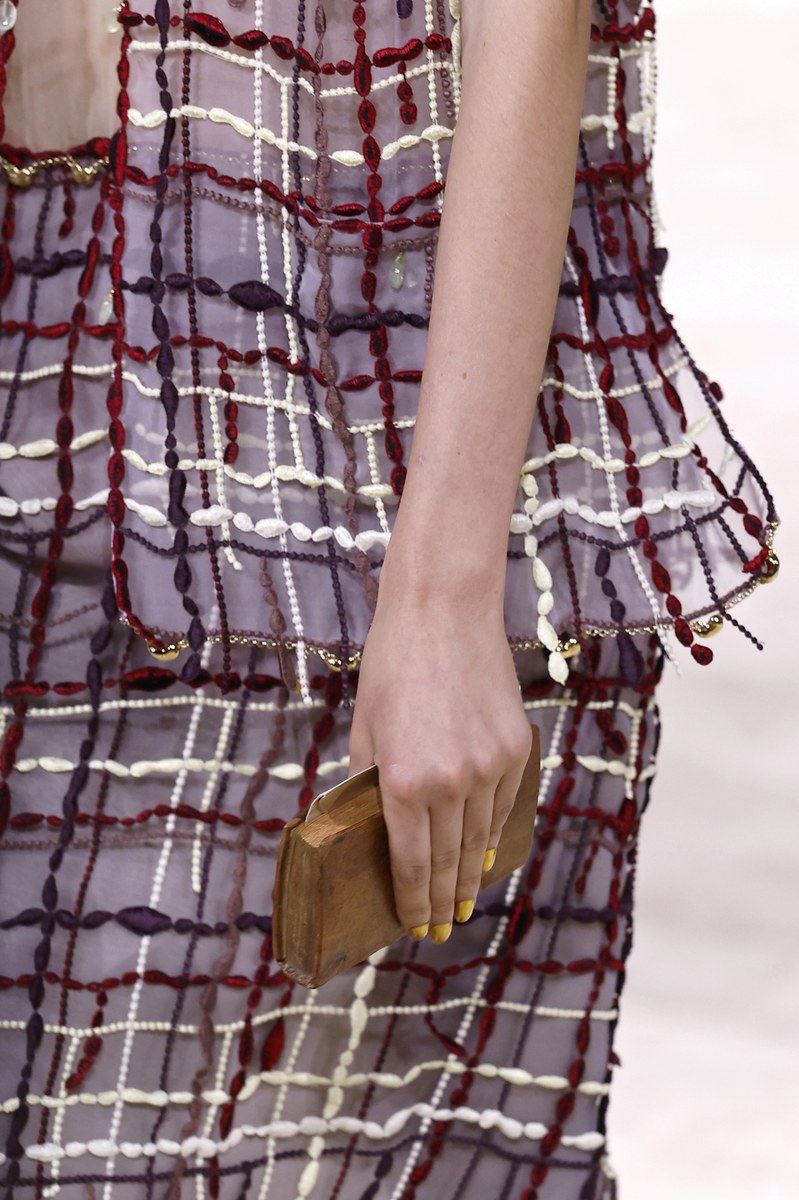
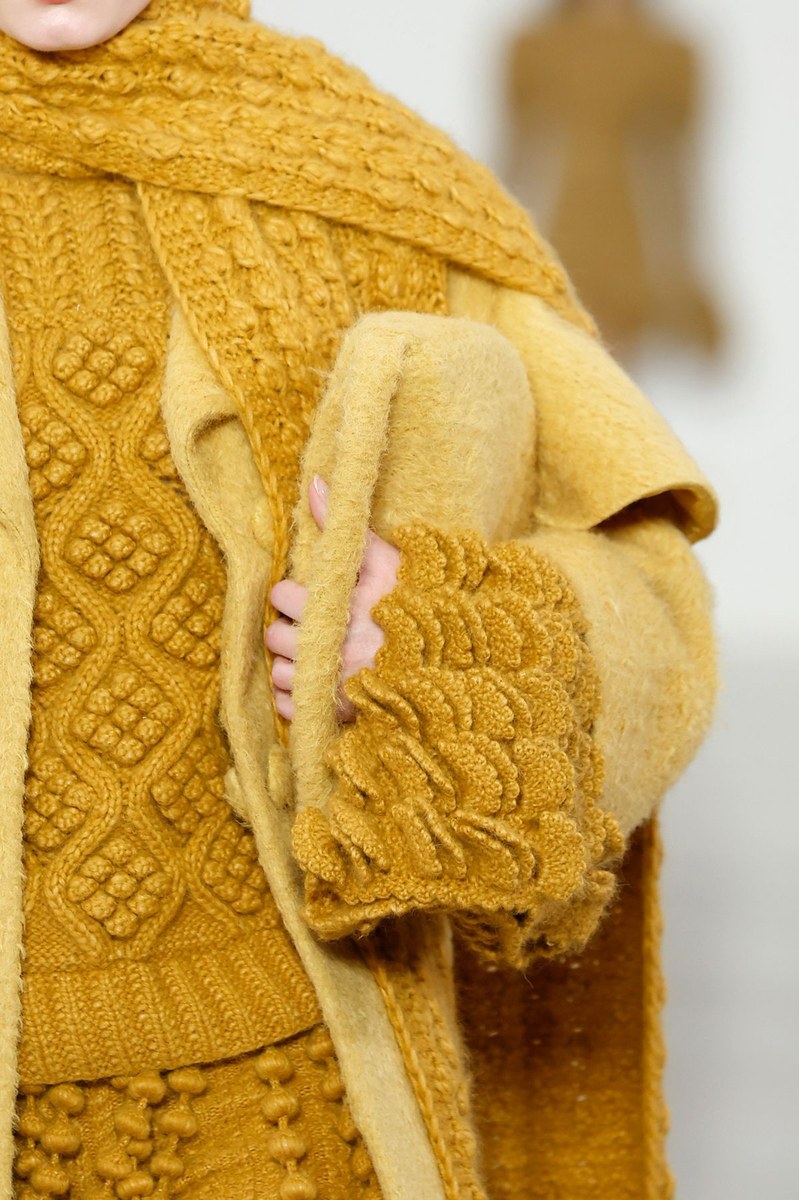
Bag 1 Constructed in ochre felted wool with a textured front panel that mirrors the cable-knit cuff of the coat sleeve, making it the most garment-integrated bag in the collection from a production coordination standpoint.

Bag 2 Executed in dusty rose felted wool with a smooth, unpatterned body surface, creating a deliberate material contrast against the dense crochet and ruffle-trim knit of the accompanying look.

Bag 3 The dusty rose colorway in a version with a formed tubular loop handle, photographed against a heavily napped mohair coat, confirming the brand's intent to match bag fiber weight to outerwear fiber weight.

Bag 4 The mustard version with a tubular handle, carried against an ivory cable-knit coat, delivers the strongest contrast story in the group and the most commercially readable color-blocking moment for retail display.

Operational Insights
Material sourcing: All four bags require a reliable wet-felting supplier capable of producing consistent density and surface finish at small batch scale. Felted wool at this rigidity level is not a commodity textile and demands specialist mill relationships.
Range depth: The collection presents one silhouette in two colorways with two handle variants. Buyers should treat this as a focused capsule rather than a full bag range, and plan buy quantities accordingly rather than expecting category breadth.
Total-look dependency: These bags are designed to be sold alongside the knit and coat looks they accompany. Standalone retail placement without the garment context will reduce their commercial legibility significantly for end consumers.
Hardware absence: The complete elimination of metal hardware lowers unit cost and simplifies customs classification across markets, but also removes an upsell lever. Product managers should evaluate whether a limited-edition version with a single brass closure could expand the price architecture.
Seasonal window: Felted wool and muted warm palettes position these bags firmly in October through January retail. Buyers should not plan spring floor placement, and should time delivery accordingly to avoid markdown pressure from seasonal mismatch.
✦ This report was generated with AI — combining human editorial vision with Claude by Anthropic. Because the future of fashion intelligence is already here.