J Press FW26 Details

J Press FW26 Details
J Press FW26 Details Report

J Press FW26 builds its entire visual language through surface manipulation, treating textile construction as the primary design statement across every dress detail. Buyers and product managers should pay close attention because this approach signals a clear shift toward tactile, artisanal fabrication that commands premium retail positioning and resists fast replication.

Category Overview

All six details fall within the Dress Detail category. What's striking is the collection's full commitment to a single strategic thesis: maximum surface complexity achieved through craft-based textile techniques. Heavy knit construction, fine crochet work, pleated organza, and frilled ribbing move across the range, demonstrating that the label is exploring texture as a cross-material discipline rather than a seasonal accent. There is no smooth fabric in sight. Every silhouette earns its visual weight from the fabric itself, not from cut or color contrast.
Material and Construction

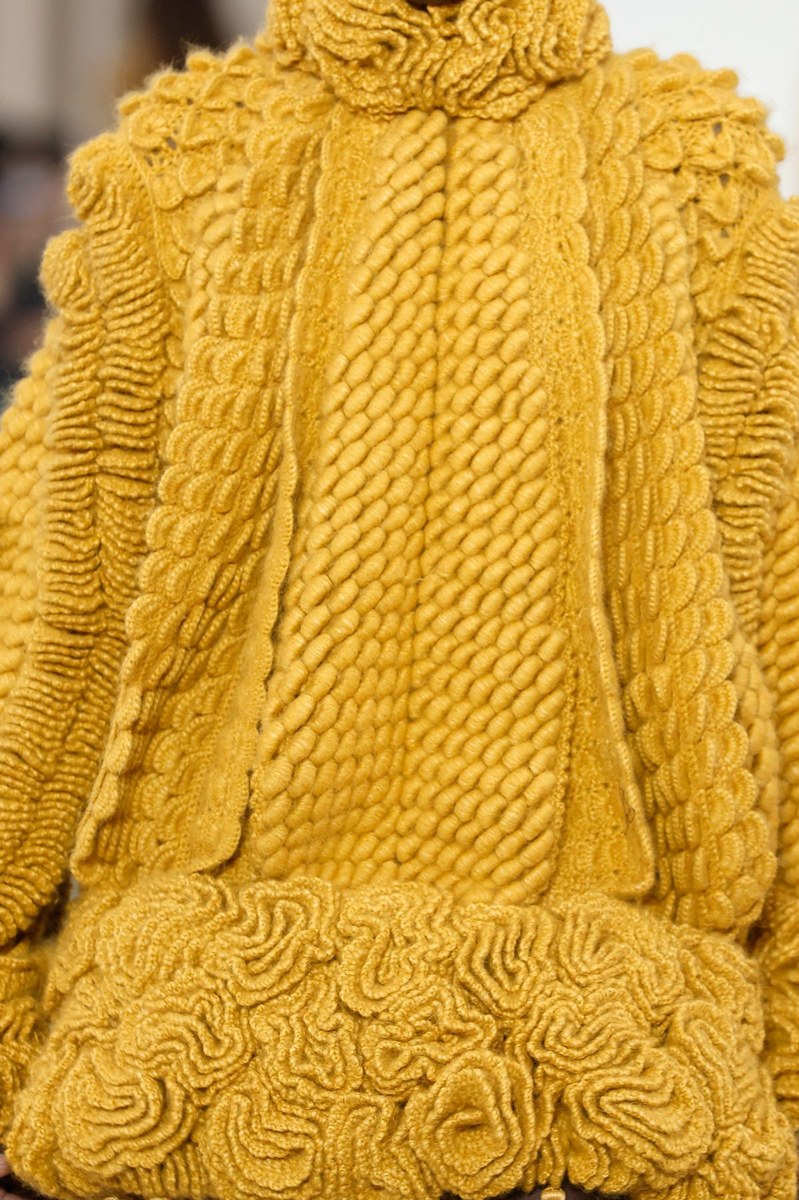
Details 1 and 2 work in dense crochet and chunky yarn construction. Detail 1 shows coiled rosette appliqué at the hem and a scalloped cord border framing a central bobble-knit panel. Detail 2 layers multiple crochet stitch patterns across a single garment, including scaled appliqué on the sleeves, wavy mid-body stitch bands, and cascading bead-tipped fringe at the hemline. Details 4 and 6 pivot to knit. Detail 4 presents tiered ribbed ruffle layers stacked vertically over crochet floral patches in an off-white yarn, while Detail 6 combines cable-knit panels with scallop-edged horizontal tiers in a teal wool-weight yarn. Details 3 and 5 bring in woven and chiffon-type fabrics. Detail 3 uses accordion-pleated organza ruffles arranged in overlapping tiers across the chest and shoulders, and Detail 5 applies vertical columns of pleated chiffon strips to create a cascading, almost feathered surface.

Detail 1
Detail 1

Color and Finish Direction

The palette runs in two tight registers. Warm mustard and golden ochre anchor Details 1 and 2, while teal, specifically a deep blue-green closer to petrol than turquoise, dominates Details 5 and 6. Detail 3 sits in a muted dusty rose, and Detail 4 holds to an off-white with a faint natural linen undertone. No metallic finishes appear anywhere. There is no shine, which reinforces a matte, handcraft aesthetic throughout. What emerges is deliberately analog and anti-digital, a direct counter to the high-gloss trend cycle.

Detail 3
Detail 3

Key Pieces and Details

Detail 2 is the strongest commercial proposition in the group, presenting a complete short dress that layers no fewer than five distinct crochet techniques into a single coherent garment, finished with hanging bead chains that extend the hemline into movement. Detail 3 presents the clearest runway-to-editorial translation, with its deep-plunge pleated organza bodice and balloon sleeves making it immediately legible as a hero piece for press and wholesale. Detail 4 is the most technically ambitious production challenge, stacking ribbed ruffles across what appears to be the full length of a skirt or trouser, requiring precise knit engineering to maintain consistent tier spacing. Buyers should flag Details 1 and 6 as potential capsule anchor pieces given their strong outerwear-adjacent proportions and high perceived value.

Detail 2
Detail 2

Detail by Detail Highlights

Detail 1 (Dress Detail) The mustard yellow piece centers a dense bubble-knit torso panel bordered by thick twisted cord in a scalloped pattern, with coiled rosette clusters massed at the hem and a ruched funnel collar at the neckline.

Detail 2 (Dress Detail) A golden ochre short dress combines at least five crochet stitch zones, capped sleeve scales, wavy body bands, and hemline fringe terminating in small yarn spheres that swing with movement.

Detail 3 (Dress Detail) The dusty rose organza dress layers accordion-pleated ruffles from shoulder to hip in a tiered cascade, with a vertical keyhole cutout running from the high neck to the waist, creating structural tension against the volume.

Detail 4 (Dress Detail) Off-white knit tiers stack in tight ribbed ruffles from hip to ankle, interrupted at two points by crochet floral patch bands, and the whole column sits above a pointed-toe kitten heel boot in the same ivory tone.

Detail 4
Detail 4

Detail 5 (Dress Detail) The teal chiffon dress applies vertical columns of pleated fabric strips across the entire body and sleeves, creating a directional, almost baroque surface that catches light at varied angles and gives the silhouette its own internal movement.

Detail 5
Detail 5

Detail 6 (Dress Detail) A teal wool-weight overpiece combines a cable-knit upper body with asymmetric front panels and three horizontal scallop-edged ruffle tiers at the lower half, sitting above bright teal trousers for a monochromatic tonal stack.

Detail 6
Detail 6

Operational Insights

MOQ planning: The crochet-intensive pieces in Details 1 and 2 will carry high unit labor costs. Buyers should negotiate minimum order quantities carefully to protect margin without overcommitting to slow-turn SKUs.

Colorway strategy: The collection runs in three hero tones, mustard, teal, and dusty rose, with one neutral. Product managers can use this as a clean three-way colorway split across a capsule buy without creating palette confusion at retail.

Production lead time: The tiered ribbed knit construction in Details 4 and 6 requires specialized knit machinery and significant finishing time. Flag these for extended lead time allocations of at least 16 to 20 weeks from sample approval.

Retail positioning: The visible handcraft in every detail justifies premium price architecture. Style directors should build editorial and in-store merchandising around the construction narrative to support full-price sell-through.

Trend alignment: The matte, artisanal, monochromatic surface-texture direction aligns with the broader quiet luxury to craft luxury trajectory visible across multiple European houses this season, giving buyers a strong trend argument for open-to-buy allocation.

✦ This report was generated with AI — combining human editorial vision with Claude by Anthropic. Because the future of fashion intelligence is already here.