J Press FW26 Shoes
# J Press FW26 Shoes Report
J Press FW26 builds its entire footwear program around a single kitten heel last, approximately 5 to 6 centimeters, topped with a pointed toe, and differentiated almost entirely through textile surface treatments that mirror the knitwear and crochetwork running through the ready-to-wear. For buyers and product managers, this strategy signals a clear commercial thesis: one versatile base construction sold across a wide color and texture matrix, reducing tooling costs while multiplying SKU depth.
Silhouettes and Construction
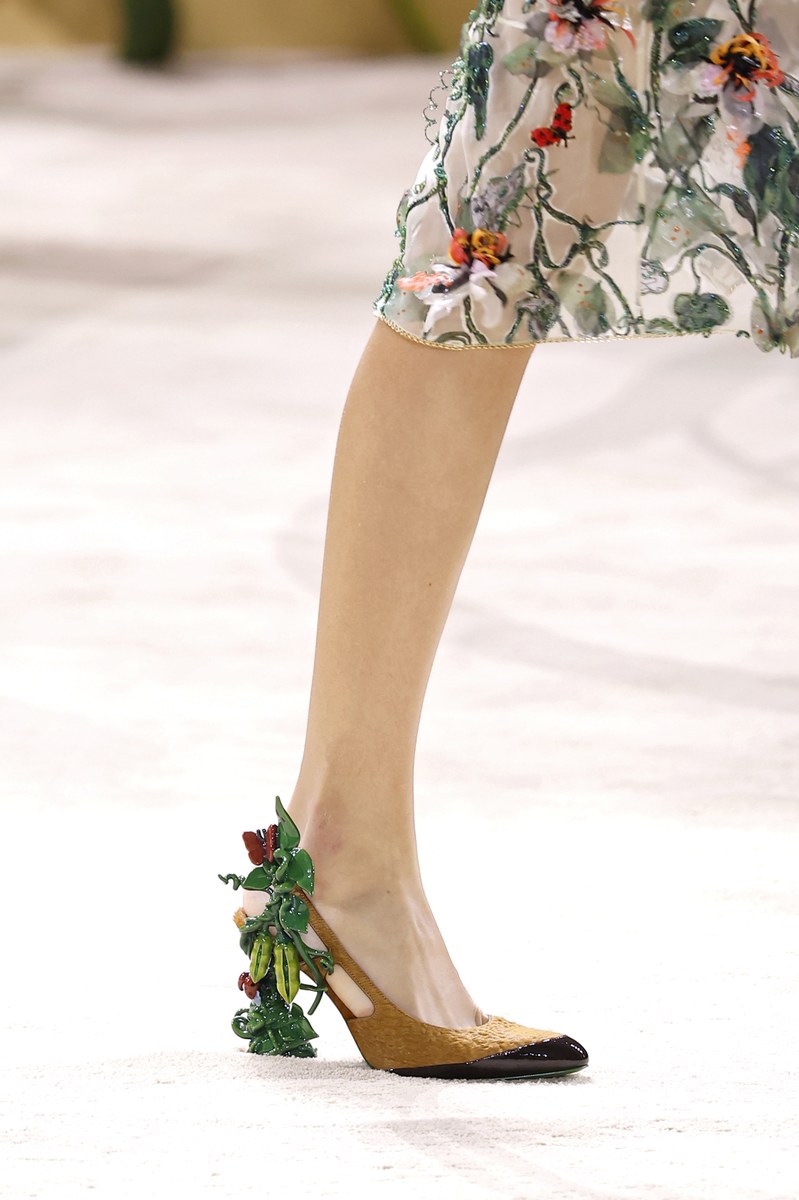
Every shoe in the lineup shares the same pointed-toe last and a sculptural kitten heel ranging from approximately 5 to 6 centimeters. The heel itself has a distinctive waisted, slightly splayed shape, closer to a flared geometric column than a traditional stiletto, which adds visual weight at the base and improves stability. Two construction formats appear: closed pumps with a full upper (Shoes 4, 6, 8, 12, 13, 14, 16) and slingbacks with an open heel and an elasticated or strap closure at the back (Shoes 1, 2, 11, 18, 19, 20). Shoe 10 reads as a flat or near-flat variant, making it the only outlier in heel height across the lineup.
Materials and Finishes
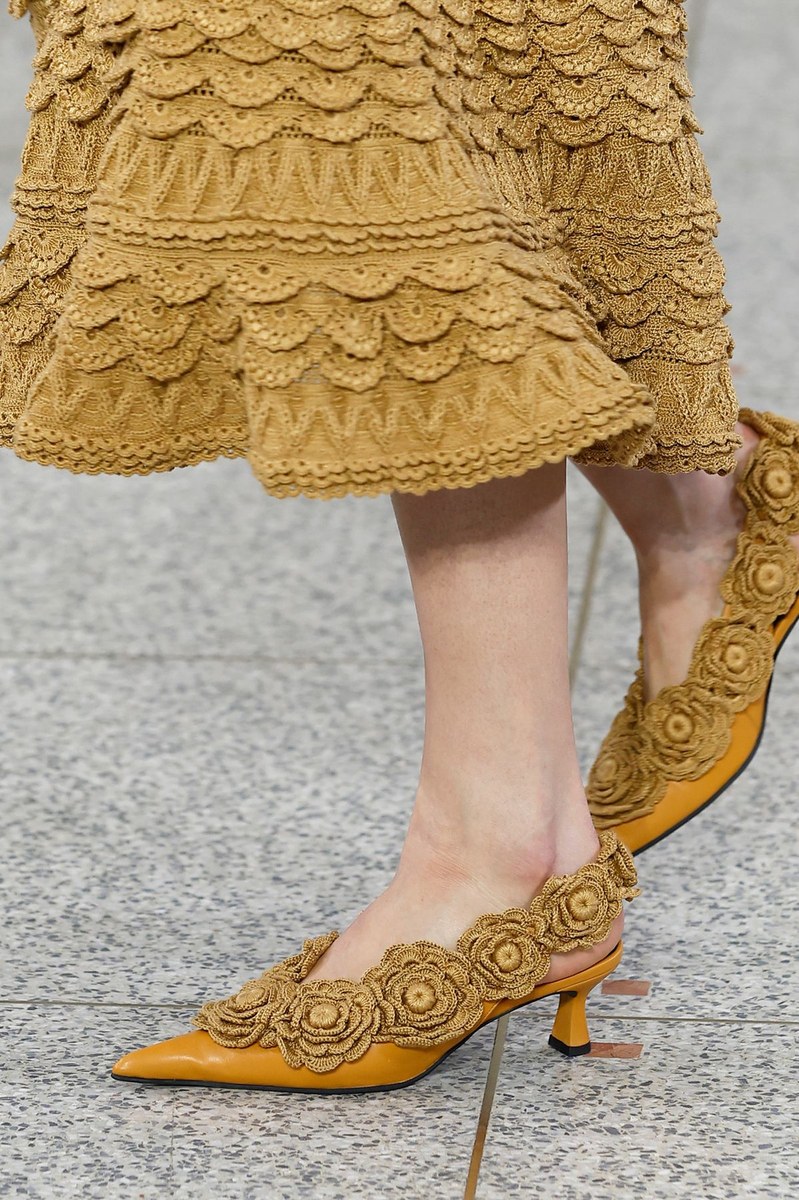
Smooth leather or patent-finish leather forms the base shell on every model, most visible at the pointed toe cap and on the heel column, in colors matched to the upper textile. The collection then layers three distinct textile constructions over that foundation: a chunky hand-knit or bouclé fabric (Shoes 2, 4, 6, 9, 11, 13, 18, 19), a crochet rosette appliqué (Shoes 1, 7, 20), and an open-weave macramé or net construction that covers the entire leg as a boot-stocking hybrid (Shoes 5, 15, 17). Shoe 3 uses a smooth crinkled or embossed leather upper with no applied textile, positioning it as the most commercially accessible model in the range. A leather or synthetic flat sole with a black welt runs consistently across all models.
Color Direction
The palette divides into two distinct groups. Neutrals anchor the range: white (Shoes 7, 8, 16), black (Shoes 12, 14, 15), and a warm off-white that reads ivory or cream. Saturated brights and earthtones fill out the rest: mustard yellow (Shoes 1, 2, 4, 6, 20), teal or petrol blue (Shoes 9, 10, 17, 18), brick red (Shoes 11, 19), dusty rose pink (Shoes 3, 5), and olive green (Shoes 13, 17). Mustard and teal tones carry the most visual frequency across the collection, suggesting these are the intended hero colorways for wholesale. Black and white function as the wardrobe-staple anchors with the broadest retail reach.
Key Models and Details
Three distinct models emerge from the lineup. First is the crochet-flower slingback, seen in mustard (Shoes 1, 20), teal (Shoe 18), red (Shoes 11, 19), and white (Shoe 7), which carries rosette appliqués across the vamp and reads as the most decorative and brand-forward design in the group. Second is the bouclé or chunky-knit closed pump, seen in yellow (Shoes 4, 6), teal (Shoe 9), red (Shoe 11 in slingback format), and green (Shoe 13), where the textile upper wraps fully over the instep to the toe cap, leaving only the leather cap-toe and heel column exposed. Third is the stocking-boot hybrid, in green (Shoe 17), black (Shoe 15), and pink (Shoe 5), where a crochet or open-net leg covering is integrated directly into the shoe construction, creating the appearance of a single continuous piece from knee to toe. No visible logo hardware or branding placement appears on any model, keeping the aesthetic clean and wholesale-friendly.
Shoe by Shoe Highlights
Shoe 1 The mustard slingback with crochet rosette appliqués across the full vamp is the collection's signature piece and will require skilled artisan labor at scale, making it a premium-tier SKU.

Shoe 4 The fully bouclé-covered closed pump in canary yellow reads as the most commercially scalable textured model, with the toe cap and heel in matching leather providing a natural cut-and-sew boundary that simplifies production.

Shoe 5 The pink open-net crochet stocking-boot is the collection's highest-risk, highest-reward piece, likely produced in very limited run, and its open-weave construction over a base shoe raises questions about whether the leg covering is attached or separate.

Shoe 8 Clean white leather with no textile embellishment, this closed pump is the collection's purest expression of the base last and heel, and it will be the easiest to recolor and the strongest performer in corporate and occasion wear accounts.

Shoe 10 The teal crochet flat, the only near-flat heel in the group, broadens the collection's commercial range and targets a comfort-oriented buyer who wants the textile story without the heel.

Shoe 12 A smooth black leather pump with a V-cut vamp and sculptural kitten heel in gloss black, this is the collection's most versatile and wardrobe-ready silhouette, likely to carry the highest sell-through rate across all retail channels.

Shoe 16 The white pump with a black-tipped heel is a subtle two-tone construction detail that separates it from Shoe 8 and adds a collectible element without increasing material complexity significantly.

Shoe 17 A green crochet stocking-boot worn with a matching crochet net tight creates a total-look proposition that buyers for concept stores and editorial-driven retail will find compelling as a coordinated set.

Operational Insights
Tiering strategy The collection naturally breaks into three commercial tiers: plain leather pumps (Shoes 8, 12, 16) as the accessible entry point, bouclé and knit-covered pumps as the mid-tier texture story, and crochet rosette or stocking-boot constructions as the top-of-range artisanal pieces. Plan inventory ratios accordingly, weighting the plain and bouclé tiers for volume and limiting the crochet florals to controlled allocation.
Shared last leverage Every model uses the same pointed-toe kitten heel last, which means a buyer can negotiate last exclusivity or preferred-customer pricing with the manufacturer and achieve significant per-unit cost efficiencies across a multi-SKU order.
Textile sourcing risk The bouclé, crochet rosette, and open-net constructions each require specialist textile suppliers, and the hand-finish quality visible in these samples may be difficult to replicate at scale without a dedicated co-development agreement with the factory. Request production samples at minimum order quantities before committing to full buys.
Color carry-over potential Black and white base leather last and heel construction are strong candidates for carry-over into FW27, allowing buyers to reduce newness risk by holding over proven base models while refreshing only the textile overlay or colorway each season.
Stocking-boot compliance Integrated crochet stocking-boot models (Shoes 5, 15, 17) may trigger import classification questions in certain markets, particularly around whether the product classifies as a shoe or hosiery, which directly affects duty rates. Compliance teams should confirm tariff codes before placing cross-border orders.
More Shoes
More Shoes
More Shoes


✦ This report was generated with AI — combining human editorial vision with Claude by Anthropic. Because the future of fashion intelligence is already here.