Jarel Zhang FW26 Women Looks Report
Milan Fashion Week
Jarel Zhang's FW26 collection treats protection as a design language, fusing extreme outerwear volume with feral texture to build garments that read simultaneously as shelter and spectacle. For buyers navigating a market where outerwear is both the highest-margin and most contested category, this arrives with a clear point of view and commercially translatable silhouette logic.
Silhouette and Volume
The macro scale dominates here. Coats and jackets expand dramatically at the shoulder and taper or fall away at the hem, creating a top-heavy trapezoid that dominates Looks 2, 5, 7, 16, and 19. Draped and asymmetrically hemmed skirts in Looks 1 and 17 introduce the only true bottom-weight moments, grounding the sculptural outerwear above them. Look 7 stands out architecturally: the neon yellow and black quilted coat fans outward from the torso like overlapping plates, making volume a structural argument rather than a comfort decision.
Color Palette
A tightly controlled opposition between matte black and acid yellow-green runs across the bulk of the collection, with that pairing appearing in Looks 4, 7, 8, 9, 12, 16, 18, and 13. Warm tobacco brown and burnt umber enter in Looks 3, 9, 11, 14, and 19, pulling the palette toward an organic, earth-saturated register that counters the synthetic brightness of the neon. Red and black diagonal stripes in Looks 1 and 17 function as punctuation, bold enough to read as a signature print rather than a colorway variation. Purple surfaces briefly in Looks 8 and 16 as a sleeve accent, adding just enough chromatic tension to keep the black-dominant looks from reading flat.
Materials and Textures
Two material families divide the collection sharply. High-gloss or matte technical nylon appears in the quilted down pieces across Looks 2, 4, 5, 7, 10, 13, 16, and 18, where the fabric holds rigid channel quilting and reads almost inflatable at scale. Shaggy, long-pile knit or faux fur shows up in Looks 1, 6, 14, and 17 in the red-and-black stripe and the all-over dark brown, where the surface is deliberately uneven and frayed rather than groomed. Fur trim in warm caramel tones runs along the perimeters of Looks 2, 5, and 19, adding a contrast between the sleek down shell and the tactile edge. Look 3 introduces a matte rubberized or bonded green fabric in a floor-length wrap coat that holds its shape without padding, demonstrating range beyond the quilted thesis.

Styling and Layering
Most looks build through visible layering rather than concealment. Neon yellow puffer scarves or neck tubes appear beneath larger coats in Looks 4, 9, and 13, functioning as both warmth layer and color signal. Striped neckties appear in Looks 8 and 15, worn over technical outerwear to introduce a deadpan prep-versus-utility collision. Footwear splits between two poles: utilitarian hiking boots and chunky sandal-clogs in looks worn by male models, and pointed black ankle boots consistent across the women's looks, reinforcing a gender-coded ground line even as the outerwear itself ignores those boundaries. Crossbody straps and structured belt hardware appear in Looks 1 and 14, the only accessory logic that threads consistently through both the women's and men's silhouettes.
Look by Look Highlights
Look 1 The red-and-black diagonal shag jacket worn over a draped asymmetric black skirt establishes the collection's central tension between textile aggression and composed lower-body restraint, making it a strong candidate for editorial lead placement.

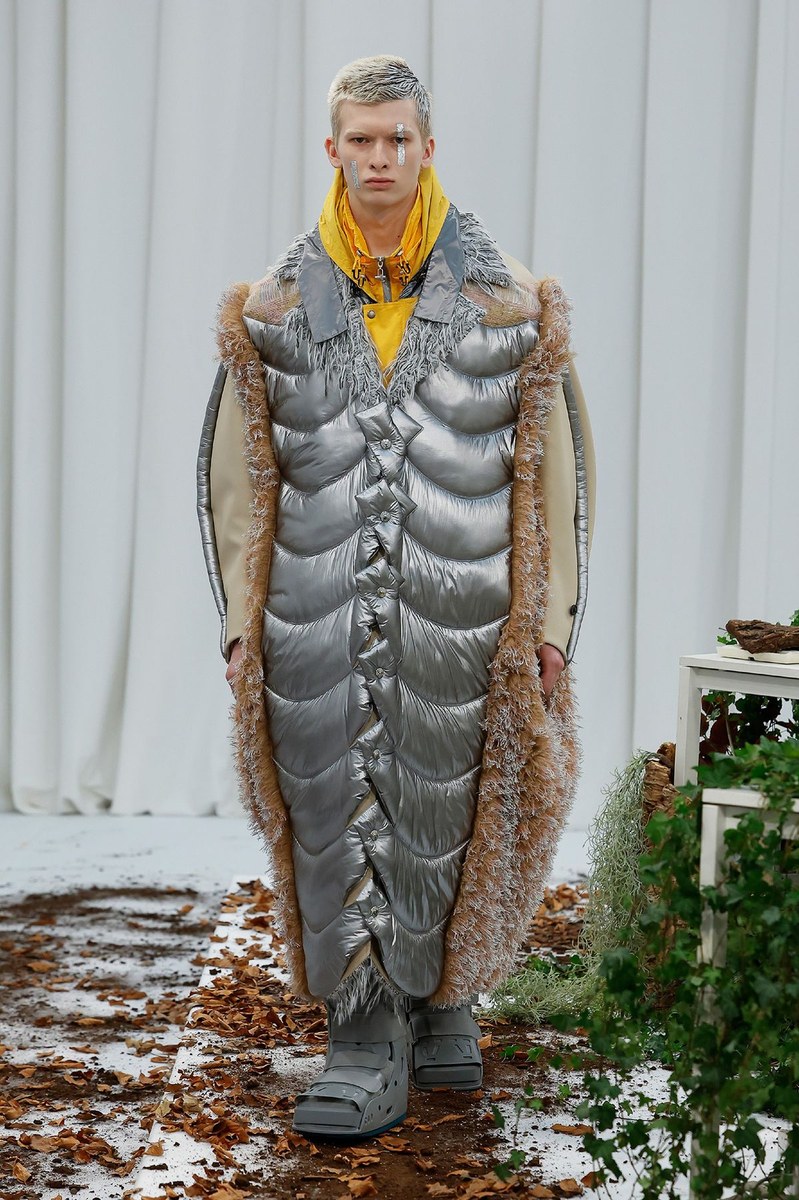
Look 2 The floor-length silver quilted puffer with caramel fur trim along the lapel and sides represents maximum volume here, a piece that will perform in markets where outerwear commands premium retail positioning.

Look 4 Black patent puffer jacket with yellow neck tube and fur-trimmed cuffs over a black leather midi skirt delivers the most commercially direct look in the collection, with each component separable into its own selling unit.

Look 5 The oversized brown and black tiger-stripe fur-trimmed puffer with a bonded leather hood is the collection's most production-intensive piece, and its visual impact at retail or in campaign imagery justifies the cost-per-unit investment.

Look 7 The neon yellow and black quilted plate coat with its radiating wing silhouette carries the strongest sculptural argument in the collection and will drive conversation in style press and buyer previews regardless of sell-through projections.
Look 9 Tie-dye brown floor-length coat paired with a neon yellow puffer collar and cuffs demonstrates how Zhang uses the acid yellow as a modular accent rather than a full-garment commitment, a layering strategy directly adaptable to capsule or carry-over programming.

Look 11 The wide-shoulder brown felted or brocade cape layered over a dark camouflage long coat over a grey mesh skirt presents the most complex layering formula in the women's section, and the tonal earth palette makes it accessible to luxury multi-brand retailers without the neon barrier.

Look 15 The oversized dark olive M65-derived parka with a ribbed knit hem and a striped tie visible at the collar is the collection's most wearable and broadest-market piece, carrying credibility for buyers targeting the premium streetwear and contemporary outerwear customer simultaneously.

Operational Insights
Separates potential: Yellow neck tubes and fur-trimmed cuffs appear across Looks 4, 9, and 12 and function as freestanding accessories. Evaluate these for separate production runs at lower retail price points to drive entry-level sales alongside hero outerwear.
Capsule color logic: The black-and-acid-yellow pairing recurs across at least eight looks and carries enough internal consistency to anchor a two-color-story capsule drop, reducing SKU complexity while maintaining visual coherence on the floor.
Outerwear as primary category: Every women's look is built around outerwear as the lead garment, which signals Zhang's intent to position the brand in direct competition with technical luxury labels rather than ready-to-wear brands. Buyers should communicate this distinction clearly to their outerwear category teams.
Texture sourcing risk: Long-pile shag knit in Looks 1, 14, and 17 and caramel fur trim in Looks 2, 5, and 19 require confirmation of faux or sustainable sourcing before placement in markets with strict import or retail sustainability policies.
Volume and retail floor planning: Extreme silhouette scale in Looks 2, 5, 7, and 16 demands wider hanger spacing and mannequin or bust-form display rather than flat-fold or rack merchandising. Buyers should factor this into visual merchandising budgets when ordering hero pieces.
Complete Collection


About the Designer
Jarel Zhang was born in China's Zhejiang province, in the suburbs of Shanghai, in a family where architecture was a daily conversation. His father was an architect, and that early exposure to structural thinking, to the way built forms organize space and movement, runs through his work in ways that are difficult to separate from the clothes themselves. He left China for the United Kingdom to study fashion, completing a first master's degree at Northumbria University and then a second in textile design at Chelsea College of Art and Design in London, a dual specialization that placed material innovation and construction at the center of his formation. He founded his label in 2015, at the point where those two educations had converged into a working method.
His entry into the international fashion circuit was rapid and deliberately ambitious in terms of geography. After showing in London, he was invited to New York Fashion Week for SS18, where he staged a presentation inside a faux construction site replicating the chaos and energy of the city streets, showing a collection of reworked anoraks built through intricate pleating and structural manipulation. Paris followed, and it has been his primary platform ever since. His shows have become increasingly immersive and performance-based over time: the SS24 presentation at Paris Fashion Week placed a dozen painters in a white room alongside the models, each assigned an outfit to interpret in real time with no rehearsal, turning the standard show format into something closer to a happening. His aesthetic draws equally from digital culture, science, and what he has described as the human capacity for rebuilding after collapse, with collection themes ranging from computer rebooting as a metaphor for starting again, to the trajectory of a specific asteroid that struck the Sudanese desert in 2008.
His studio is based in Shanghai, and the brand is distributed through stores in Shanghai, Beijing, Hong Kong, and New York. The work is built around outerwear, particularly sculptural coats and puffer constructions in unconventional materials, and the collections have a consistently futuristic register that mixes what he calls "space cotton" and mirror-effect leathers with hand-painted prints and three-dimensional pleating techniques developed in-house. He shows regularly at Paris Fashion Week and has been expanding the brand's presence in Europe, including presentations in Italy.
"Could it be possible to 'restart' life without any memory to hold us back? Through this collection we want people to know that they can dare to click the reboot button and start all over again."
"Using the digital world as a background we're going to contemplate the extreme actions human beings are capable of and attempt to convey the message that people can put an end to the suffering that destroys them and yearn for a new life."
✦ This report was generated with AI — combining human editorial vision with Claude by Anthropic. Because the future of fashion intelligence is already here.