Jil Sander FW26 Bags
Jil Sander FW26 Bags Report
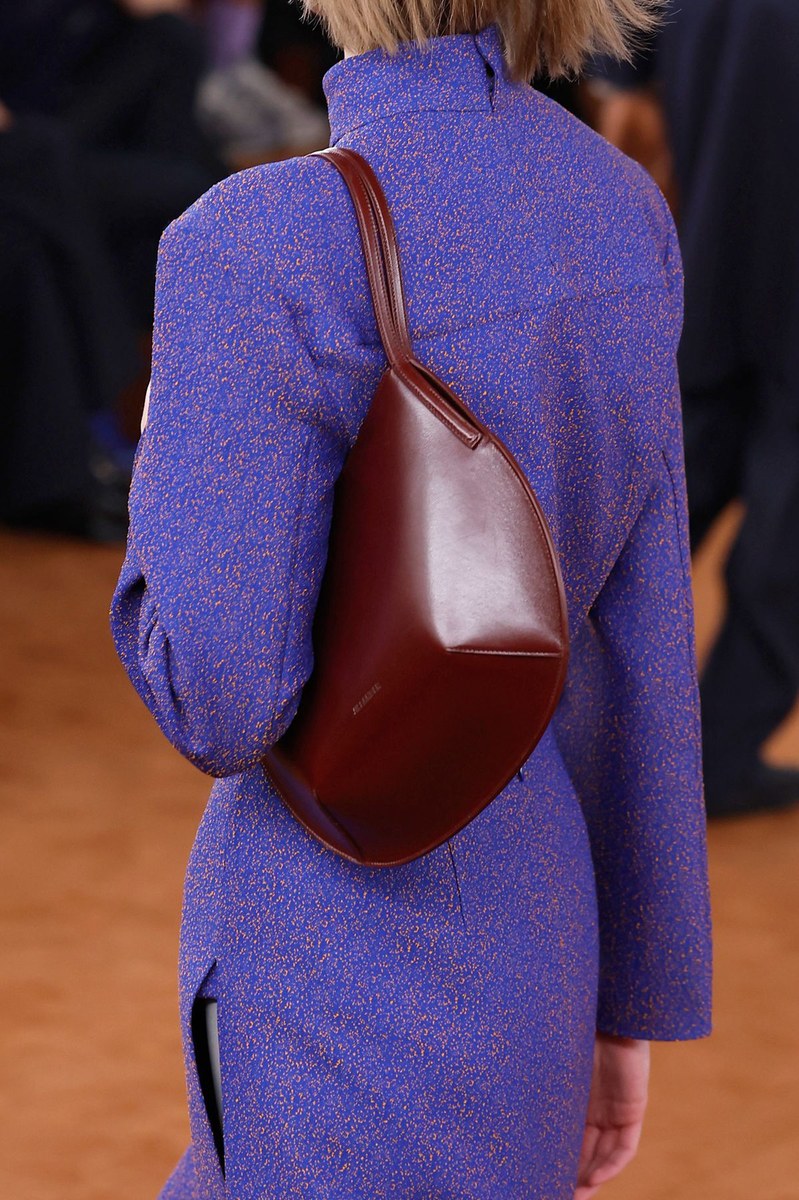
Jil Sander FW26 positions the bag as a sculptural object built on organic geometry. Rounded, seed-like forms and paneled leather construction appear across nearly every silhouette. For buyers and product managers, this signals a clear commercial direction away from logo-heavy hardware and toward shape and material craftsmanship as the primary value proposition.
Silhouettes and Shapes
Two distinct silhouette families dominate here. First is a compact, teardrop or oval shoulder bag carried close to the body, seen in Bags 1, 3, and 6, with a low-slung single strap and a pronounced curved base that creates almost three-dimensional volume. A second family emerges as an oversized, soft-structure tote with a triangular or trapezoidal body, represented by Bags 2, 5, 7, and 8, where the base swells under weight and the sides taper toward a narrow top opening. Bag 4 stands apart as a tall, slim rectangular clutch-style shoulder bag, the only strictly rectilinear silhouette in the lineup.
Materials and Hardware
Smooth calfskin dominates the compact models, with Bags 1, 3, 6, and 8 all showing a tight-grained, polished leather that holds the molded paneled construction cleanly. Bags 5 and 7 use a brushed or nubuck-finish suede-adjacent leather for their large-format totes, while Bag 7 appears in a pebbled full-grain calfskin that adds visual texture at scale. Hardware is essentially absent from the entire range. Closures appear to be concealed magnetic snaps or zip pulls, and strap hardware is kept to minimal tone-on-tone or bare-leather binding with no visible metal fittings across any of the eight looks.
Color Direction
Narrow and deliberately earthy, the palette anchors itself in natural tones. Oxblood burgundy defines Bag 1, raw ecru or pale sand defines Bag 3, and a muted sage or dried-herb green appears in Bag 6, making it the most directional color in the lineup. Black accounts for three bags, Bags 2, 7, and 8, and functions as the commercial backbone of the collection. Bag 4 and Bag 5 sit in a warm camel-tan and a dry sand-beige respectively, completing a season palette built entirely from natural, desaturated tones with no metallics, brights, or prints.
Key Models and Details
The paneled oval shoulder bag, recurring across Bags 1, 3, and 6, is the collection's signature model. It uses a two or three-panel curved construction that creates a domed face and a flat back, with a single narrow strap attached at a central top seam. Logo treatment on Bag 6 is a debossed or embossed wordmark directly on the leather surface, small and flush, with no metal plate or applied badge. Large totes, particularly Bags 5 and 7, feature a centered vertical seam that divides the bag face and contributes structural definition without any visible closure mechanism at the top opening.
Bag by Bag Highlights
Bag 1 The compact oxblood oval in smooth calfskin is the strongest immediate commercial pick, with its rich color and tight construction translating well across both editorial and retail floor contexts.

Bag 2 In smooth leather with a more polished grain than Bag 7, the mid-size black tote sits at a proportionally wearable size that appeals to a broader age and lifestyle range than the oversized styles.

Bag 3 The ecru paneled oval is the most directional color-silhouette combination in the compact category, and the pale natural tone will read as a strong spring transition carry for FW delivery windows.

Bag 4 The tall rectangular suede shoulder bag in camel tan introduces a completely different construction logic to the collection and will appeal to buyers seeking a more minimal, understated format at a likely lower production cost.

Bag 5 With a centered seam and flat-base structure, the oversized sand-beige suede tote is the strongest volume-driven style for markets where large carry capacity is a primary purchase driver.

Bag 6 The sage green oval in smooth calfskin is the collection's clearest color trend signal, sitting at the intersection of the quiet luxury palette and the emerging warm green direction confirmed across multiple FW26 collections.

Bag 7 The oversized pebbled black calfskin tote reads as the most accessible and giftable of the large formats, with its familiar hobo-adjacent silhouette and neutral color removing barriers at the point of sale.

Bag 8 The structured black calfskin tote with two straps and a rigid upper panel is the most architecturally resolved silhouette in the lineup and will perform with fashion-forward wholesale accounts looking for a statement carry with editorial credentials.

Operational Insights
Silhouette investment: The paneled oval shoulder bag is the model to pursue for a first-buy order, as it appears in three colorways across the collection and signals that the house intends to develop it as a hero style with seasonal color rotation potential.
Color depth: Black, ecru, and oxblood are the three colors with the broadest sell-through probability across retail channels. Initial orders should weight toward these before committing to the sage green or camel, which carry higher markdown risk outside fashion-forward doors.
Material sourcing: Production cost conversations should focus entirely on leather quality and paneling precision, where cutting and construction tolerances will determine margin. No visible hardware across any bag in the collection simplifies this calculation considerably.
Size range strategy: The collection splits cleanly into compact shoulder and oversized tote, with no medium or crossbody format present. Product managers building a full accessories range will need to supplement Jil Sander FW26 deliveries with mid-size styles from other sources to avoid a gap in the assortment.
Trend positioning: The organic curved panel construction places Jil Sander FW26 in direct dialogue with the broader sculptural bag movement confirmed at Bottega Veneta and Loewe. Accessories directors can use these styles as supporting evidence when presenting the organic-form bag direction to retail buyers and editorial partners.
✦ This report was generated with AI — combining human editorial vision with Claude by Anthropic. Because the future of fashion intelligence is already here.