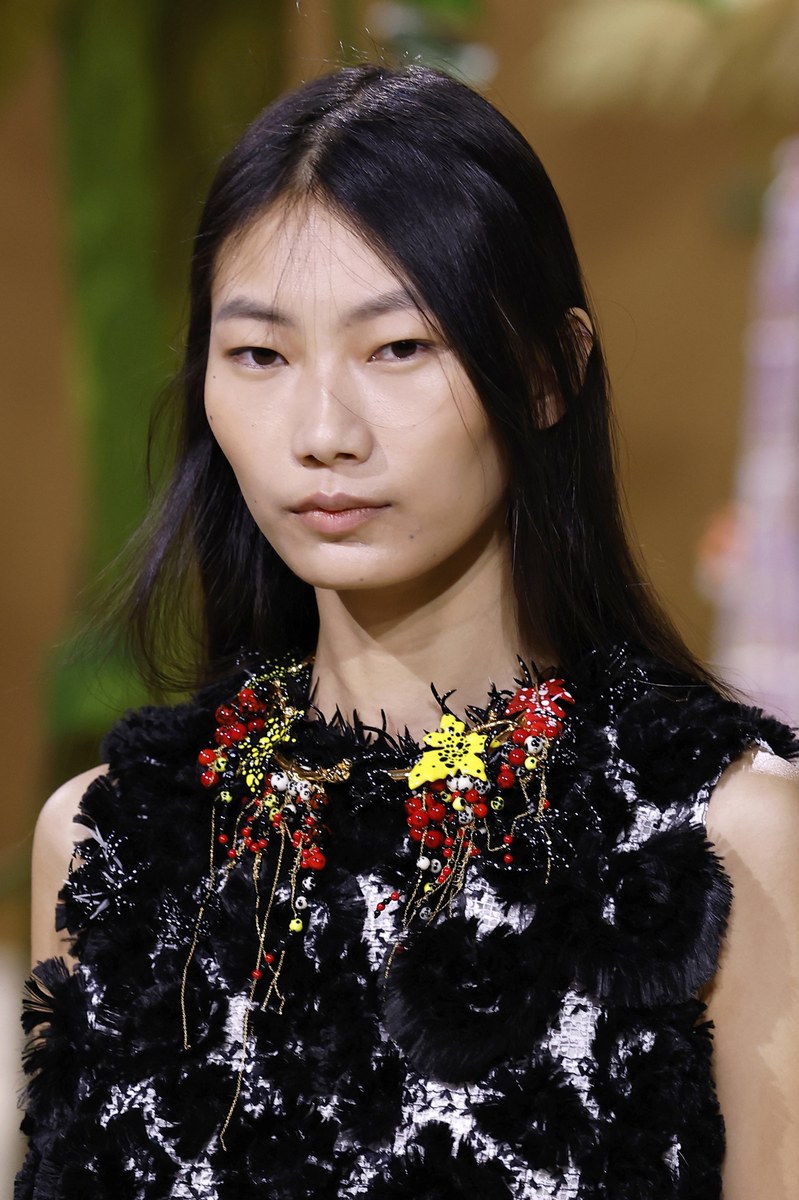
Jil Sander FW26 Women Looks Report
Milan Fashion Week
Luke and Lucie Meier built this collection on a conviction that precision tailoring and architectural volume can coexist in a single wardrobe. For buyers navigating a market fatigued by maximalism, there's a direct commercial signal here toward considered, high-unit-cost dressing with genuine cross-gender appeal.
Silhouette and Volume
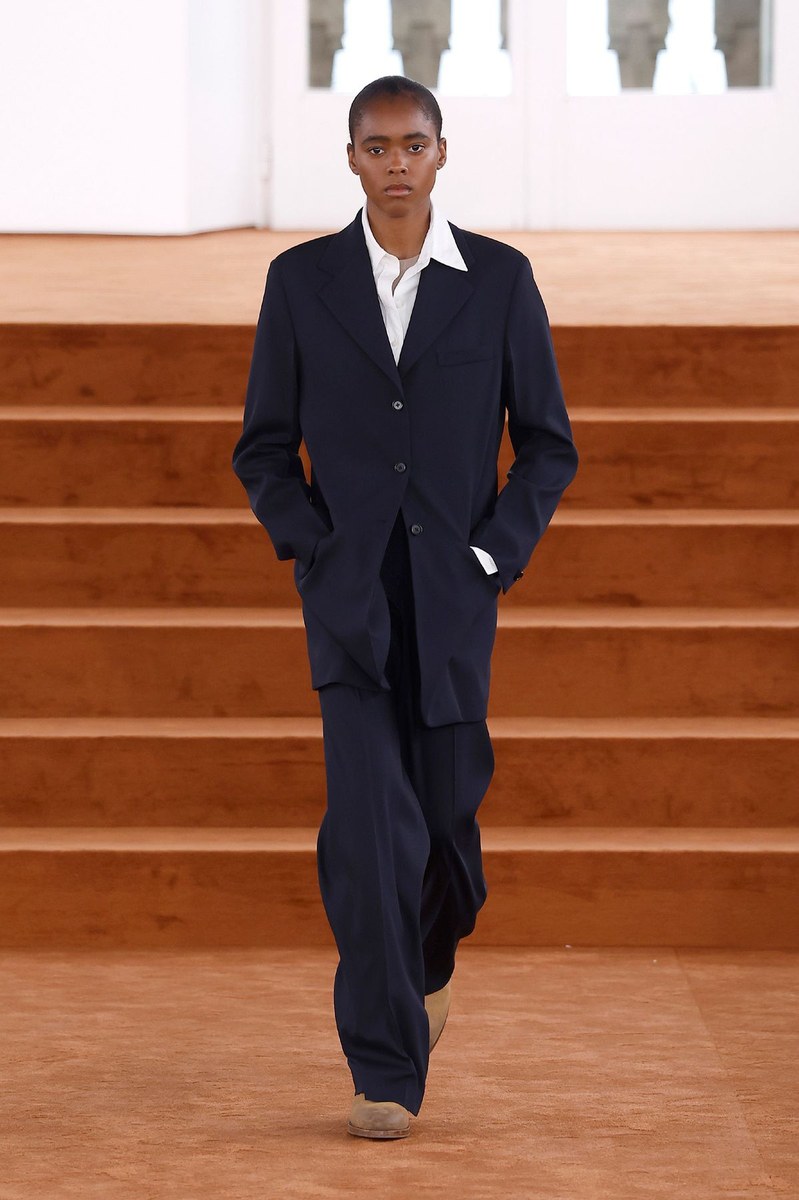
Two opposing but complementary poles structure everything: close-cut elongated forms and dramatically oversized cocoon or barrel shapes. Look 3 pulls the body into a slim vertical column through a floor-length buttoned-through coat dress, while Look 13 and Look 18 push outward with rounded, voluminous wool coats that dwarf the figure beneath. High-sitting trousers appear throughout, whether on Look 1, Look 2, or Look 15, breaking long with a gentle flare that grounds the volume above them. What emerges rewards both the minimalist and the customer willing to commit to statement outerwear.
Color Palette
Navy and charcoal grey dominate the landscape, appearing in paired suiting as well as standalone coating and creating a near-monastic restraint across the first half of the lineup. Black enters with authority in Look 3, Look 4, Look 6, Look 16, and Look 19, functioning less as a neutral and more as a structural material choice. Look 10 delivers the single chromatic disruption, a violet-flecked purple bouclé-effect dress with bold red lip styling that reads as a deliberate commercial punctuation mark. Look 17 introduces a pale silver-grey leather skirt against a warm sand bodysuit, the only moment of literal lightness in an otherwise deeply tonal edit.
Materials and Textures
A mid-to-heavyweight wool suiting, likely, carries the majority of the collection and reads with a clean, matte surface that holds structure without stiffness. Coating weight escalates significantly in Look 13 and Look 18, where dense double-faced wool creates self-supporting shapes that move independently of the body. Leather appears as a men's-proportioned black blazer in Look 14, a fitted sheath dress in Look 16, and a draped midi skirt in Look 17, each carrying a high lacquer finish that contracts sharply with the matte wools surrounding it. A long navy knit in Look 9 introduces softness, a fine-gauge jersey-weight fabric that extends to full length and layers over wide tailored trousers.

Styling and Layering
Suiting layered over suiting repeats throughout, with a vest placed beneath the single-breasted blazer in Looks 1, 2, and 5 to add visual depth without sacrificing the clean line. Footwear divides cleanly between two codes: taupe suede ankle boots that read almost barefoot against the terracotta runway floor worn in the tailored looks, and black leather oxfords or platform block-heel boots reserved for the more architectural womenswear pieces. Accessories stay minimal. A rigid arc-handled black patent bag in Look 2 and a matching mint-green version in Look 16 constitute the primary bag story. Look 15 introduces a detail worth flagging for buyers, stirrup-cut grey trousers worn over block-heeled square-toe shoes with a cobalt blue sock visible at the ankle. That small but precise color break adds commercial freshness to an otherwise austere base.

Look by Look Highlights
Look 1 The women's navy single-breasted suit with layered vest and wide-leg trouser sets the foundational suiting proportion for the entire collection and will anchor the core tailoring buy.

Look 3 The floor-length black buttoned coat dress in structured matte fabric is a single-piece wardrobe solution with strong standalone retail potential across multiple buying categories.
Look 4 A black off-the-shoulder dress with structured folded fabric at the neckline and worn with black opaque tights and leather oxfords reframes the occasion dress in a non-decorative, architectural register.

Look 6 The black sleeveless bodice paired with a grey paneled skirt that opens from a contrasting ivory underlayer on the stride is the collection's most technically complex piece and a strong editorial pull for production investment.

Look 13 The oversized grey double-faced wool cocoon coat with stand collar is the outerwear hero of the collection, fully self-supporting and reading as genuinely cold-weather functional.
Look 16 A black leather fitted coat dress with deep V-neck and seam detailing worn with a mint-green rigid handle bag is the collection's sharpest single-look commercial package for a luxury accessories-led market.

Look 17 A sand-toned long-sleeve jersey bodysuit beneath a pale silver-grey draped leather midi skirt is a separates story that opens a new color and fabrication direction for the brand's womenswear range.

Look 19 A navy oversized single-button wool coat worn over wide trousers with black cat-eye sunglasses and black loafers closes the outerwear arc and delivers the most wearable volume proposition in the lineup.

Operational Insights
Suiting reorder depth: The three-button single-breasted suit in both navy and charcoal grey, Looks 1, 2, 5, 7, 11, repeats across men's and women's silhouettes with minimal modification, making it a strong candidate for a gender-neutral SKU strategy that reduces sample and production costs.
Outerwear as hero unit: The double-faced wool cocoon coat, Look 13, and single-button oversized navy coat, Look 19, are constructed to be worn over heavy suiting, meaning buyers should plan sizing depth across a wider range than typical coat buys to accommodate layering.
Leather fabrication: Leather appears in at least three distinct applications, a men's blazer in Look 14, a women's sheath dress in Look 16, and a draped skirt in Look 17, signaling that the material is a collection-level commitment rather than a seasonal accent, and sourcing should be consolidated accordingly.

Color break opportunity: The cobalt blue sock detail in Look 15 and the mint and violet accents across the lineup suggest that small-unit accessory buys in unexpected accent colors will serve the editorial and styling community without requiring deep inventory commitment.

Cross-gender buying logic: Seven of the nineteen model looks present suiting or coating that sits within a two-centimeter silhouette tolerance of the men's looks, giving style directors a clear argument for a unified buy across both categories and reducing markdown risk through shared inventory flexibility.
Complete Collection


About the Designer
Simone Bellotti was born in 1978 in Giussano, a small town in the Brianza area north of Milan, and grew up with a particular proximity to craft: his father worked as an upholsterer, someone for whom materials and construction were daily realities rather than abstract references. He enrolled in accountancy school in Seregno, lasted one year, and quit. What followed was a period of working mornings at the Barzaghi textile mill in Giussano while spending afternoons studying fashion at the Istituto Carlo Secoli in Milan, a sequence that gave him the technical grounding to match the ambition he had already developed. The mid-1990s clubs of Lombardy had done some of the earlier formation: scenes where people came from Naples, Rome, and Bologna to converge around shared passions, and where he first understood, as he has put it, that this was really something. Then, decisive and deliberate, he moved to Antwerp.
The timing was specific: he was heading to a city that had become, by the late 1990s, the most important laboratory of conceptual fashion thinking in the world. He interned at Carol Christian Poell, the extreme Austrian-Italian designer whose deconstructed and process-based work occupied the outer limits of wearable form. Then he joined A.F. Vandervorst as a womenswear design assistant, absorbing the Belgian tradition of treating garments as structural entities with intellectual stakes. He returned to Italy equipped with a sensibility quite different from the Italian mainstream, and moved through a sequence of houses that gave him fluency in different registers: Gianfranco Ferré, then Bottega Veneta, then Dolce & Gabbana. In 2007 he joined Gucci in Florence, where he worked for sixteen years across two entirely different creative eras, first under Frida Giannini's rational discipline and then under Alessandro Michele's baroque excess. He has described those two approaches as opposite poles, both of which shaped who he became as a designer.
He left Gucci quietly in 2022 and joined Bally as design director, was promoted to creative director in May 2023, and in less than two years transformed a brand that had lost its cultural relevance into one of the more compelling propositions at Milan Fashion Week. His Bally collections drew from Swiss identity with genuine specificity: references to Dada, Alpine flora translated into gossamer prints on cashmere, peplum structures and sculptural tailoring that had a rigorous architectural logic. In March 2025, he was appointed creative director of Jil Sander, succeeding Luke and Lucie Meier. His debut collection for SS26 was shown in September 2025 and was read as a deliberate return to the house's founding purist logic, austere tailoring disrupted by electric color and sheer fabrics, precision undercut by wit.
"There were two very different approaches. Frida was a very organized and rational person. Alessandro was the opposite, and a real artist. They both helped build who I am today."
"I am incredibly honored to join Jil Sander, a storied house that created a new aesthetic with its unique approach and strong identity, and that has always had such a significant influence on the design community."
✦ This report was generated with AI — combining human editorial vision with Claude by Anthropic. Because the future of fashion intelligence is already here.