John Richmond FW26 Women Looks Report
London Fashion Week
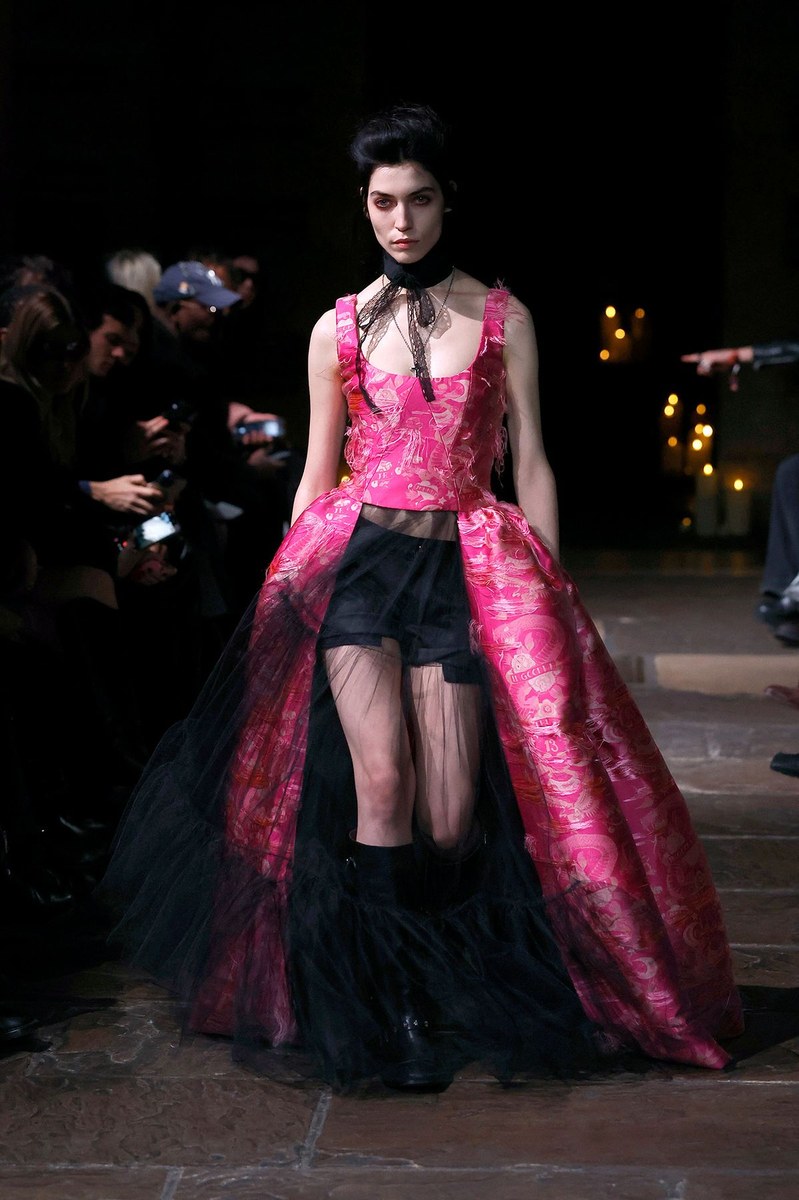
John Richmond FW26 positions gothic romanticism against hard rock energy, running a deliberate tension between ball gown drama and streetwear destruction through every look. Buyers operating in the premium contemporary and rock-luxe segments will find strong commercial anchors here, particularly in the black wardrobe staples and the recurring hot pink accent pieces that work across both womenswear and gender-fluid categories.
Silhouette and Volume
Two poles define this collection, neither giving ground. Looks 1 and 19 feature expanded ball skirt volumes, while most women's looks favor a cropped-and-bloomed proportion, pairing abbreviated hemlines with structured or oversized upper halves. Look 8 delivers full tiered ruffle volume from shoulder to hem, creating a cocoon silhouette that reads as both maximalist and wearable. Cape construction appears in Looks 6 and 7, adding a third silhouette language, one that is architectural at the shoulder and fluid below.
Color Palette
Black anchors roughly two thirds of the collection, appearing in every weight from matte wool to sheer chiffon. Hot magenta pink drives the remaining energy, dominating Looks 1, 3, 5, 6, 15, and 19. This contrast between the two colors is the collection's most bankable visual identity. Look 18 interrupts sharply with an off-white military leather jacket, and Look 9 pairs black leather with heavily distressed grey-washed denim for the only true neutral moment. Across retail environments, the pink-black binary will photograph exceptionally well and supports a tight, scalable colorway strategy for buyers placing orders.

Materials and Textures
Looks 1 and 3 carry jacquard with dense graphic print in magenta and gold, featuring visible raw fraying at the seams that suggests intentional deconstruction rather than finish failure. Shaggy curly-pile faux fur coats appear in Looks 13, 14, and 15, carrying substantial visual weight and a high-pile surface that reads as premium against the black ground. Black taffeta with beaded trim constructs the tiered ruffle dress in Look 8, and the structured faille or bonded fabric of Look 19 holds its bell shape without visible boning. Lace, sheer chiffon, and satin appear as underlayers in Looks 4, 10, and 11, adding depth and transparency to what would otherwise be flat black compositions.
Styling and Layering
Hard outer garments consistently pair with soft or transparent interiors throughout the collection. Cropped blazers layer over lace blouses in Look 4, shaggy coats over sheer dresses in Look 15, and studded capes over satin shirts in Look 6. Footwear runs almost exclusively through two categories: knee-high black leather buckle boots and low ankle boots, both with flat or low block heels. This keeps the overall proportion grounded and avoids any courtly softness. Accessories carry strong attitude. Lace chokers, pearl-chain necklaces worn long, fingerless gloves with stud detailing, and small hard-case bags with studs appear across multiple looks, creating a coherent accessories story that buyers can develop as margin-positive add-ons. Look 7 adds a wide-brim black fedora that reinforces the androgynous mystery threading through the women's lineup.

Look by Look Highlights
Look 1 The magenta jacquard ball gown with black tulle underskirt and raw-frayed bodice seams establishes the collection's core tension between formal volume and punk deconstruction, making it a strong editorial and capsule anchor.

Look 2 The all-black strapless mini dress trimmed entirely in deconstructed satin bows is the most immediately commercial piece in the collection, translating easily to evening and event dressing without requiring the full gothic context.

Look 4 The cropped black blazer over a lace blouse and satin bubble shorts with knee-high lace tights underneath delivers a strong multi-SKU layering formula that product managers can break apart and sell as separates.
Look 7 The studded black wool cape with asymmetric zip front, worn over a micro-check short and knee-high boots with a wide-brim hat, reads as a complete head-to-toe editorial look with real outerwear commercial potential.

Look 8 The black tiered taffeta ruffle cocoon dress with beaded-trim separating each layer is the most technically complex piece here and the strongest candidate for a made-to-order or limited-production strategy.
Look 15 The oversized shaggy black faux fur coat with embroidered cuff detailing worn over a sheer black maxi dress creates the strongest layering moment for cold-weather premium retail, and the white floral embroidery on the sleeve provides a quiet contrast detail that lifts the price perception.

Look 19 The structured hot magenta strapless mini dress with a studded crystal bustier band and full bell skirt holds shape independently, making it a strong standalone party and occasion piece that requires no styling context to sell.

Look 5 The hot magenta and black tartan long-line jacket with extreme exaggerated train worn over black skinny jeans is the collection's clearest bridge between rock heritage and contemporary styling, and it will drive strong response from buyers serving music, entertainment, and luxury streetwear customers.

Operational Insights
Colorway discipline: The hot magenta and black binary is tight enough for buyers to build a focused capsule around two to three colorways without inventory risk. Do not dilute this with additional colors at the buying stage.
Separates strategy: Looks 4, 11, and 13 are built from pieces that function independently as tops, outerwear, and bottoms. Product managers should evaluate these for separate SKU development rather than buying as full looks, which increases sell-through probability.
Outerwear priority: The cape constructions in Looks 6 and 7 and the shaggy faux fur coats in Looks 13, 14, and 15 represent the strongest outerwear story here. These carry the highest perceived value and the most visual distinctiveness for floor placement and window styling.
Accessories volume: Chokers, long pearl chains, fingerless gloves, and studded mini bags appear consistently enough to constitute a coordinated accessories range. Style directors should work with the brand on accessories pulls for editorial coverage, as these pieces have strong standalone margin and low risk.
Gender-fluid placement: Looks 3, 9, 12, 14, 16, and 18 were presented on male models but draw directly on the same fabrications, silhouettes, and styling codes as the women's looks. Buyers with gender-neutral or expanded-size floor strategies should flag these for cross-floor placement rather than treating them as a separate category.
Complete Collection


About the Designer
The working-class streets of Manchester shaped John Richmond's earliest years, where he grew up in 1960 surrounded by the industrial rhythms of northern England. At 16, he faced a pivotal decision that would define his career. Initially accepted to study architecture at Manchester University, Richmond made a last-minute change of heart and moved to London to pursue fashion at Kingston University instead. This shift from the structured world of buildings to the fluid realm of clothing proved prophetic. After graduating in 1982 with a fashion design degree, he immediately began collaborating with established brands including Armani, Joseph Tricot, and Fiorucci, while simultaneously launching his own label.
Richmond's aesthetic DNA formed during London's vibrant music scene of the late 1970s and early 1980s. The city's clubs and underground venues became his classroom, where he absorbed the visual language of punk, glam rock, and new wave movements. This musical foundation proved crucial when he co-founded Richmond-Cornejo with Maria Cornejo in 1984, before establishing his own three-line empire by 1987 with John Richmond, Richmond X, and Richmond Denim. His designs became synonymous with rock royalty, dressing everyone from Madonna and David Bowie to Mick Jagger and Lady Gaga. The brand's "Destroy" range achieved cult status in the 1990s, while his "RICH" jeans, originally created for a Bryan Adams photoshoot, accidentally launched the logo-mania trend years before other fashion houses caught on.
Today, Richmond remains at the helm as Creative Director of his global fashion empire, which has expanded beyond clothing into accessories, fragrances, childrenswear, and even architectural projects. Despite legal battles and ownership changes over the years, he has maintained creative control and recently spearheaded the brand's relaunch focusing on Asian markets. His influence extends into luxury residential design through partnerships in Dubai, bringing his rebellious aesthetic to architecture. The brand continues to evolve while staying true to its rock and roll roots, with Richmond drawing inspiration from contemporary music genres including hip-hop and jazz fusion.
"The only advice I would give anyone going into any industry is to do what your heart tells you. If you are in your element in what you do, it's not work, it's love." Richmond reflects on his journey with characteristic directness: "My DNA is made of all the subcultures and music and clubs that I grew up with and in. Ironically this period has become even more relevant and influential on contemporary fashion with the passing of time."
✦ This report was generated with AI — combining human editorial vision with Claude by Anthropic. Because the future of fashion intelligence is already here.