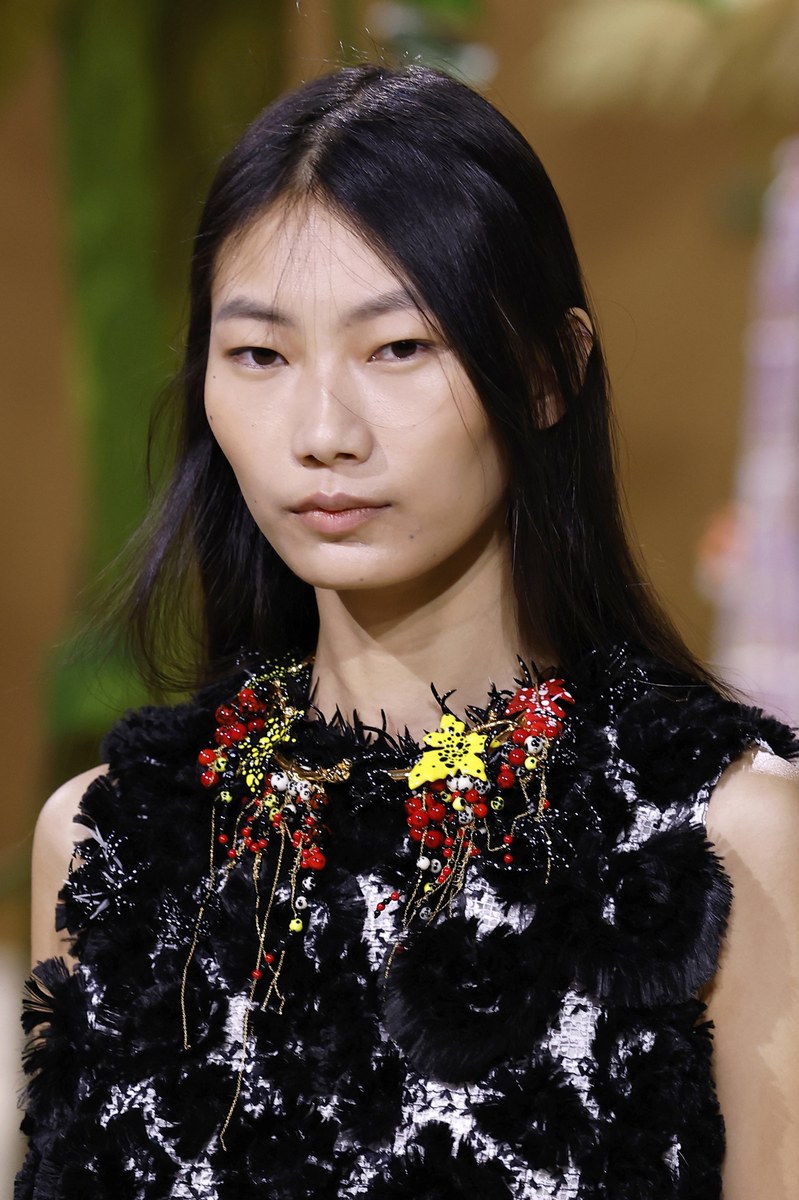
Junya Watanabe FW26 Women Looks Report
Paris Fashion Week
Junya Watanabe FW26 builds a direct argument for fashion as emotional armor, layering tactical hardware, salvaged textiles, stuffed animals, crumpled mylar and couture construction into garments that treat the dressed body as a site of conflict, accumulation and survival. For buyers navigating a market fatigued by minimalism and quiet luxury, volume, material density and narrative weight emerge as the new premium, signaling a clear commercial counter-position.
Silhouette and Volume
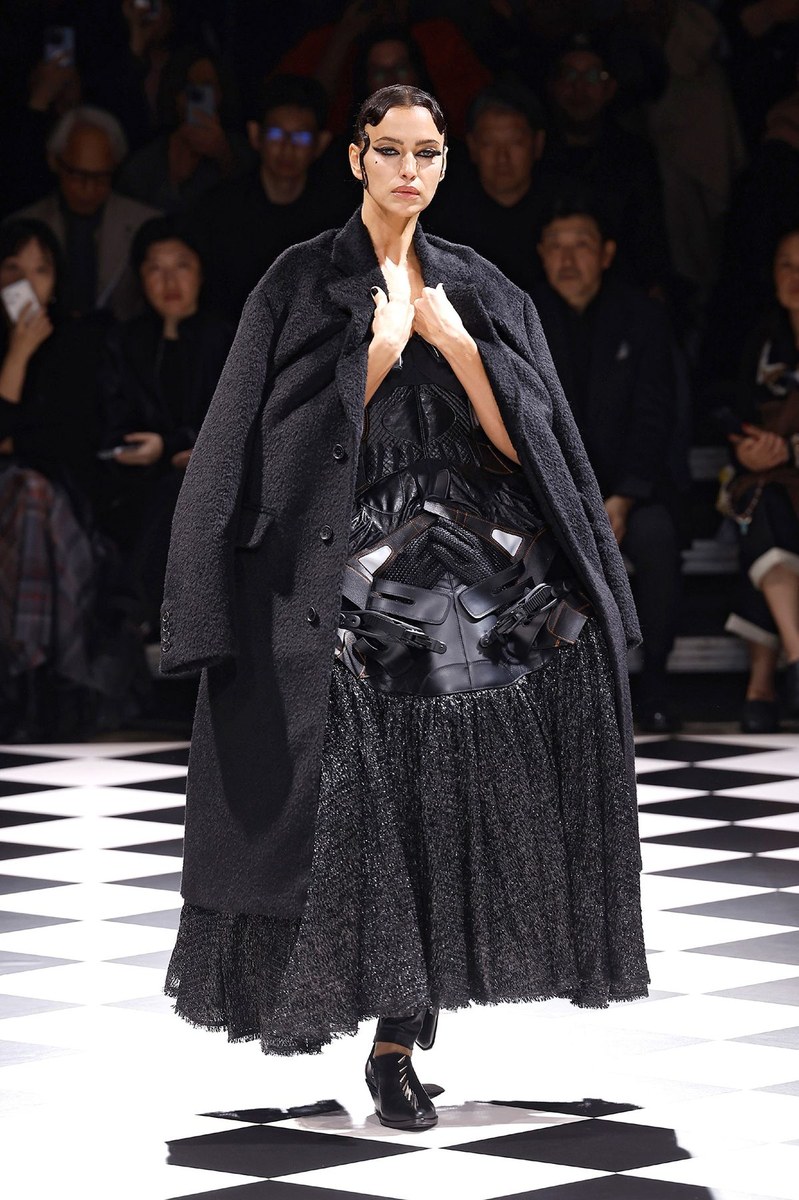
Two dominant shapes anchor the collection. A compressed, exoskeletal torso widens dramatically at the hip and releases into a floor-length skirt. The other is a broad-shouldered sculptural coat that overwhelms the body beneath it. Look 2 and Look 21 demonstrate the hip-amplified mermaid logic most clearly, while Look 16 pushes the puffer-as-architecture concept to its furthest point, quilted panels fanning outward like load-bearing wings. Look 11 delivers the collection's most extreme volume, a crinkled gold mylar tent dress with exaggerated puff sleeves that reads as both emergency blanket and ballgown. Proportion throughout is deliberately confrontational. Nothing here hugs or streamlines.
Color Palette
Matte black dominates, present across at least fifteen looks and anchored in leather, knit, velvet and taffeta. Against that ground, crumpled silver and gold mylar appear as accent and primary material, most legibly in Look 6 and Look 11. Look 9 ruptures the monochrome logic entirely, introducing saturated fuchsia, red, orange and printed tiger panels as the collection's single loudest color statement. Look 7 carries an equally charged white, evoking wound dressing or protective padding rather than bridal tradition.

Materials and Textures
Watanabe builds from opposing material weights held in simultaneous tension. Heavy black leather, stiff enough to hold sculptural form without internal structure, anchors Looks 22, 23 and 24. Against that rigidity sit sparkle-knit fringe skirts, crumpled mylar sheeting, feather trim, bubble-wrap-textured mesh and raw-edge lace, all moving and catching light in direct opposition to the leather's stillness. Stuffed-animal assemblages in Looks 13 and 14 introduce soft toy fabric into the material vocabulary, functioning as deliberate category disruption rather than whimsy. Puffer nylon in Looks 16 and 17 adds a sportswear-adjacent weight that grounds the more fantastical pieces within recognizable outerwear grammar.
Styling and Layering
Every look builds outward from a base layer, typically a black turtleneck knit or simple tank, onto which structural harnesses, corsets, padded panels and draped fabric are assembled like field equipment. Footwear is consistently a pointed-toe, flat or low-block-heel boot in black leather, worn knee-high in most looks and never decorative, keeping the lower body anchored while directing all visual energy toward the torso. Look 4 adds a wide architectural neck ring in black leather that functions as collar, gorget and sculptural frame simultaneously. Stuffed animals appear as accessories in Looks 13 and 14, replacing the bag entirely and charging each look with emotional narrative that no handbag could replicate.

Look by Look Highlights
Look 2 The full corset-and-petticoat silhouette with black leather tactical hardware layered over a glitter-dust skirt presents the clearest single-garment argument for the collection's commercial core, a wearable sculptural dress with real red-carpet application.
Look 5 A strapless silver-gray taffeta ballgown with black and red mesh panels edged in red binding stands as the collection's most directly eveningwear-ready piece, with volume and fabrication that would translate to made-to-order production.

Look 6 Silver mylar, long silver opera gloves and a black puffer accent create immediate editorial pull and strong costuming crossover value for film and performance clients.
Look 9 Patchwork red, fuchsia, tiger print, silver lurex and hot pink feather trim on a single dress makes this the collection's key test for buyers willing to stock color. Structured construction underneath carries the material chaos effectively.

Look 10 A Portuguese-language sash reading "Que a Paz Prevaleça no Mundo" layered over a collage dress with geometric wood, printed fabrics and florals turns this into the collection's political statement piece, high press value, lower sell-through probability.

Look 11 The crinkled gold mylar tent dress with feather and leopard-print shoulder inserts photographs as pure spectacle. Mylar's light weight and packability make it a technically interesting production proposition for event and resort markets.

Look 22 An all-black leather harness coat with straps, buckles and a visible wooden structural shoulder represents the tightest construction in the collection and the clearest signal of where Watanabe's armor vocabulary reaches its most resolved form.

Look 16 The black quilted puffer with geometric panel construction and feather trim hem anchors the outerwear portion of the collection. This single look proves most transferable to a contemporary commercial outerwear program with minimal adaptation.

Operational Insights
Armor-as-silhouette Structured harness and exoskeletal torso pieces in Looks 1, 2, 22 and 24 require specialist leather pattern-making and hardware sourcing. Buyers investing in this direction should pre-qualify manufacturers with experience in theatrical or equestrian leather construction, not standard apparel factories.
Mylar and reflective fabrication Looks 6 and 11 use crinkled metallic mylar that behaves like fabric but sources from industrial supply chains. Product managers should open conversations with technical fabric converters now, as lead times on specialty mylar with drape and hand comparable to what appears here can run 16 to 20 weeks.
Patchwork and collage construction Looks 9, 10, 12 and 19 depend on labor-intensive patchwork assembly across heterogeneous materials including leather, fur, sequin, velvet and print. Costing these pieces requires a per-unit labor audit, not a standard CMT model, and minimum order quantities will be low by necessity.
Footwear consistency as a margin lever An identical pointed-toe black boot appears across nearly every look, signaling that Watanabe intends the shoe as a system component, not an afterthought. Style directors building capsule buy-ins around this collection should treat the boot as a hero SKU and negotiate exclusivity or early delivery windows with the footwear supplier.
Stuffed animal and soft sculpture accessories Plush animal assemblages in Looks 13, 14 and 15 operate as accessories with no conventional bag function. Retailers with strong concept accessory categories or art-adjacent clientele should treat these as limited-edition collectible objects with display value, not volume accessories, and price and present them accordingly.
Complete Collection


Junya Watanabe was born in 1961 in Fukushima, a city in central Japan, and grew up in a household that had no obvious creative ambitions. Nobody in his family, as he has put it, had a creative profession. The one exception that comes closest to an origin story is his mother's small shop, where she took in garments and tailored ready-to-wear to fit individual bodies. As a teenager, Watanabe was not absorbed by clothes. He was absorbed by music, particularly the sounds coming out of Britain: Led Zeppelin, Pink Floyd, The Who, punk. He has carried that sonic obsession into his work ever since, dedicating entire collections to the visual language of Debbie Harry or Jay Kay, treating band merchandise the way other designers treat archival couture. Fashion arrived later, and arrived through a magazine, when he came across the work of Issey Miyake and was stopped by the discovery that clothes did not have to follow the body's existing contours. That revelation sent him to Bunka Fashion College in Tokyo, where his teacher later recalled that his sketches were so good they were regularly stolen by other students.
He graduated in 1984 and walked directly into Comme des Garçons as a pattern cutter, learning under Rei Kawakubo in the most technical, unglamorous way possible: reading fabric, understanding construction, building a vocabulary of form from the inside out. By 1987 he had been promoted to design director of the Tricot knitwear line. In 1992, Kawakubo offered him the opportunity most young designers spend careers dreaming about: his own label, still within the Comme des Garçons structure. His debut show was held in the concourse of Tokyo's Ryogoku Station. The following year he came to Paris.
His references are drawn more from music subculture, British tailoring history, Japanese textile tradition, and the work of Pierre Cardin than from what his contemporaries are doing, which he has admitted he makes little effort to follow. The concept of monozukuri, a Japanese word that subordinates the maker to the act of making, is the closest he has come to defining his own philosophy. Collections are built obsessively around a single material, a single theme, and pursued with a precision that critics have described as almost scientific. His Spring/Summer 2000 show, in which models stopped mid-runway to invert their waterproof garments while artificial rain fell overhead, remains one of the most deliberately structured acts of showmanship in the last thirty years of Paris fashion. He also does not take a bow at the end of his shows. Today, working from his atelier on the second floor of Comme des Garçons' Tokyo headquarters, Watanabe presents four collections a year in Paris across his womenswear and menswear lines.
"I was not interested in fashion in my adolescence; I was instead a boy who was purely obsessed with music. My first step into the fashion world was when I became interested in Issey Miyake's clothes while searching for a job that would allow me to express my ideas in some way."
"I was drawn to the fact that designers before Miyake, like Dior and the big names, would create clothes that were form-fitting. Issey totally changed the idea, completely different, and that impact was profound on me."
✦ This report was generated with AI — combining human editorial vision with Claude by Anthropic. Because the future of fashion intelligence is already here.