Karoline Vitto FW26 Women Looks Report
London Fashion Week
Karoline Vitto FW26 builds a commercial language around bodies that most luxury RTW collections still ignore, constructing every silhouette, cut-out, and drape specifically for curves rather than adapting them after the fact. For buyers serving a plus-size customer who wants editorial weight without compromise, this collection arrives at exactly the right moment.
Silhouette and Volume
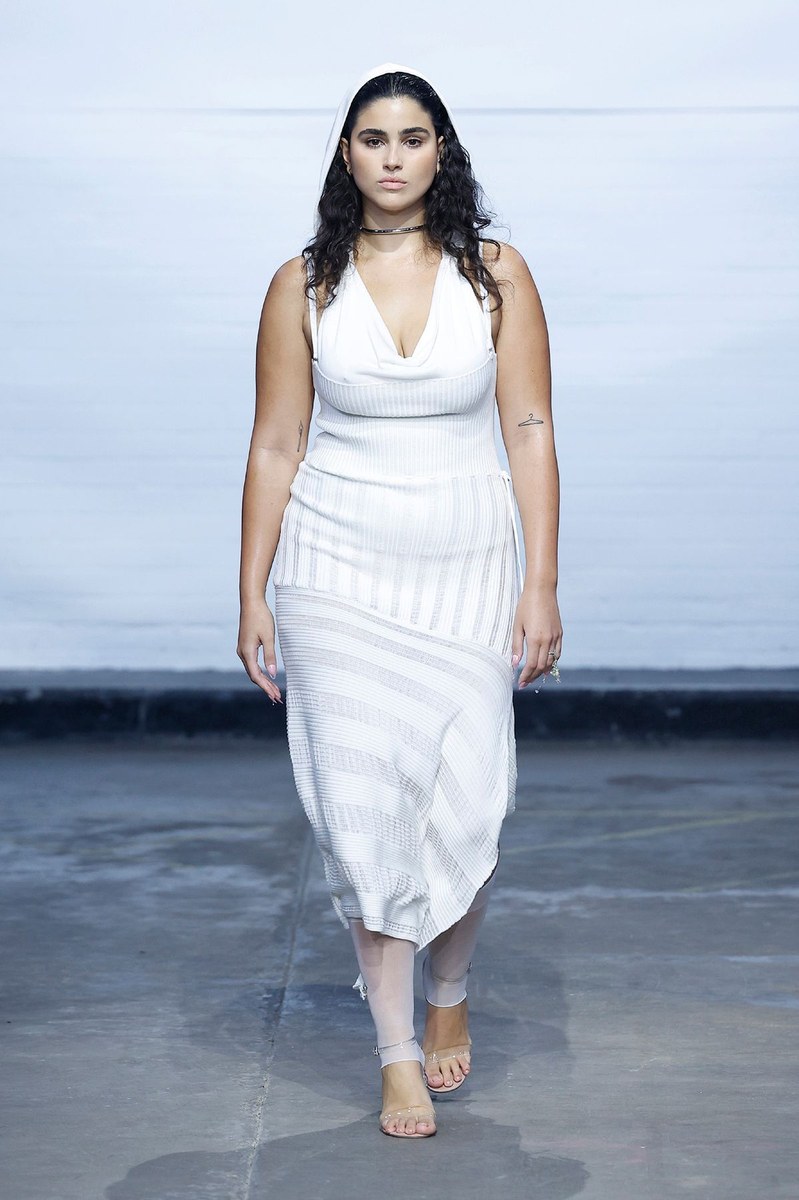
Vitto works in two registers simultaneously: fluid, body-skimming shapes that wrap and knot at the torso, and oversized tailored volumes that sit wide at the shoulder and pool at the floor. Asymmetric hems recur throughout, from the diagonal cut of the ribbed knit dress in Look 1 to the draped maxi skirt in Look 4, creating movement without sacrificing structure. What reads as a design signature rather than a trend application: the cut-out at the midriff, repeated in Looks 2, 3, 16, 17, and 19. Wide-leg trousers in Looks 9, 15, 17, and 18 read as tailored cargo, with excess fabric gathered deliberately at the thigh and knee.
Color Palette
Off-white, heather grey, navy, and black account for nearly all 20 looks. Sage green appears once in Look 16 and mauve-brown once in Look 15, both acting as palette breaks against the dominant navy and grey runs. The effect is serious and directional, closer to menswear color logic than to typical plus-market pastels. No prints appear except for the bleached denim treatment in Look 12, which reads as a surface intervention rather than a pattern decision.

Materials and Textures
Ribbed stretch knit carries the opening looks, with enough body to hold structure at the bodice while releasing into fluid drape at the skirt. A heavier cotton jersey, visible in Looks 2, 8, and 16, has more weight and a matte surface that photographs cleanly. Denim comes in two forms: a glossy, almost waxed finish in Look 10 and a distressed bleached version in Look 12, both cut with the same cropped jacket block. Fine cotton or linen-blend twill appears in Looks 4, 9, and 18, light enough for the asymmetric drape to function without collapsing.

Styling and Layering
Footwear splits between two options throughout the entire collection: a minimal black leather toe-post sandal with a low wraparound ankle strap, and a clear PVC ankle-strap heel that disappears against the skin. Both choices keep the leg uninterrupted. Knee-high sheer socks in white or black appear across Looks 5, 7, 11, 12, and 13, working as a styling constant that ties disparate silhouettes together. Accessories remain sparse, with sculptural floral or crystal cluster earrings in Looks 3, 4, 8, and 19 carrying the decorative load entirely. Look 20, the designer's walk, layers a navy blazer over a sheer sparkle knit with wide nylon trousers and chunky sneakers, signaling a casual register that could translate directly into a separate capsule.

Look by Look Highlights
Look 1 The off-white ribbed halter dress with a cowl neckline and diagonal asymmetric hem is the collection's most immediately commercial piece, clean enough for department store placement and distinctive enough to justify full price.
Look 2 The heather grey jersey dress with cold-shoulder cut-outs and a hip-level side opening demonstrates Vitto's cut-out architecture at its most restrained, making it the safest entry point for buyers new to the brand.

Look 4 The navy draped top-and-skirt set with a long hanging strap and crystal earrings reads as occasion wear with genuine editorial credibility, a rare combination in the plus-size formal category.

Look 10 The glossy dark denim co-ord, with a cropped zip-front jacket and low-slung wide-leg trouser knotted at the waistband, sits at the intersection of denim trend and body-conscious tailoring, a high-margin two-piece with strong sell-through logic.
Look 12 The bleach-distressed denim jacket and micro skirt set with black knee-highs is the highest-trend item here, carrying the strongest social and press pull while remaining producible at volume.

Look 18 The three-piece navy denim suiting look, comprising a collarless blazer, cropped bandeau top with front zip detail, and wide-leg trouser, is the most complete power dressing statement and the most direct pitch to corporate and workwear buyers.

Look 19 The floor-length black column dress with hip-level cut-outs bridged by chain detailing is the standout evening look, the chain hardware giving a hard-wear edge that separates it from standard eveningwear competition.

Look 9 The all-navy oversized blazer and wide-leg trouser suit, worn with a slim belt and no visible top, is the most gender-neutral piece and signals crossover potential into unisex or menswear-adjacent buying.

Operational Insights
Size range Vitto designs from the body outward, meaning the cut-out placement, drape ratios, and fabric tension are calibrated for sizes 16 to 24 from the pattern stage. Buyers should confirm grading specs hold across that full range before placing production orders.
Key fabrication risk The ribbed stretch knit in Looks 1 and 7 requires precise tension control across size steps. A fabric with too much recovery will compress the cowl and asymmetric drape details, so buyers should request multi-size fit samples before committing.
Category priority The denim co-ords in Looks 10 and 12 and the suiting in Looks 9 and 18 carry the broadest commercial applicability across both contemporary and premium department store floors. These four looks should anchor any initial buy.
Accessories entry The sheer knee-high sock is the easiest accessories category to build around this collection. White and black versions at a mid-price point would function as direct add-ons or cross-sells at point of sale.
Marketing angle The cast is entirely diverse in body type, skin tone, and apparent gender presentation, including Look 5 and Look 20 which break from conventional womenswear casting. Style directors running brand campaigns should treat the casting itself as a content asset, not just the clothes.

Complete Collection


About the Designer
Karoline Vitto Gomes grew up in Caçador, a small countryside town in southern Brazil where fashion barely registered on the cultural map. Her grandfather worked as a cobbler, her grandmothers were skilled seamstresses, and this early exposure to craft became the foundation of her design sensibility. Coming of age in 1990s Brazil, where Victoria's Secret-style models dominated fashion exports and beauty standards felt impossibly narrow, Vitto absorbed both the restrictive ideals and the resourceful making-do mentality of her small-town upbringing.
Before fashion consumed her world entirely, Vitto studied architecture, a discipline that would later inform her sculptural approach to garment construction. She completed her undergraduate degree in Brazil without working in fashion, then moved to London in 2016 seeking a more creative educational experience. After studying at Central Saint Martins and later earning a master's degree from the Royal College of Art, she found her calling in pattern cutting and construction. The shift from Brazil's technical fashion education to London's experimental approach unlocked her creative process, though her aesthetic remained deeply rooted in Brazilian sensuality and mid-century architectural forms.
Her design philosophy centers on framing rather than hiding the body's natural curves and folds. She works primarily with stretch jerseys, engineered knits, and metal hardware, creating garments that celebrate areas typically concealed by conventional fashion. Brazilian bossa nova and samba rhythms inform her collections, as does furniture design and mid-century Brazilian architecture. Her work addresses sizes from XS to 2XL as standard practice, with each piece engineered to respond to different body shapes rather than simply scaled up or down.
Since launching her brand in 2020, Vitto has become a fixture on the London fashion scene. She debuted at Fashion East in 2022, was later supported by Dolce & Gabbana for her Milan Fashion Week presentation, and has become a BFC NEWGEN recipient. She has dressed Ashley Graham, Precious Lee, and Kelly Rowland, was recognized by Vogue Business as the most inclusive brand across fashion weeks, and became the first Brazilian female designer to reach the LVMH Prize semi-finals in 2024.
"I just think there's so much that can come from cut in terms of design. Cut is just pretty informed by the actual body that goes in there – change the body, you change the cut and that's really most exciting."
"The weight of body diversity should not rest on a handful of designers."
✦ This report was generated with AI — combining human editorial vision with Claude by Anthropic. Because the future of fashion intelligence is already here.