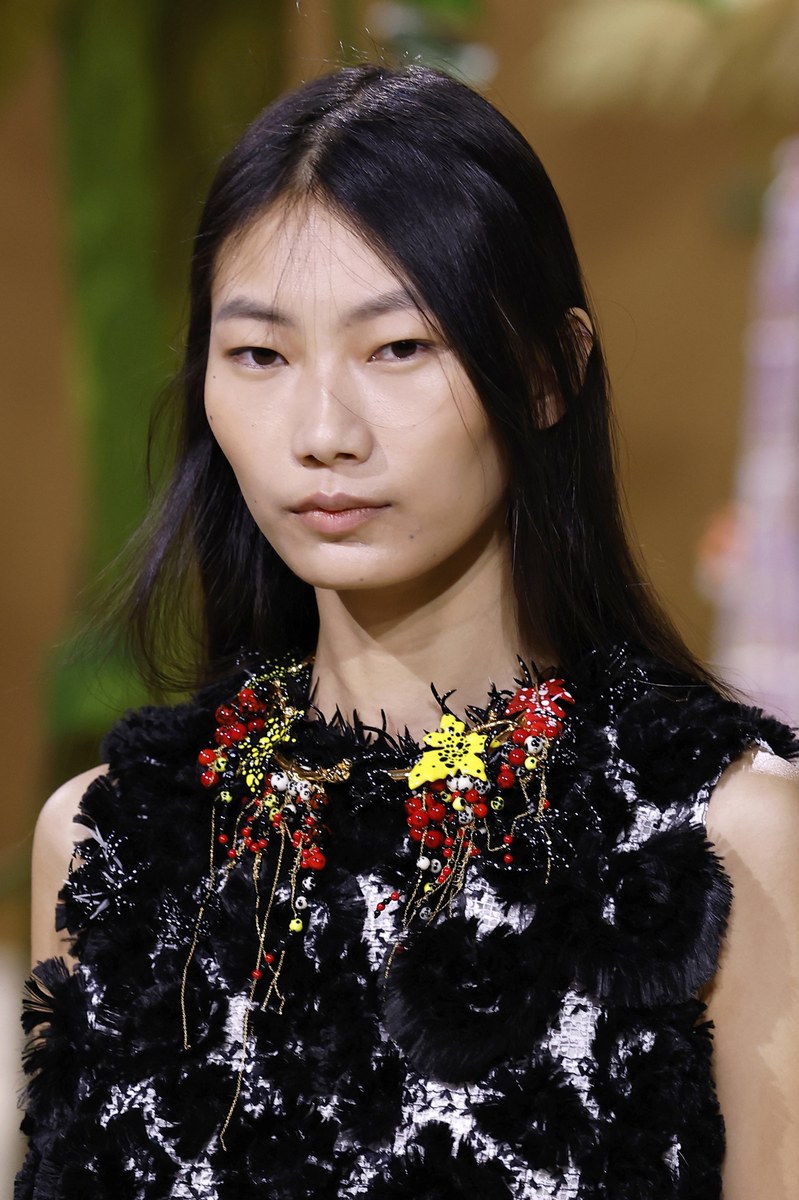
Keburia FW26 Women Looks Report
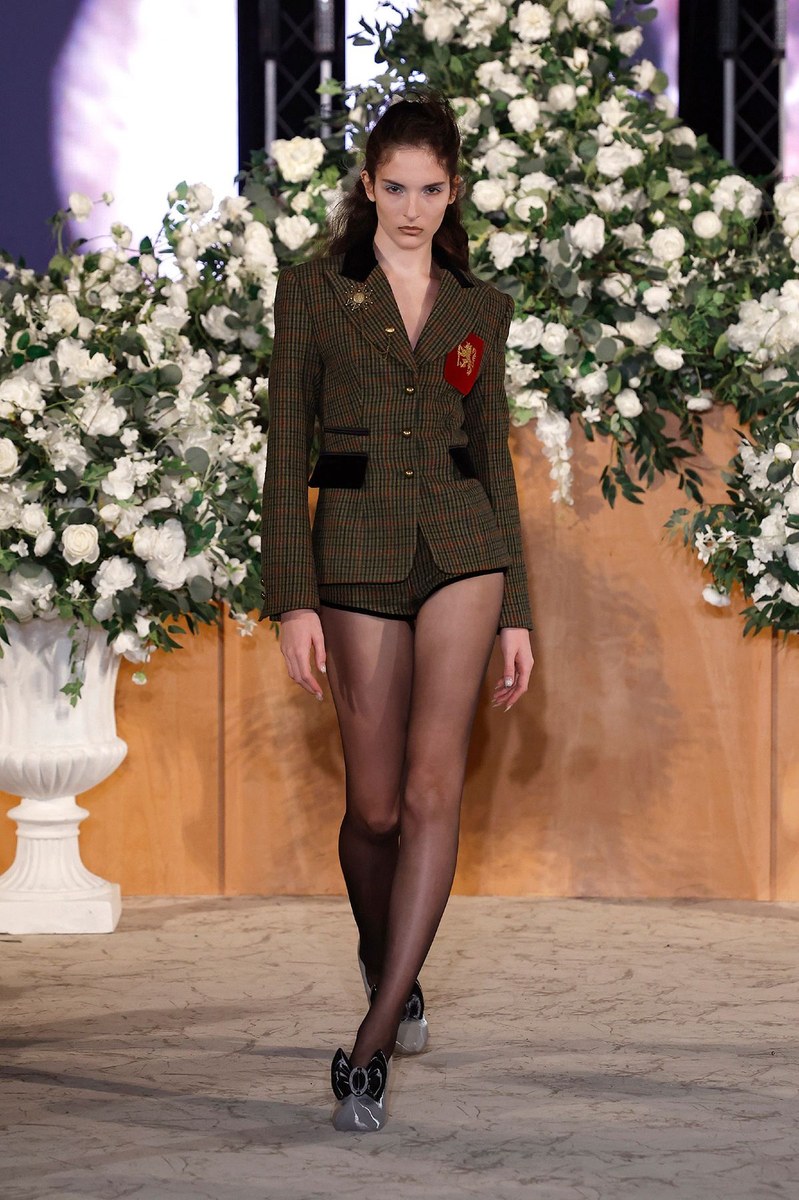
London Fashion Week
Keburia FW26 takes the military uniform as its starting point, specifically the Napoleonic-era hussar jacket. Recut, rescaled and collided with schoolgirl tailoring, lace underpinnings, fur trim and sequined eveningwear, the range moves between regimental severity and deliberate provocation. Buyers navigating a market hungry for maximalist references with a sharp editorial edge will find a clear, codeable aesthetic with strong cross-category potential.
Silhouette and Volume
Two dominant shapes anchor the collection: the cropped bolero or hussar-length jacket paired with exposed midriff and either micro-shorts or low-rise trousers, and the fitted double-breasted skirt suit cut to the knee. Look 4 and Look 9 typify the cropped-jacket-with-wide-trouser proportion, where the jacket ends above the navel and the pant drops low, leaving a deliberate gap of skin as a structural element. Look 2 and Look 3 represent the more conservative end, with blazers and pencil skirts that read as wearable, office-adjacent power dressing. The white feather-trimmed skirt suit in Look 12 and the all-over sequin column in Look 19 push volume into occasion territory without abandoning the military spine.
Color Palette
Muted olive plaid and camel tweed open the collection before pivoting hard into black and then exploding into red, yellow and gold. Black recurs as the dominant base across Looks 3 through 8 and Look 17, creating a consistent, commercially safe throughline. Red and black combine in Look 8 and Look 10 as the collection's most visceral pairing, while the high-visibility yellow of Look 16 against black frogging stands as the single loudest commercial signal in the show. Look 19 closes the color arc in full gold sequin, positioning the finale as a clear eveningwear capsule anchor.

Materials and Textures
Wool tweed, velvet, denim, jacquard brocade and sequined knit form the backbone of the collection, with feather and shearling-style fur trim used as recurring texture punctuation. Brocade appears across at least three looks, Looks 11, 13 and 14, in the same paisley-on-earth-tone print, treated as both suiting fabric and full-length trouser cloth. Fur, whether as a hood lining in Look 18, sleeve cuffs in Look 13, or collar trim in Looks 2 and 3, adds weight and tactility without changing the structural logic of the garment beneath it. Feather-trimmed details introduce a lighter, airborne surface quality that contrasts productively with the stiffness of the braided military toppers, visible in the feather skirt in Look 12 and the feather-hem trousers in Look 13.

Styling and Layering
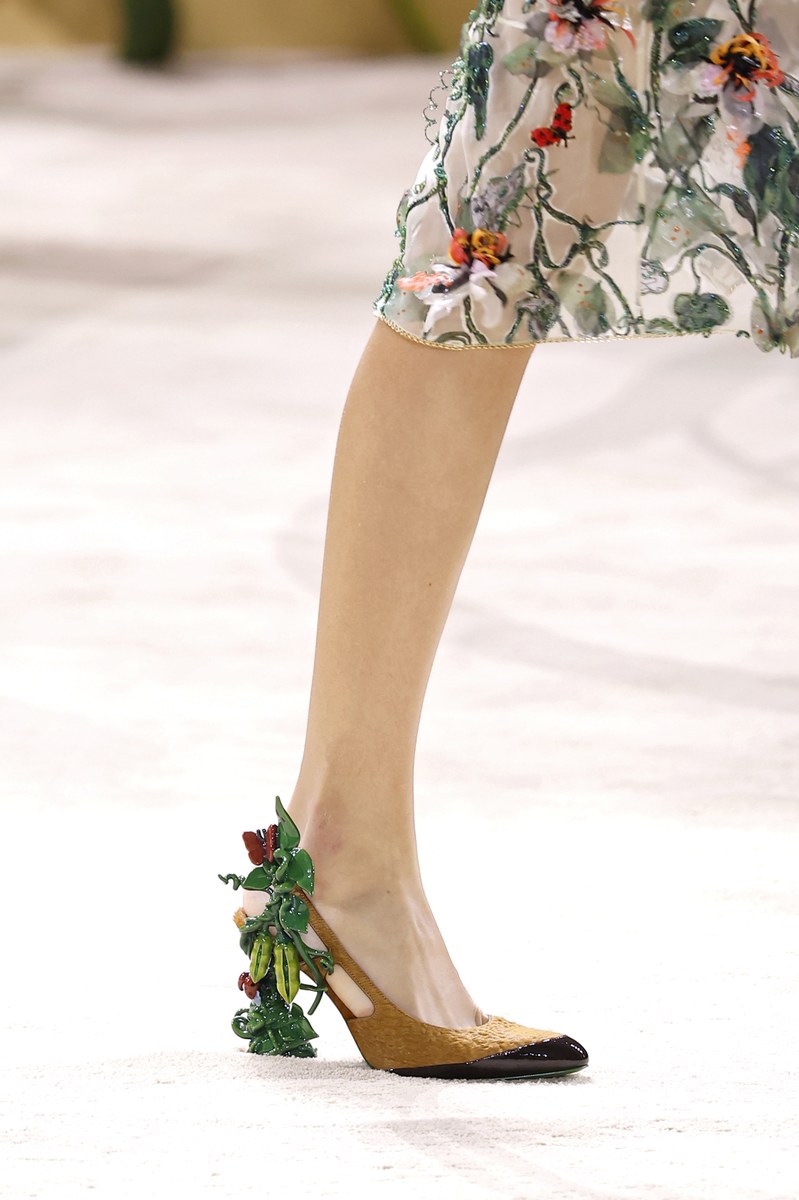
An Elizabethan ruff collar appears on Looks 9, 11 and 15 as a recurring historical splice, sitting incongruously beneath military vests and denim jackets to generate deliberate temporal dissonance. Footwear runs almost entirely on one silhouette: a square-toed kitten heel or low court shoe covered in textured shearling-style fabric, seen across the majority of looks. The bow-detail mule in Looks 1 and 6 and the yellow bow flat in Look 7 serve as the primary variations. A spider-motif belt buckle appears on Looks 9, 17 and 18, giving the collection a proprietary hardware signature. Looks 6 and 8 add the micro-bag worn at the hip, reinforcing the military pouch reference while addressing the small-bag commercial category.

Look by Look Highlights
Look 1 The olive plaid single-button blazer over sheer black shorts introduces the school-uniform-meets-regiment idea at its most commercially legible and wearable.

Look 6 A black velvet-collared hussar jacket in gold braid over a fur-trimmed micro-short stands as the collection's single most editorial look and its clearest candidate for press coverage and display merchandising.

Look 8 The black and red hussar jacket with gold aiguillette paired with ivory lace bloomers creates the most surreal proportional contrast in the show and will likely drive the strongest sample pull from stylists.

Look 10 An oversized red hussar jacket cropped above the hip over black low-rise trousers serves as the highest-volume, easiest-to-read hero piece for buyers targeting the statement-jacket category.

Look 13 The full-length paisley brocade coat with white feather trim functions as a standalone outerwear statement with high perceived value and strong gifting or red-carpet adjacency.

Look 15 A denim fitted jacket with toggle closures and a denim pleated micro-skirt delivers the most accessible, trend-right two-piece for a mid-tier commercial buyer.

Look 16 The yellow and black marching-band set with a pleated micro-skirt is the single most immediate social media candidate in the collection and will test well for pre-season content.

Look 19 A gold sequined crop jacket and floor-length column skirt closes out the collection as a complete eveningwear proposition, production-ready with minimal restyling for a formal or occasion category.

Operational Insights
Hero jacket category: The hussar jacket in its cropped, braided form appears in at least seven distinct colorways and fabrications, making it a clear capsule anchor for buyers who want to build a focused reorder strategy around a single silhouette.
Fabric consolidation: The paisley brocade runs across Looks 11, 13 and 14 as a shared base cloth, suggesting the brand is working with a single fabric investment across multiple SKUs. This signals efficient minimum order quantities and favorable unit economics for buyers.
Accessory entry points: The spider-motif belt buckle, the bow-detail kitten heel and the hip-worn micro-bag each appear across multiple looks and function as lower-price-point entry accessories for wholesale accounts that cannot commit to full looks.
Occasion versus everyday split: Daywear anchors around Looks 1 through 4 and Look 15 to 16, while occasion and editorial pieces anchor around Looks 6, 8, 12, 13 and 19. This gives style directors a clear framework for departmental placement without range overlap.
Fur and feather compliance risk: Shearling-style trim, feather hems and fox-adjacent fur pieces appear across Looks 2, 3, 6, 12, 13, 14 and 18, which means compliance teams at any retailer operating under strict animal-derived materials policies will need material origin confirmation before committing to those specific SKUs.
Complete Collection


About the Designer
George Keburia's story begins in 1990 Tbilisi, where he grew up in a traditional Georgian household during the country's turbulent post-Soviet transformation. From childhood, he showed an unusual fascination with fashion, playing what he called "guess the brand" with celebrity photos and sketching designs in the margins of his school notebooks while examining his mother's fashion magazines. His parents discouraged these interests, preferring he pursue business management at university. After starting his studies, Keburia eventually abandoned the path his family had mapped for him and turned to fashion completely by instinct and necessity.
What makes his trajectory remarkable is its entirely self-taught nature. With no formal fashion education, he learned through experimentation and mistakes, developing his skills organically rather than following established academic frameworks. His breakthrough came when he decided to enter Tbilisi Fashion Week's newcomer contest in 2010, creating his debut collection entirely by hand. The surrealist pieces, saturated with fantastical references, won him the "Best Newcomer" award and launched his career. Two years later, his "Bird Nest" capsule collection earned international recognition, winning the Be Next contest and the Community's Choice Muuse x Vogue Talents Vision Award.
His aesthetic draws heavily from vintage wardrobes, which he reinterprets through a lens of gender-free femininity and modern self-expression. Keburia cites Nicolas Ghesquiere and Jonathan Anderson as key influences, while finding inspiration in 1980s fashion and the eclectic street style of Tbilisi's young creative community. His designs frequently address Georgia's complex socio-political landscape, incorporating references to the country's 1990s civil war and contemporary issues around tolerance and freedom of expression. The work balances serious social commentary with playful, surrealist elements that create what he describes as "fashion escapism."
"When these processes are not easier, your creativity and your perspective take yet another turn. And that moment, the process that you are in, may turn into a journey with full of surprises." Discussing the challenges of working in Georgia's developing fashion infrastructure, he adds: "I don't really see one particular way of wearing my clothes, and would rather see lots of different types of women wearing KEBURIA in different ways."
✦ This report was generated with AI — combining human editorial vision with Claude by Anthropic. Because the future of fashion intelligence is already here.