Kiko Kostadinov FW26 Bags
Kiko Kostadinov FW26 Bags Report
Kiko Kostadinov FW26 positions bags as material-driven objects that sit between utility and sculpture, splitting the collection across two distinct languages: structured leather carry pieces built on a cylindrical-to-boxy chassis, and chunky hand-crocheted pouches with braided rope handles. Buyers and product managers should pay attention now because this dual-track strategy directly mirrors the bifurcation happening in the mid-to-luxury accessories market, where functional hardware-forward bags and craft-textured soft goods are both gaining shelf traction simultaneously.
Silhouettes and Shapes
Bags 1, 3, and 7 share a compact, top-zippered cylindrical body that widens at the base, sitting somewhere between a boxy camera bag and a structured bucket. A secondary front panel, geometrically seamed and slightly protruding, acts almost as a face on the bag, giving it sculptural presence without adding significant volume. Then there are the crocheted bags: Bags 2, 4, and 6 read as oversized slouch pouches, unstructured and gathered, held against the body rather than hung from a strap. Bag 5 and Bag 8 occupy their own category entirely, a large flat-to-pillow leather clutch with a die-cut scalloped surface, carried tucked under the arm in an oversized folio proportion.
Materials and Hardware
Smooth, matte-finish calfskin with no visible grain makes up the leather bags, rendered in a palette that reads as spray-painted or buffed rather than naturally finished. Construction is precise: multiple panel seams, integrated zippered pockets, and small leather fringe tags at zipper pulls on Bags 1, 3, and 7. For the crocheted bags, Bags 2, 4, and 6 use a metallic-flecked boucle yarn for the body with a contrasting matte cotton or raffia-weight yarn at the base and braided into the rope handles. Bags 5 and 8 present the most technically demanding construction, smooth matte leather with uniform circular perforations punched across the upper surface, creating a scaled or reptilian texture entirely through cut pattern rather than applied material.
Color Direction
A tight tonal range defines the leather bags: icy slate grey for Bag 1, silver-black for Bag 3, and flat black for Bag 7. These are not seasonal novelty colors. Rather, they function as wardrobe-permanent neutrals designed to sit across multiple outfit builds without stylistic friction. Real color energy enters the collection through the crocheted bags, where Bags 2 and 6 combine sage green with burnt orange at the base and handles, while Bag 4 shifts to metallic denim blue with a natural tan base and yellow-green rope detail. Warm greige holds Bags 5 and 8, functioning as the collection's connective neutral between the leather and knitwear families.
Key Models and Details
The cylindrical leather bag emerges as the collection's clearest commercial proposition. Its top zipper runs the full width of the bag, the protruding front panel includes a secondary zip pocket, and the fringe tag hardware detail adds a point of recognizability without logo dependency. At the top of the crocheted pouch model sits a gathered drawstring or pinch-close with multiple looped rope handles that cascade down the side, functioning simultaneously as handle, decoration, and closure mechanism. Bags 5 and 8 show a single large flat pouch with no visible closure system, relying entirely on the stiffness of the perforated leather panels to hold form. No visible logo treatment appears anywhere across the collection.
Bag by Bag Highlights
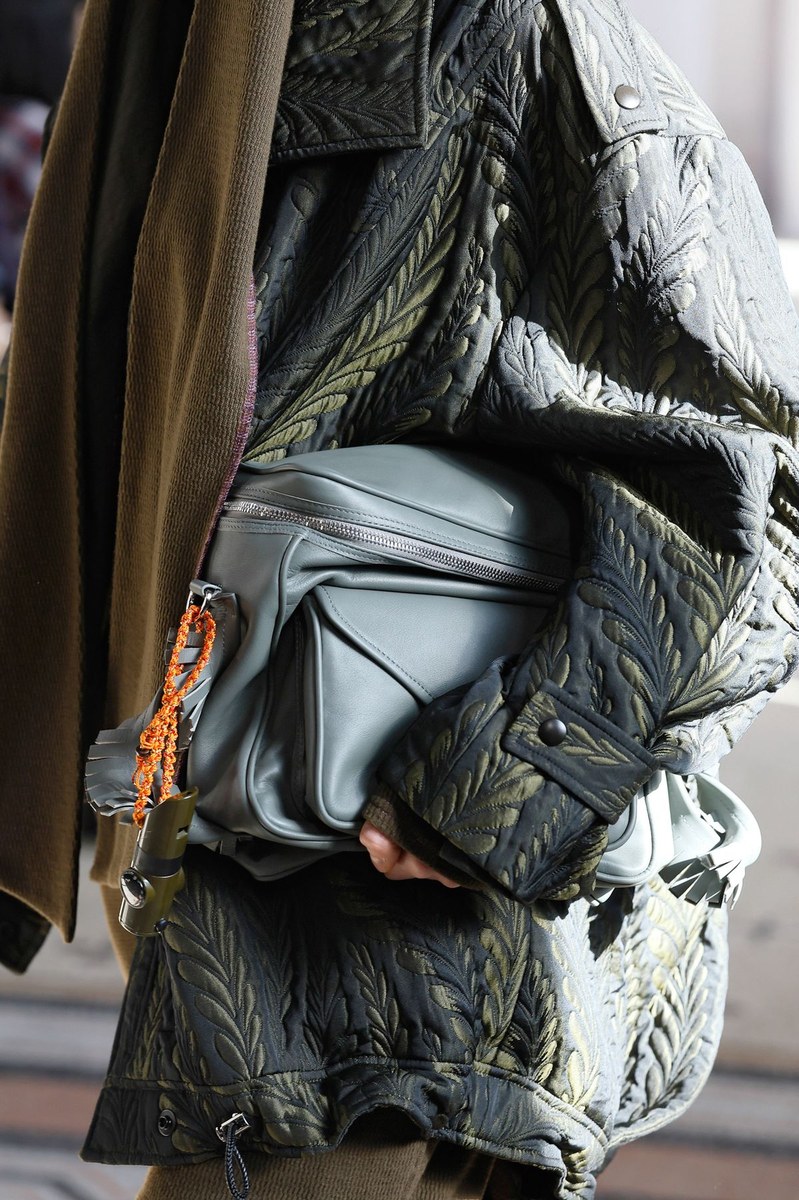
Bag 1 Slate grey smooth calfskin cylinder with embossed-leaf outerwear context, a front panel zip, and orange fringe zipper pull, making it the collection's most complete commercial look when considered as a coordinated set proposal.

Bag 2 Hand-crocheted sage and burnt orange pouch carried deep in the hand against a teal tweed coat, demonstrating how the styling conceals the silhouette almost entirely and positions the bag as a tactile object over a visual one.

Bag 3 Silver-black smooth calfskin version of the cylindrical model paired with brown shearling, showing the hardware-bag's versatility across warm outerwear and making a clear case for a two-tone or bicolor leather production variant.

Bag 4 Metallic denim-blue crocheted pouch with natural tan lower body and braided yellow-green rope handles, the strongest single colorway in the collection for buyers targeting spring crossover stocking or resort carry.

Bag 5 Warm greige perforated leather pillow clutch shown loosely held and gathered, demonstrating how the die-cut scaled surface reads as textured even in a single neutral tone, removing the need for color to achieve visual differentiation at point of sale.

Bag 6 Sage and orange crocheted pouch shown at full arm extension against printed outerwear, giving buyers the clearest view of the bag's volume and rope handle length, both of which are substantial enough to read as an oversized statement carry.

Bag 7 Flat black cylindrical leather bag alongside a branded bottle accessory clipped to the outside strap, hinting at a modular attachment system that product managers could develop as an add-on hardware program.

Bag 8 Perforated greige leather folio clutch held flat across both arms, with the scalloped cut pattern visible across the full face of the bag, making it the most immediately legible production sample for category directors evaluating laser-cut leather investment.

Operational Insights
Material dualism: Two entirely separate production pipelines run through this collection, smooth matte calfskin and hand-crocheted yarn construction, which means buyers must assess vendor capability separately for each track rather than sourcing from a single leather goods manufacturer.
Colorway efficiency: The leather bags operate in a three-color run of slate grey, silver-black, and flat black, which reduces tooling and dye cost per unit and signals that Kostadinov intends the shape to carry the commercial weight rather than color novelty.
Craft scalability risk: Bags 2, 4, and 6 involve multi-yarn, multi-technique construction with hand-braided rope handles, all of which create significant per-unit labor time and make large-order volume commitments risky without a confirmed atelier partner.
Attachments as revenue layer: The modular clip-on accessory visible in Bag 7 points toward a hardware attachment system that accessories directors should evaluate as a separate SKU category, bottle holders, carabiner charms, and zipper clip units that extend average transaction value per bag purchase.
Die-cut leather as category differentiator: Bags 5 and 8 use uniform circular perforations across a flat leather panel as the primary design gesture, a technique that requires precision die-cutting at the manufacturing stage but produces a high visual return with zero added material cost, making it a strong candidate for a mid-tier leather line looking to add perceived complexity without embellishment spend.
✦ This report was generated with AI — combining human editorial vision with Claude by Anthropic. Because the future of fashion intelligence is already here.