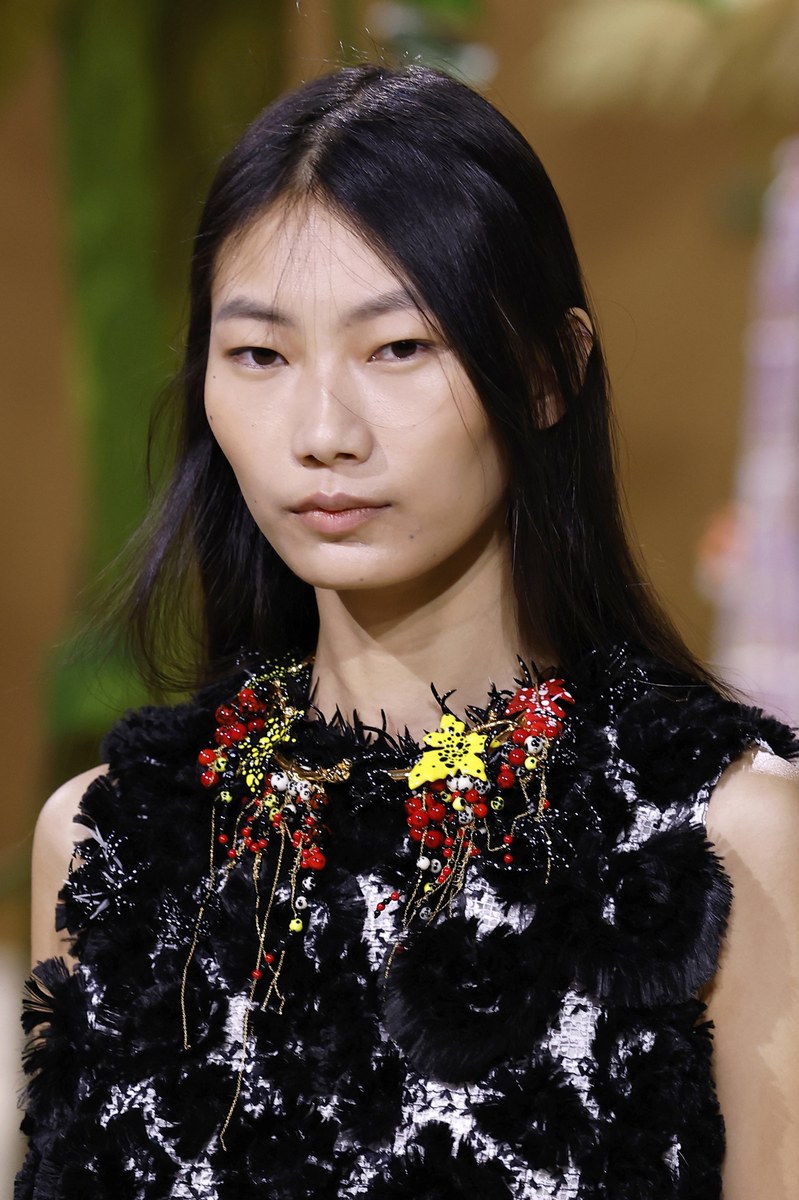
Kiko Kostadinov FW26 Women Looks Report

Kiko Kostadinov FW26 Women Looks Report
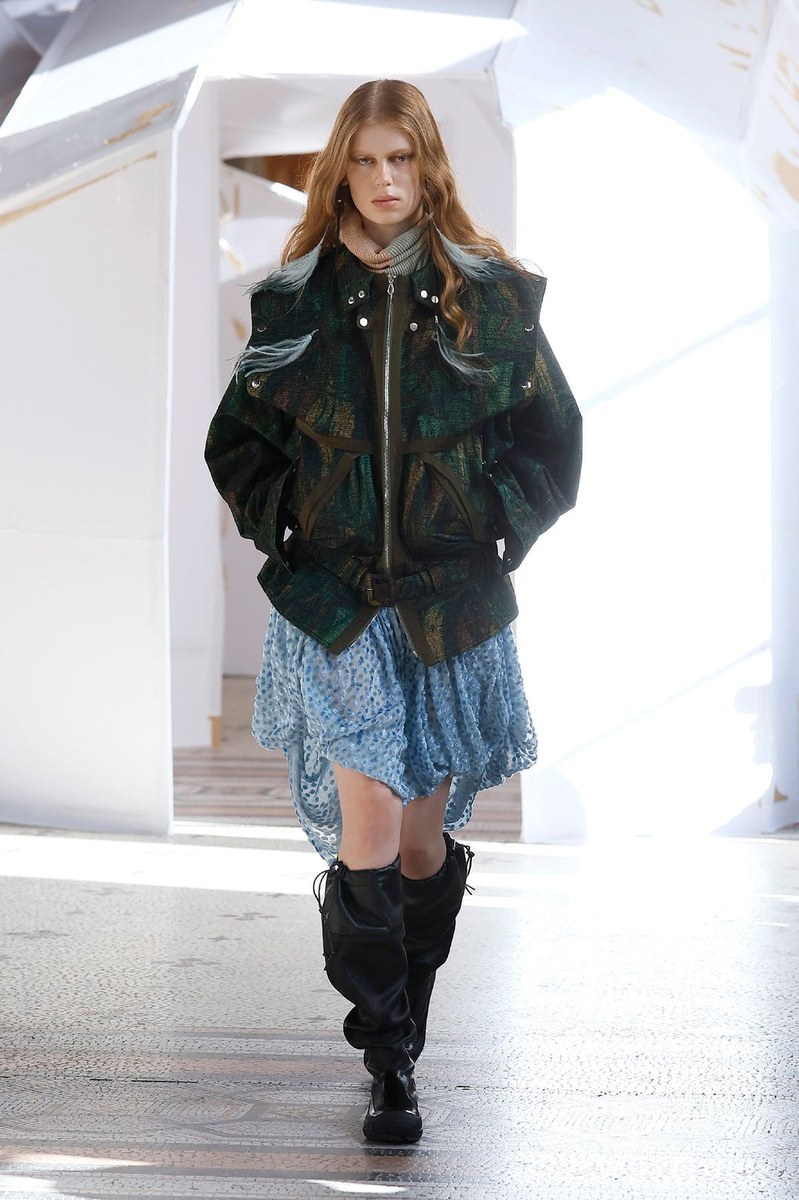
Kiko Kostadinov FW26 Women Looks Report

Paris Fashion Week

Kiko Kostadinov FW26 builds a wardrobe around controlled contradiction, pairing utilitarian outerwear architecture with fluid, draped eveningwear and ribbed knitwear that functions as both base layer and statement piece. Buyers navigating a market fatigued by minimalism will find a commercially grounded rationale for textural complexity and deliberate volume here.

Silhouette and Volume

Two dominant shapes anchor the looks: an exaggerated, wide-shouldered jacket and coat structure with military-derived pocket placement, and a soft, gathered dress silhouette that pools and floats away from the body. Look 1 and Look 4 demonstrate the bulked-up outerwear logic, while Looks 6, 16, and 36 pull in the opposite direction, favoring voluminous, handkerchief-hemmed dresses that collapse inward at the waist. Trouser options, as in Look 20 and Look 15, read as tapered cargo with articulated seaming rather than simple relaxed cuts. Hard contrasts between structured outer shells and near-formless interior layers dominate throughout, with little middle ground.
Look 1
Look 1

Color Palette

A deep forest green jacquard print, shot through with bronze and black, anchors the opening sequence and reappears across Looks 1 through 5. Black runs continuously from Look 7 through Look 24, broken by warm brown in Looks 14, 20, 21, 22, and 23, where a dark oxblood-adjacent burgundy reads as the key accent. Mid-collection, burnt orange appears in Looks 28 and 29, powder blue in Looks 6, 9, and 29, and pale blush pink in Looks 16 and 17. Gold lamé in Looks 34 and 36 closes the palette on a ceremonial note.

Look 7
Look 7

Materials and Textures

Dense and slightly stiff, the forest green jacquard used across the opening looks features a metallic surface sheen, sitting between brocade and technical outerwear cloth. Sheer organza in Looks 8, 11, 13, and 19 introduces a weightless, smoke-tinted film layered over structured underlayers, creating deliberate opacity conflicts. Multi-color patching reads painterly rather than decorative across the high-pile mixed yarn construction of the faux fur coats in Looks 33 and 35. Ribbed knit appears as leggings, over-the-knee boots integrated into the styling, and full-body fitted dresses, functioning across all three contexts as a unifying texture with strong repeat-buy potential.

Styling and Layering

Base layers function as visible components rather than hidden infrastructure throughout. Ribbed knit leggings and over-the-knee ribbed boots appear beneath sheer dresses, beneath parkas, and beneath jackets, as in Looks 4, 7, 10, 23, and 33, making the knit leg the connective thread across otherwise disparate tops. Footwear splits into two camps: lace-up chunky-soled boots in black or brown leather for the outerwear-heavy looks, and low-heeled flat pumps or loafers for the draped and tailored exits. Accessories stay restrained and functional, with net or crochet drawstring bags in Looks 2, 27, and 28, structured leather totes in Look 14, and a repeated long-chain pendant necklace with a large disc or spherical resin pendant anchoring the proportions without competing with the clothing.

Look 14
Look 14

Look by Look Highlights

Look 3 A sleeveless forest green jacquard vest dress with double zipper closure and matching cropped shorts presents the print as a coordinated set, a clear wholesale unit.

Look 3
Look 3

Look 6 Powder blue polka-dot chiffon draped into exaggerated gathered layers pairs with coordinated green ribbed over-the-knee boots, capturing the collection's key tension between feminine volume and athletic base dressing.

Look 6
Look 6

Look 12 An all-black textured velvet-like jumpsuit with matching jacket, worn with a long amber resin pendant, is the most immediately commercial look in the collection, requiring no editorial context to translate to a retail floor.

Look 12
Look 12

Look 20 Burgundy satin cargo suit with oversized chest pockets and articulated seaming reads as a wearable hero piece with clear styling versatility across multiple customer profiles, especially with light blue shirt cuffs visible at the sleeve hem.

Look 20
Look 20

Look 22 Black wool bomber with brown leather harness strapping, belted waist, and brown satin midi skirt beneath demonstrates Kostadinov's material mixing at its most resolved and production-ready.

Look 22
Look 22

Look 29 Burnt orange ribbed button-front dress with open side seams, worn with a two-tone blue and orange knit hood and white knee boots, is the strongest color story in the collection and translates well to a capsule range.

Look 29
Look 29

Look 34 Olive gold lamé draped halter dress with pleated skirt gathered at the hip and feather shoulder trim stands apart as the evening anchor, removed from the collection's utilitarian vocabulary and targeting a formal occasion buy.

Look 34
Look 34

Look 35 An oversized intarsia faux fur coat in grey, blush pink, sage green, and black worn over a simple black ribbed dress with black pumps functions as the outerwear statement piece, practical for buyers seeking a single hero coat SKU.

Look 35
Look 35

Operational Insights

Print ownership: The forest green bronze jacquard appears across at least six distinct silhouettes, from a sleeveless vest dress in Look 3 to a quilted parka in Look 2. Buyers should evaluate licensing or exclusivity windows early, as the print carries strong season identification value.

Knit program depth: Ribbed knit appears as leggings, over-the-knee boot-socks, full-length dresses, and cardigans in at least ten looks. Both fashion item and wardrobe foundational, the category suggests a dedicated knit capsule buy would perform across multiple price points and departments.

Faux fur positioning: Multi-color blocked faux fur with distinctive intarsia construction appears in Looks 33 and 35. Given current market pressure on real fur alternatives, these coats carry strong press coverage potential and should be prioritized for wholesale seeding and visual merchandising placement.

Color capsule strategy: Burnt orange and powder blue combination in Looks 28 and 29 represents the strongest colorway story for a targeted capsule. Product managers should assess whether these two SKUs can be merchandised as a coordinated set, as the contrast reads cohesively in adjacent rack placement.

Footwear integration: The ribbed over-the-knee boot-sock appears in at least eight looks and functions as a collection-specific styling tool. Style directors should note that this piece drives the reading of multiple looks and would benefit from being bought and displayed as a companion item alongside dresses and outerwear, not merchandised separately in a footwear zone.

Complete Collection

Look 2
Look 2
Look 4
Look 4
Look 5
Look 5
Look 8
Look 8
Look 9
Look 9
Look 10
Look 10
Look 11
Look 11
Look 13
Look 13
Look 15
Look 15
Look 16
Look 16
Look 17
Look 17
Look 18
Look 18
Look 19
Look 19
Look 21
Look 21
Look 23
Look 23
Look 24
Look 24
Look 25
Look 25
Look 26
Look 26
Look 27
Look 27
Look 28
Look 28
Look 30
Look 30
Look 31
Look 31
Look 32
Look 32
Look 33
Look 33
Look 36
Look 36

Kiko Kostadinov was born in 1989 in Pazardzhik, Bulgaria, and grew up in a household where clothes were not a subject of contemplation. His father worked construction, his mother in childcare and cleaning, and the closest thing to a cultural education in fashion was the Umbro kit his uncle would post over from London, which made you, as Kostadinov has put it, the boss of the playground. When Bulgaria joined the European Union, his family moved to London. He was sixteen, didn't want to stay, and spent his first years there trawling through High Street Kensington shops and raiding TK Maxx with no particular idea that any of it pointed toward a career. Before fashion fully claimed him, he enrolled in an IT degree, which he abandoned with the observation that he had no desire to spend his life behind a computer. The irony, he later noted, is that he now does.

He started at London College of Fashion on a foundation course, dropped out, got rejected from Central Saint Martins, spent time assisting designers including Aitor Throup, Nicola Formichetti, and stylist Stephan Mann, then applied again and was accepted. He completed both a BA and an MA in Menswear at CSM, where the professor Louise Wilson, who died in 2014 and whom Kostadinov credits as a genuine influence, pushed her students to do primary research before ever touching a computer. He graduated from the MA in 2016 and, within months, was on the London men's schedule with British Fashion Council funding, the first menswear student to receive NewGen Men support directly out of school.

His references were never nostalgic in the conventional sense. He built an archive of military and Japanese workwear catalogs not to replicate them but to register what already existed and then refuse to make it again. The Richard Serra artist book that gave its name to his early Stüssy collaboration, the Arte Povera movement that ran beneath his Mackintosh 0001 work, Yohji Yamamoto's precision and Rick Owens' structural aggression: these sit alongside his father's construction site and his mother's cleaning job as sources that feed his thinking about garments that carry invisible purpose. His 2019 gallery installation in Los Angeles, titled "Otto 95.8," placed coats and bags drawing directly on Bulgarian heritage and his father's profession in an art context, and eventually grew into a diffusion line. In 2018 he launched a womenswear arm run by Australian twins Laura and Deanna Fanning, who share his studio in London. He opened flagships in Tokyo in 2024 and Los Angeles later the same year. The ongoing collaboration with ASICS, which began with footwear in 2017 and formalized into the Novalis line in 2023, has made him one of the more structurally serious figures in the space between fashion and athletic design.

"Growing up in Bulgaria, I wasn't really exposed to this culture or art at all. But that can be a good thing. Knowledge can be restrictive. It's forced me to learn my own way."

"It's about how to design something in a way that has invisible purpose, because my work goes against what I call flat designing. I find the time to rethink the materials and garments."

✦ This report was generated with AI — combining human editorial vision with Claude by Anthropic. Because the future of fashion intelligence is already here.