Kimhekim FW26 Women Looks Report

Kimhekim FW26 Women Looks Report
Kimhekim FW26 Women Looks Report

Paris Fashion Week

Kimhekim FW26 splits into two distinct registers: a highly commercial opening act built around pastel mini dresses and bow accessories, and a conceptual second half that uses human hair, pearl-studded draped satin, and logo-tape as raw construction material. For buyers working across both the ready-to-wear and statement-piece segments, this collection presents a clear tiering opportunity, with wearable entry points and high-impact editorial pieces that serve press and visual merchandising in equal measure.

Silhouette and Volume

The collection opens with a tight A-line silhouette in the form of structured duchess satin mini dresses (Looks 1 through 3) before expanding dramatically into voluminous draped forms pinned with oversized pearl buttons (Looks 4 through 6). Mid-collection tailoring arrives in oversized blazer proportions, with wide-leg trousers dropped low on the hip and jackets that extend well past the waist (Looks 9, 21, 22). A cropped blazer with a high-cut bodysuit (Look 38) and a logo-tape bra set with matching micro skirt (Look 39) close things out. Throughout, the designer never stays with one silhouette long enough to let it settle into a single commercial category. That's both the collection's energy and its production challenge.
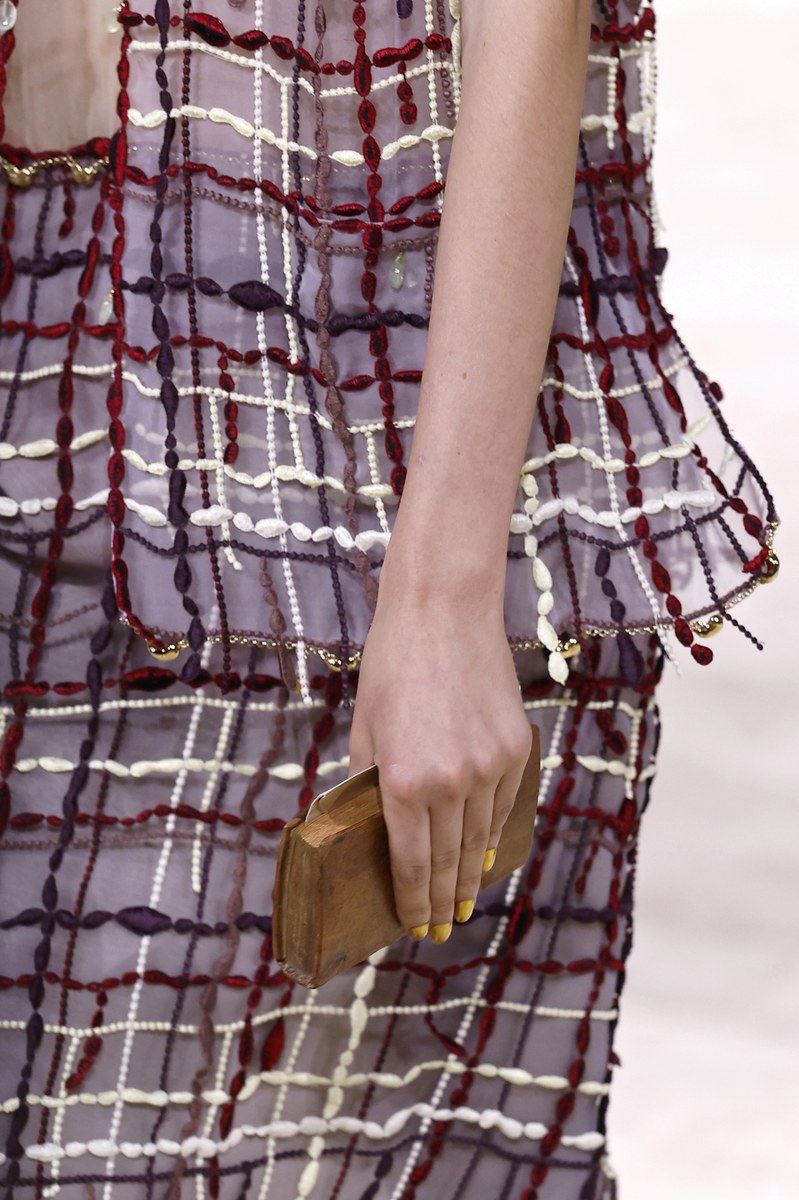
Look 38
Look 38

Color Palette

The first third runs on soft pastels: optical white (Look 1), baby pink (Look 2), and mint (Looks 3, 4, 19), each matched to its own accessories in the same tone for a total head-to-toe read. Black dominates the middle and closing sections, appearing in tailoring (Looks 7, 9, 11, 22, 26, 36, 37, 38), sheer organza (Look 33), and even the hair-constructed look (Look 16). Camel and wheat tones bridge the two registers, running through the trench coats (Looks 15, 29, 30) and the extraordinary blonde-hair braided gown (Look 17). The logic is commercially legible: pastels for the younger, dress-driven consumer; black for the tailoring and eveningwear buyer; neutrals for outerwear.

Look 1
Look 1

Materials and Textures

The duchess satin used in the opening mini dresses carries a heavy, matte sheen with enough body to hold the A-line shape without internal structure, making it both cost-effective and photogenic. From Look 4 onward, the same satin reappears in loose gathered forms, pleated and pinned with large pearl-set buttons that act as the primary closure and decorative element simultaneously. What appears to be extensions and raw fiber in braided, woven, and ringlet form applied directly onto sheer organza or sculpted as freestanding garments defines the hair looks (Looks 14 through 19), a craft-intensive approach that signals artisanal positioning. Wool bouclé coats (Looks 27, 28) and cotton poplin shirts (Looks 24, 31, 32) provide the grounded commercial backbone, with clean drape and familiar fabrication that requires no explanation on the shop floor.

Look 4
Look 4

Styling and Layering

Bows function as a unifying accessory system across the collection, appearing on headbands (Looks 1, 2, 3, 32), shoes (Looks 1, 2, 3), handbags (Looks 1, 2, 3), and jacket closures (Look 35), which gives the opening pastel looks strong set-selling potential. Legwear is deliberate throughout: white knee socks with the mini dresses, white opaque tights with the oversized shirts (Looks 31, 32), and colored-to-match socks under the pastel looks (Look 2 in pink, Look 3 in mint). Footwear divides cleanly into two families: a sculptural low-heeled mule with a square toe that runs through the tailored looks, and knee-high boots in patent or leather that anchor the more constructed editorial pieces. A gray wool scarf worn as a draped belt in Look 20 is a precise, low-cost styling detail that product managers will find reproducible at multiple price points.

Look 35
Look 35

Look by Look Highlights

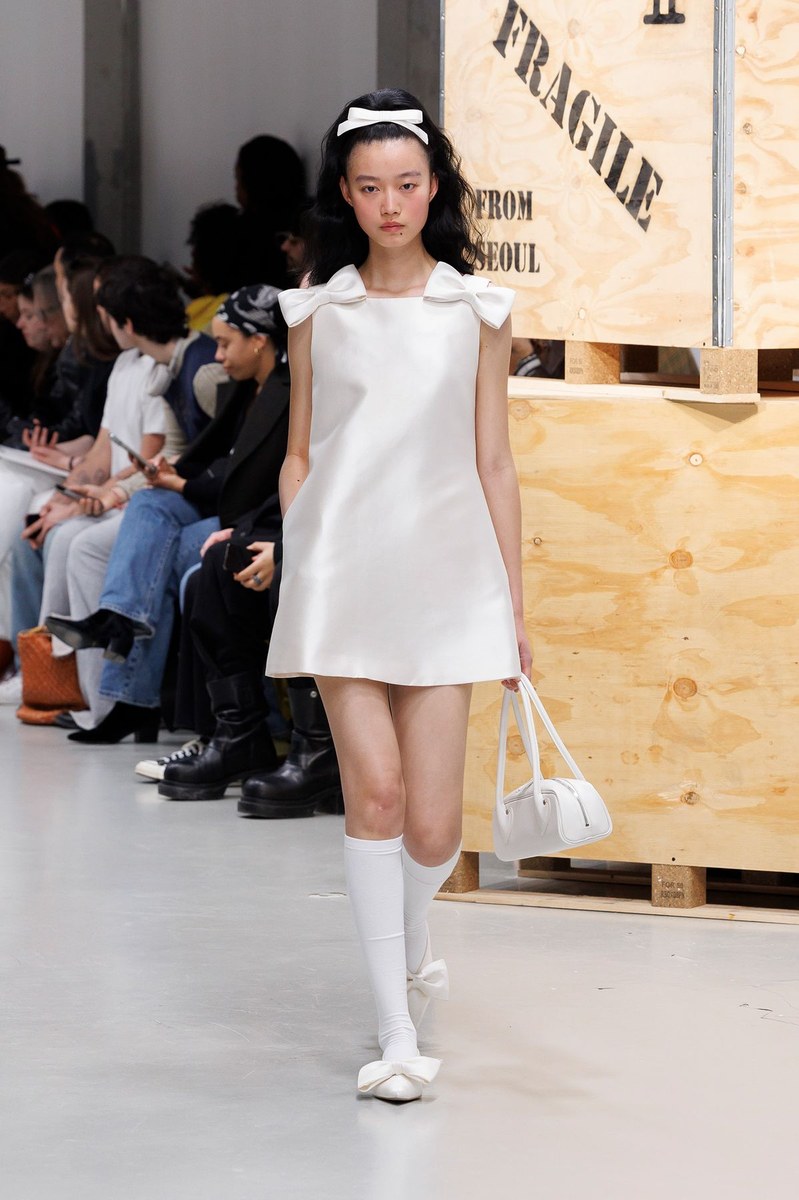
Look 1 The white duchess satin mini dress with matching bow shoulders, white knee socks, white bow-embellished flats, and a structured white top-handle bag functions as a complete set that could be sold in components across accessories, footwear, and apparel without losing coherence.

Look 6 An all-white pearl-pinned draped satin top and wide-leg gathered trouser ensemble reads as a bridal or occasion alternative with a contemporary construction logic, making it a strong candidate for special-occasion departments looking beyond conventional eveningwear.

Look 6
Look 6

Look 9 A pearl-studded double-breasted coat worn over a white shirt with belted trousers and a structured black bag converts the pearl motif from craft detail to outerwear-scale hardware. That's a commercially scalable move.

Look 9
Look 9

Look 14 The sheer nude organza sleeveless coat dress, structured only at the lapels and buttons, worn with cascading auburn braided extensions as epaulettes, creates a high-concept bridal or editorial option that requires minimal fabric yardage but maximum craft hours.

Look 14
Look 14

Look 17 The full-length blonde fiber gown with a braided spine and shoulder-length cape extensions is the collection's most technically ambitious look. Its marketability sits entirely in editorial placement and museum or gallery retail contexts rather than conventional wholesale.

Look 17
Look 17

Look 20 A pearl-studded oversized denim jacket and wide-leg pearl-denim jeans worn with a branded gray fringed scarf represents the collection's most accessible and commercially immediate look, pairing a trend-relevant pearl embellishment with a denim base that translates across multiple retail tiers.

Look 20
Look 20

Look 39 The logo-tape cropped blazer, high-cut brief, and matching knee-high boots covered in repeating brand labels turns the brand name itself into pattern and structure. It's a bold brand-awareness play that will generate press coverage but requires careful channel management to avoid diluting the label's positioning.

Look 39
Look 39

Look 41 The cream baby-tee printed with "DO NOT CROSS" paired with straight black trousers is the collection's quietest and most reorderable piece, carrying enough graphic attitude to attract a streetwear-adjacent buyer without alienating the core tailoring customer.

Look 41
Look 41

Operational Insights

Set-selling potential: The bow-accessory system in Looks 1 through 3 creates a direct bundling opportunity. Headband, shoe, bag, and dress share a single color and motif, which supports curated display, gifting sets, and margin-building through accessories attachment at point of sale.

Craft cost versus volume: The hair-constructed looks (Looks 14, 15, 16, 17, 18, 19) involve intensive handcraft and material sourcing that is incompatible with standard MOQs. Buyers should treat these as press or capsule exclusives and build order quantities around the satin, tailoring, and denim looks instead.

Pearl hardware as a recurring brand signature: Pearl-set buttons appear across Looks 4, 5, 6, 7, 8, 9, 20, and 36, suggesting the designer intends pearls as a house code that can be applied to hardware across categories. Trim suppliers and accessories buyers should identify this detail early for lead-time planning.

Outerwear deliverable: The high-neck wrap coats in navy boiled wool (Look 26), camel alpaca (Look 27), and gray bouclé (Look 28) are the collection's strongest outerwear segment, with a distinctive cowl-neck-meets-wrap closure that is silhouette-specific enough to feel designed but wearable enough for mid-to-premium department store buying.

Look 26
Look 26

Brand positioning split: The collection operates across two consumer profiles without fully bridging them. The pastel mini-dress customer (Looks 1 to 3) and the conceptual art-fashion customer (Looks 14 to 19) require different approaches. Style directors should build floor sets around one profile per door rather than mixing both, or risk a confused in-store narrative that serves neither buyer.

Complete Collection

Look 2
Look 2
Look 3
Look 3
Look 5
Look 5
Look 7
Look 7
Look 8
Look 8
Look 10
Look 10
Look 11
Look 11
Look 12
Look 12
Look 13
Look 13
Look 15
Look 15
Look 16
Look 16
Look 18
Look 18
Look 19
Look 19
Look 21
Look 21
Look 22
Look 22
Look 23
Look 23
Look 24
Look 24
Look 25
Look 25
Look 27
Look 27
Look 28
Look 28
Look 29
Look 29
Look 30
Look 30
Look 31
Look 31
Look 32
Look 32
Look 33
Look 33
Look 34
Look 34
Look 36
Look 36
Look 37
Look 37
Look 40
Look 40

Fashion Designer

Kim In-te, who works professionally under the name Kiminte Kimhekim, grew up in South Korea carrying two things that would eventually define his work: a family name with the weight of history, and a grandmother who taught him to sew. Kimhekim is an ancient royal family name descended from the Gimhae Kim clan, a lineage associated with golden crowns, celadon ceramics, and a tradition of decorative precision that runs through Korean art across centuries. The sewing came first, though. As a child he made clothes for dolls, learning by hand next to his grandmother, absorbing a kind of quiet care for the physical act of making that no school curriculum replaces. He studied fashion in Seoul, then left for Paris, where he enrolled at Studio Berçot, graduating in 2009.

What came immediately after was formative in a different way. He interned for four seasons at Balenciaga during the Nicolas Ghesquière era, moving between the studio and the atelier and watching craftspeople with entirely different skills converge on a single garment. The experience fixed something for him: he wanted his own atelier, his own team, his own process of making things with that level of care. He stayed in Paris for a decade in total, building the infrastructure and the eye, before launching Kimhekim in 2014 with a debut couture collection staged inside a flower shop during Paris Fashion Week. The setting was deliberate in its intimacy. He returned to Seoul in 2017, establishing his studio in the Samcheong-dong neighbourhood, a district of galleries and museums where old and new coexist without much friction.

His references are worn openly. The Cristóbal Balenciaga archive sits alongside the hanbok, the traditional Korean garment whose silhouette logic, tension between structure and softness, runs beneath many of his cuts. Each season is built around a single material obsession, pursued until it yields something new: bows, then hair, then denim, then rope knots, then ballet. The hair collection remains the most discussed, dresses literally constructed from human hair, but it was never a provocation for its own sake. It was the extension of a recurring question about what a material can hold and what it means to transform something familiar into something that unsettles you. In 2019, he became the youngest Korean member of the Fédération de la Haute Couture et de la Mode, and has shown on the official Paris calendar ever since. In 2025 the house was named best designer at the Korean Designer Fashion Awards, and in early 2026 it marked its tenth anniversary with a milestone show in Paris.

"For me, clothing comes before design as a good memory."

"Every time I start a collection, I always start with a light heart and simply have fun with the process. Then I try to make the ideas more shareable, and it naturally develops into something more commercial."

✦ This report was generated with AI — combining human editorial vision with Claude by Anthropic. Because the future of fashion intelligence is already here.