Kseniaschaider FW26 Women Looks Report
London Fashion Week
Kseniaschaider FW26 rebuilds denim from the ground up, treating waistbands, pocket panels and selvedge strips as raw material to be recut, layered and stitched into new garments entirely. For buyers sourcing in a market saturated with basic five-pocket updates, this collection argues that denim's next commercial moment lives in reconstruction, not wash.
Silhouette and Volume
Two distinct bodies emerge across the lineup. Cropped tops, bandeau constructions and micro-skirts dominate the denim looks, while outerwear and separates run wide and floor-length with dropped shoulders and relaxed inseams. Look 11, a pale blue denim boilersuit belted at the natural waist, is the one moment where volume is controlled from top to hem in a single garment. Look 19 pushes the opposite extreme, pairing an oversized olive cotton bomber with trousers wide enough to read as barrel-leg from the back.
Color Palette
Dark indigo and mid-wash blue carry the first third of the collection, with the patchwork denim pieces reading darker at waistbands and lighter across body panels, creating a tonal gradient effect without any dyeing. Ecru and chalk white arrive in Looks 12, 16 and 17, built from the same cotton denim base but in an unbleached finish that reads closer to raw canvas. Military-adjacent silhouettes gain grounding through olive drab in Looks 18 and 19. Look 14's pale lemon mohair stands as the only genuinely warm tone in the lineup, placed deliberately against the cool blue corduroy and burgundy colorblocked trousers beneath it.

Materials and Textures
Deconstructed denim is the primary material, and the construction logic is specific: salvaged waistbands, belt loops, riveted pocket pieces and selvedge edges are stitched in horizontal bands to create new cloth, visible in Looks 1, 3, 4 and 5. No traditional denim weave replicates the result, a stiff, structured surface with built-in tonal variation. Chunky hand-knit and heavy-gauge machine knit appear in Looks 7, 8, 9 and 10, in a slate blue and off-white that share the palette of the denim pieces. Look 18 introduces a brocade or jacquard panel in a grey-and-khaki abstract print, cut into jacket sleeves and trouser inserts alongside olive cotton twill.

Styling and Layering
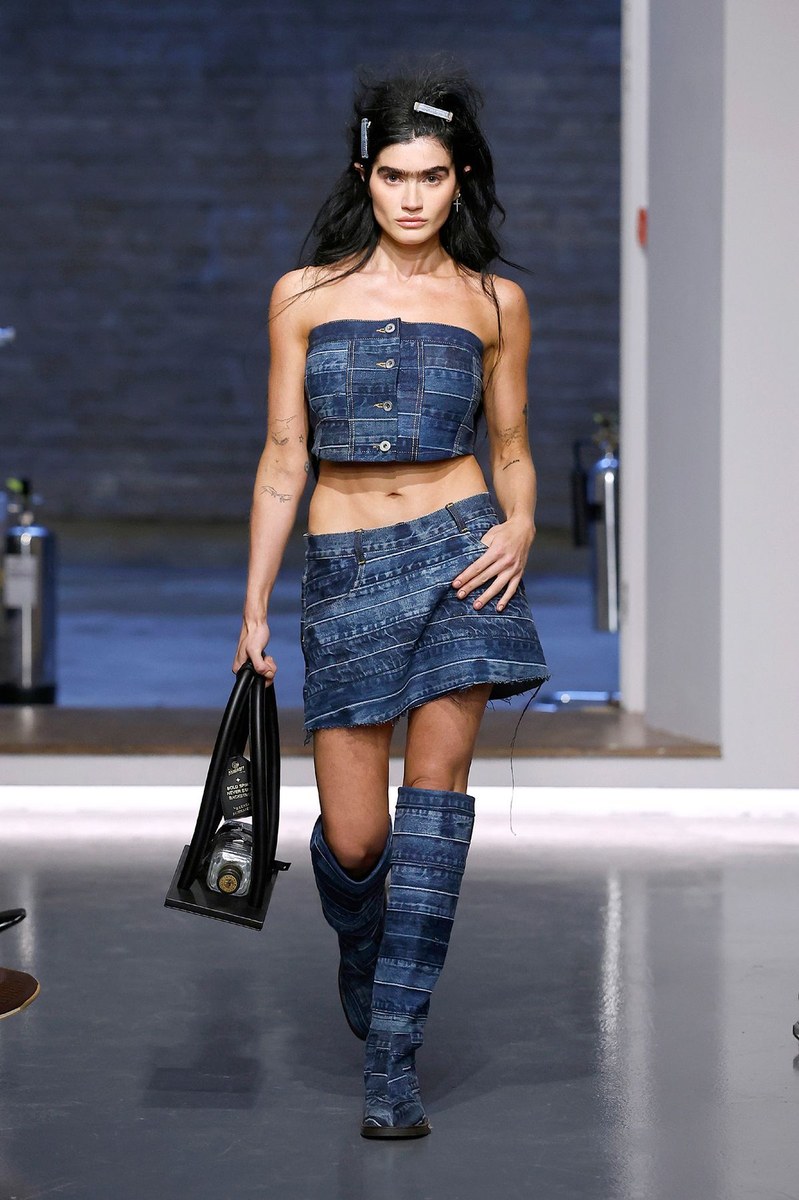
Hair clips, worn in multiples and stacked near the crown, run across nearly every look and function as the collection's single recurring accessory. Footwear splits between white low-top trainers for the casual and knitwear looks and black ankle boots or denim knee boots, the latter appearing only in Look 1 where the boot is itself constructed from the same patchwork denim panels as the top and skirt. Look 15 layers a grey mohair crewneck over a black midi skirt with raw hem, worn over dark indigo denim jeans, producing a deliberate double-bottom effect that will polarize buyers but generates strong editorial pull. The transparent structured bag in Look 1, with a liquor bottle visible inside, and the miniature box bag in Look 15 read as conversation pieces rather than commercial bag propositions.

Look by Look Highlights
Look 1 The full patchwork denim set, strapless top, wrap micro-skirt and knee-high boots all cut from reconstructed denim panels, is the collection's most complete commercial argument for the deconstruction concept as a three-piece buy.
Look 4 The indigo patchwork zip-front cropped jacket paired with matching wide-leg trousers in the same banded fabric makes the strongest case for a coordinated set at a mid-to-upper price point, with the zip front adding practicality that the bandeau looks lack.

Look 5 A strapless button-front mini dress in reconstructed denim, fitted through the bodice and flaring at the hem, is the tightest single-garment edit of the collection's core idea and the easiest piece to position for wholesale.

Look 11 The pale blue denim boilersuit with western-style yoke seaming and a D-ring belt is the most wearable volume piece, translating workwear references into a silhouette that reads as directional without requiring editorial context to sell.
Look 12 The chalk white cotton set with tonal embossed or quilted lettering across the boxy tee and wide trousers operates as a logoless branded statement, giving product managers a graphic hook that avoids seasonal logo fatigue.

Look 17 The ecru denim jacket and wide-leg trouser suit, with contrast topstitching as the only decorative element, is the collection's clearest entry point for buyers who need the aesthetic direction without the construction complexity of the patchwork pieces.

Look 18 The olive and jacquard patchwork three-piece, bralette, oversized jacket and wide trousers with print paneling inset into plain twill, opens a distinct fabrication story separate from denim that buyers can develop as a standalone capsule.
Look 19 The oversized olive cotton anorak-style top with large chest pockets and wide-leg matching trousers is the strongest outerwear-adjacent commercial piece, sitting at the intersection of utility and fashion without leaning too far into either.

Operational Insights
Deconstruction sourcing: Buyers need to identify suppliers capable of producing the patchwork denim cloth at scale, since the banded waistband-and-selvedge construction is the technical core of Looks 1, 3, 4 and 5 and cannot be approximated with standard denim.
Set pricing architecture: Two- and three-piece denim sets run consistently through the lineup, giving retailers the option to price components individually or as coordinated buys, a flexibility that supports both mass and specialty retail channels.
Knitwear as a parallel category: Heavy-gauge blue and white knits in Looks 7 through 10 run as a coherent mini-collection within the show and can be bought and merchandised independently of the denim story without losing coherence.
Gender-fluid merchandising: Looks 2, 7, 9 and 12 were walked by male models in pieces that carry no gender-specific construction, giving style directors a direct argument for placing these in unisex floor sets without remerchandising the buy.
Color discipline: The palette narrows to three anchors, indigo, ecru and olive, which means a tightly edited buy across all three colorways still reads as a coherent floor presentation and reduces markdown risk from over-assortment.
Complete Collection


About the Designer
Born into Ukraine in 1984, Ksenia Schnaider spent her formative years developing an early fascination with design before eventually establishing one of Eastern Europe's most recognized sustainable fashion brands. Together with her husband Anton, a former graphic designer who previously worked for tech giant Yandex, she founded KSENIASCHNAIDER in 2011. Their partnership began serendipitously on a Crimean beach, setting the stage for a creative collaboration that would transform how the fashion world approaches denim construction and upcycling practices.
The brand gained global recognition in 2016 with their asymmetrical demi-denims, a radical reimagining of traditional jeans that fused one skinny leg with a wide leg silhouette. This deconstructed approach to tailoring reflected Schnaider's philosophy of finding beauty in imperfection and transforming mundane materials into unexpected forms. Working from their Kyiv studio, the duo processes approximately 500 pairs of vintage jeans monthly, turning textile waste into everything from patchwork garments to their signature denim fur coats. Their aesthetic draws heavily from Ukraine's visual landscape, with Schnaider often citing the city's chaotic architecture and jarring advertisements as sources of inspiration alongside Ukrainian folk artists like Maria Prymachenko and Kazimir Malevich.
Since Russia's invasion of Ukraine in 2022, Schnaider has been forced to divide her time between the UK and Kyiv, managing production remotely while maintaining her commitment to local manufacturing. The war initially paralyzed her creative process, but encouragement from industry peers helped reignite her design practice. Today, she continues to oversee the brand's operations from both countries, working with a team of approximately 30 people who remain based in Ukraine despite the ongoing conflict.
"Only through true passion can you become the best at what you do," she reflects. "Our work is a blend of art and responsibility. Every piece we create is evidence of the possibilities of sustainable fashion."
✦ This report was generated with AI — combining human editorial vision with Claude by Anthropic. Because the future of fashion intelligence is already here.