Lacoste FW26 Women Looks Report
Paris Fashion Week
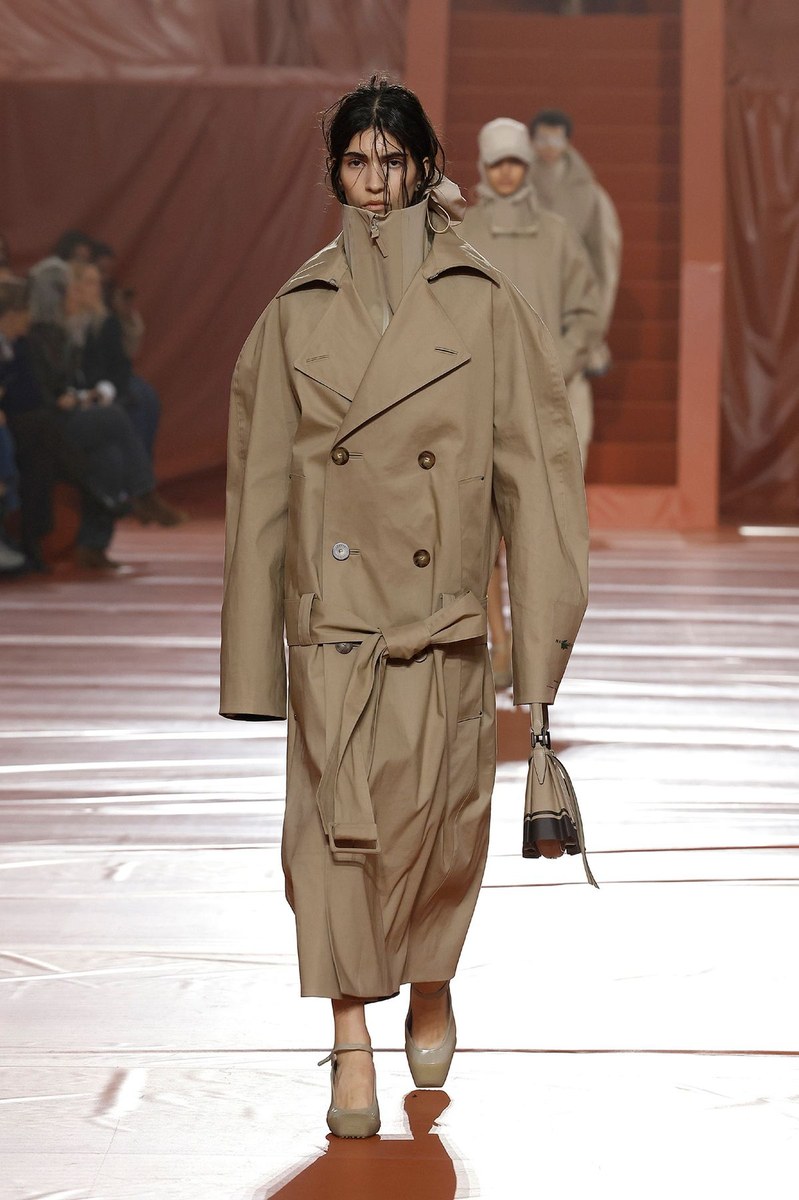
Lacoste FW26 reframes the brand's sportswear DNA through extreme volume, monochromatic dressing and a deliberate collision between tailoring codes and athletic construction. For buyers operating in the premium sportswear and contemporary markets, court heritage anchors a full lifestyle wardrobe without any concession to nostalgia.
Silhouette and Volume
Oversized dominates at every tier. Trench coats, parkas, and outerwear shells balloon to near-architectural proportions in Looks 1 through 7, while cropped knits in Looks 28 and 29 introduce a counterpoint of deliberate compression at the torso. Mid-length pleated skirts recur throughout Looks 19, 20, 22, 25, 34, 36, and 47, grounding the volume above the knee in something structured and wearable. Mass sits at the top, release at the hem, with wide-leg trousers carrying the same generosity through the bottom half whenever skirts are absent.
Color Palette
Three distinct color chapters unfold in strict sequence. Khaki tan opens the show across Looks 1 through 7, building a uniform, clay-court warmth that reads as both utilitarian and considered. A sustained red chapter from Looks 8 through 16 and returning in Looks 38 and 41 uses a single high-saturation red across every category, from leather outerwear in Look 10 to a slim track set in Look 13. Teal and dark navy carry Looks 17 through 37 and 40 through 47 into cooler, more commercial territory, and the finale moves into white from Looks 46 through 54, reading as a full reset, accented only by vivid green accessories in Looks 46, 48, and 51.

Materials and Textures
Two primary fabric categories layer against each other throughout: structured cotton gabardine for the tailored and outerwear pieces, and high-sheen coated nylon for the athletic shells and oversized capes in Looks 6, 10, 35, and 54. Khaki trench coats in Looks 1 and 3 read as stiff and architectural, holding their shape without any internal structure visible at the shoulder. Leather appears in Look 10 for a voluminous red blouson, and patent-finish materials in Look 4 and the red caps throughout the red chapter add surface tension that contrasts with the matte wool blends of the tailored suits in Looks 9, 11, and 32. Translucent coated cotton in Looks 50, 52, and 54 allows layered graphics to read through the outer layer.
Styling and Layering
A zip-neck athletic inner worn beneath a tailored or outerwear shell recurs across the entire collection, visible at the collar in Looks 3, 9, 18, 25, 26, 32, and 40. This creates a consistent product pairing logic with direct implications for retail bundling. Footwear runs almost entirely to two silhouettes: a platform Mary Jane in neutral tones for the women's looks, and a broad-toe flatform trainer in white or tonal colors for the more athletic exits. Structured mini bags in leather and patent finishes dominate the accessories, with the green oversized tote in Look 48 and the black leather duffle in Look 45 representing the volume end of the bag range.

Look by Look Highlights
Look 4 pairs a lacquered red windbreaker printed with "The Lacoste Tennis Club" against a high-waisted khaki circle skirt, making it the most commercially direct women's look in the first half of the show.

Look 10 sends a fully red oversized leather blouson with gathered cuffs over wide red trousers, creating the strongest single-color leather statement in the collection and a clear candidate for a hero product strategy.
Look 13 tightens the red chapter with a slim long-sleeve zip jersey over a red turtleneck and a bias-cut midi skirt in dark burgundy satin, the most body-conscious silhouette of the entire show.

Look 27 functions as a pivotal transitional moment, layering a charcoal double-faced wool coat with a pink lining over red and pink pieces, making the coat's interior color a functional styling device rather than a lining detail.

Look 28 grounds the pink accent color in a cable-knit cropped sweater with green and navy contrast bands, worn over a red turtleneck and a dark navy wrap skirt, producing the most knit-forward buying opportunity in the collection.

Look 36 pairs the teal "Lacoste Tennis Club" windbreaker with a full dark navy A-line skirt in heavy wool, the cleanest sport-meets-tailoring proportion in the teal chapter and a straightforward product for contemporary buyers.

Look 46 opens the white chapter with a floor-length printed shirt-coat over a white midi dress and knee boots, anchored by a vivid green shoulder bag, making green the only color accent against white and a strong accessory investment signal.

Look 54 closes the show with a translucent white coated cotton overcoat printed with "French Cup" graphics that bleed through the fabric, a production-intensive finale piece that communicates the graphic-print direction for the season's hero outerwear.

Operational Insights
Color sequencing: Three chapters, khaki, red, teal and navy, closing in white, map directly onto a tiered delivery strategy. Buyers can build opening-price stories in teal and navy, drive margin in the red leather and outerwear category, and use white as a pre-spring refresh capsule.
Knit opportunity: Looks 28 and 29 introduce a cropped cable-knit with branded stripe detailing that sits outside the dominant outerwear narrative. Strong mainstream commercial potential warrants early-order priority for knitwear departments.
Graphic licensing: "Tennis Tournament 27," "Lacoste Tennis Club," "French Cup," and "Slam Open" graphic systems appear across multiple fabrications and silhouettes. Product managers should clarify which graphics are collection-exclusive and which carry over to licensed or diffusion tiers before committing to print minimums.
Accessory architecture: Bag range spans from palm-sized structured minibags, seen in Looks 5, 22, and 43, to large leather duffles and the oversized green tote in Look 48. Style directors building a full accessories buy should treat the green tote as a statement top-of-range piece and the mini bag as the volume driver.
Footwear alignment: Platform Mary Jane recurs across at least 12 women's exits and represents a consistent house shoe for the season. Buyers should assess whether this silhouette is available for wholesale or functions only as runway styling, as its frequency suggests a deliberate commercial signal rather than a one-off styling choice.
Complete Collection


Fashion Designer

Pelagia Kolotouros grew up in Queens, New York, in a Greek-American household, and her first encounter with Lacoste happened the way most lasting impressions do: unremarkably, in passing. She would walk by a local elementary school and watch kids playing tennis on a crumbling public court, most of them wearing the polo with the crocodile. The image stayed with her. She studied fashion at Parsons School of Design in Manhattan, and while her path into the industry was relatively direct, it would take her through a deliberately wide range of creative environments before she landed on something she could call her own point of view.
Her career reads like a cross-section of the last two decades of American fashion, touching almost every register along the way. She started at Theory in 2008, absorbing a certain brand of clean, cerebral New York sportswear, then moved to Calvin Klein, where she was appointed Design Director for menswear and learned to work within a tradition of refined androgyny. From there she joined the creative orbit of Kanye West at Yeezy, where, as she has described it, the central lesson was to stop censoring the collision of opposites and see what happens. She then served as Global Creative Director of The North Face and later worked on the Adidas collaborations with Ivy Park and Pharrell Williams, where she spent time thinking about how bodies are celebrated across different registers of femininity.
Her references aren't built from the fashion system inward but from the outside in: the particular smell of a New York summer, the sound of old tennis balls on a cracked court, the original 1927 Lacoste crocodile drawn by René's friend Robert George. She describes the crocodile through a lens of productive contradiction, something playful and ferocious at once, and she brings to her collections at Lacoste a sensibility shaped by that tension. Her first runway show for the house, Fall/Winter 2024 at Paris Fashion Week, drew on the spirit of the Années Folles, treating the 1920s not as a period to be replicated but as an emotional frequency. Subsequent collections have moved through archival photographs of René at the seaside, his personal notebooks, and the impressionist notes of someone who lived very close to the intersection of sport and art.
Since February 2023, Kolotouros has served as Creative Design Director of Lacoste, leading the brand's creative studio across all collections and overseeing its collaborative model with external creative communities.
"At that age, things are just imprinted on you, the smell of a New York City summer, the sound of tennis balls being thwacked outside your window."
"I think I learned from Kanye how to take things that are completely opposite and just mash them up. When I think about the crocodile, it's playfulness, but it's ferocious. How do you bring those two aesthetics together?"
✦ This report was generated with AI — combining human editorial vision with Claude by Anthropic. Because the future of fashion intelligence is already here.