Laura Biagiotti FW26 Women Looks Report
Milan Fashion Week
Laura Biagiotti FW26 builds its identity around a compressed palette of burgundy, chocolate brown and burnt orange, anchored in luxurious knitwear, patent leather and velvet across silhouettes that oscillate between fluid volume and architectural restraint. For buyers, the collection arrives at a moment when the market is actively seeking investment-grade casualwear that reads formal enough to justify elevated price points.
Silhouette and Volume
Oversized, dropped-shoulder knit bodies dominate here, worn over wide-cut or split midi skirts to establish a top-heavy proportion that recurs throughout. Long coats in both patent leather and structured wool carry the silhouette outward rather than inward, keeping the body largely concealed beneath generous layering. Evening looks reverse this logic entirely, turning to bias-cut, column or draped gown silhouettes that cling and trail. A clear split emerges between daywear built on volume and eveningwear built on elongation.
Color Palette
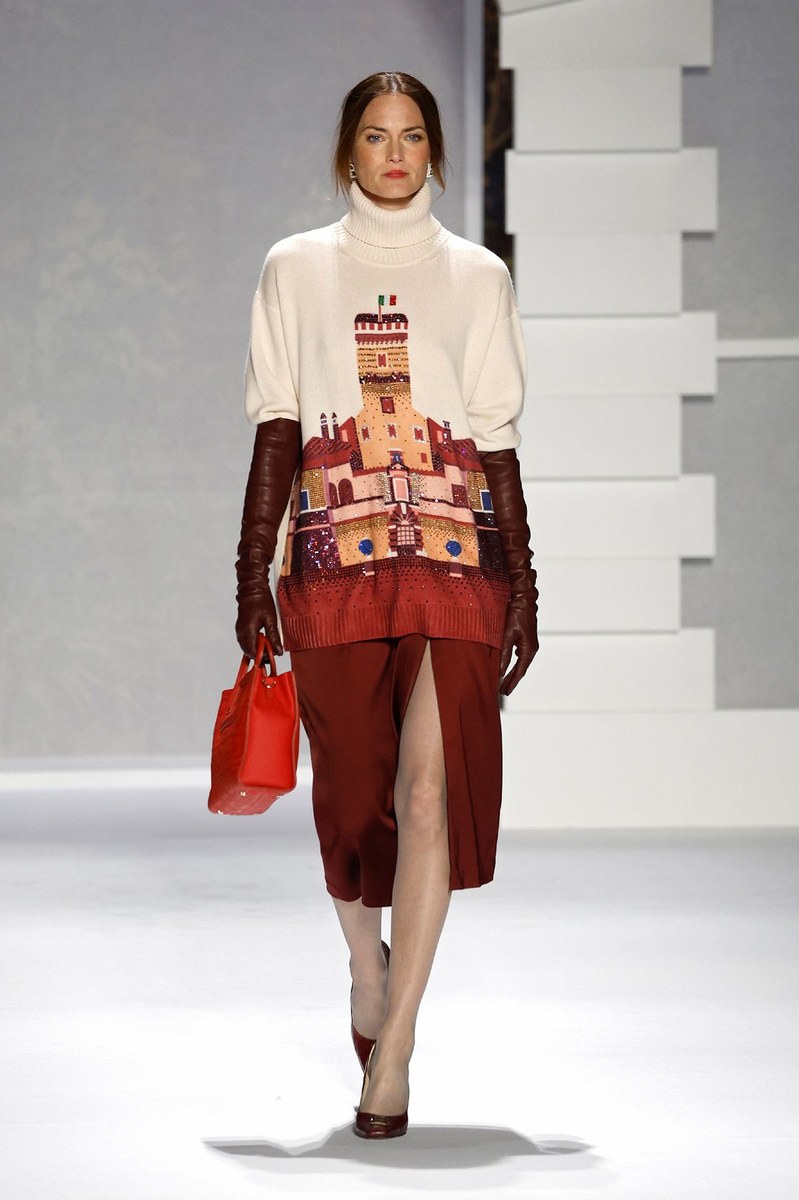
Deep burgundy and dark chocolate brown form the spine, appearing across knitwear, leather outerwear and velvet. Burnt orange enters as a deliberate disruptor in Looks 15, 17 and 18, pairing against brown tones without conflict. Cream and oatmeal provide breathing room, most legibly in the castle-motif sweaters of Looks 1, 3 and 20. Red, whether in lipstick-bright silk or scarlet jersey, closes out the eveningwear arc with high contrast against the otherwise earthy ground.
Materials and Textures
Knitwear dominates the daywear segment, ranging from dense cable-knit in Look 18 to fine-gauge ribbed constructions in Look 2 and open pointelle in Look 12. Patent and croc-embossed coated leathers appear in Looks 3, 6 and 10, carrying a high-gloss surface weight that reads premium at retail. Velvet covers the mid-tier evening category, whether in the lightweight crushed register of Look 15 or the heavier stretch of Look 16. Silk charmeuse in Look 4 and silk chiffon in Look 9 handle the lightweight eveningwear slot, with Look 9 layering sheer over opaque for depth without added bulk.

Styling and Layering
Most daywear looks build through a core-knit-plus-outerwear logic, so a turtleneck or oversized sweater sits beneath a coat or cape rather than standing alone. Long leather gloves in Looks 1 and 10 add a distinctly theatrical arm extension that lengthens the silhouette and double as an accessory statement. Footwear splits cleanly between knee-high boots in brown leather, flat loafer-style slides carrying the brand monogram, and block-heel pumps in matching fabric for evening. Structured, mid-sized bags represent the strongest commercial accessory propositions, particularly the cream croc-effect tote in Look 12 and the compact burgundy box bag in Look 8.

Look by Look Highlights
Look 1 The cream turtleneck sweater embroidered with the Biagiotti castle in needlepoint-style intarsia, styled over a burgundy split midi skirt with long chocolate leather gloves, is the collection's signature piece and strongest wholesale story.

Look 2 A head-to-toe burgundy and dark red marled cable-knit co-ord, belted at the waist with a matching leather strap, demonstrates that knitwear sets at elevated price points can carry their own formal authority without outerwear.

Look 6 The dark chocolate croc-embossed patent trench coat, belted and worn over wide oatmeal knit trousers, is a unit driver for outerwear buyers and the most immediately repeatable commercial coat in the lineup.

Look 9 A forest green to dark teal silk chiffon gown with layered ruffle tiers and a plunging V neckline reads as a strong evening option for department store buyers building a formal floor with non-black alternatives.

Look 13 The dark chocolate fringe-and-feather cocktail dress, fitted to the knee with a cap sleeve, is the collection's sharpest single piece for the special occasion market and requires almost no additional styling to land on the floor.

Look 16 A deep brown velvet dress with bateau neckline, blouson sleeves and a narrow square-buckle belt operates as a midseason reorder candidate, sitting between daywear ease and evening formality.

Look 19 The copper satin cape dress with mandarin collar, front button placket and cascading ruffled high-low hem is a statement piece built for editorial placement and trunk show traffic rather than broad distribution.

Look 14 The oatmeal donegal tweed double-breasted blazer and matching pencil-skirt suit, worn with white knee boots and a gold sequin sweater beneath, targets the professional womenswear buyer looking for a non-black suiting anchor with tonal accessories.

Operational Insights
Knit investment Knitwear runs through at least eight looks, covering everything from basic turtlenecks to the intarsia castle sweater. Buyers can build a knit-only capsule from this collection alone without relying on outerwear or eveningwear SKUs.
Outerwear depth Three distinct outerwear codes appear, patent leather long coat, croc-embossed short trench and full-length fur coat, giving style directors at multi-brand retailers the flexibility to select by climate zone and price tier without duplication.
Color continuity The burgundy-to-chocolate-to-burnt-orange gradient allows visual merchandisers to floor the collection as a single color story without breaking it into separate deliveries, reducing markdown risk on cross-category groupings.
Evening entry point Looks 4, 9, 11 and 13 cover four distinct evening moods, from draped silk to fringed cocktail. Formal floor buyers can select a narrow two-piece edit that still reads as a complete evening story in-store.
Accessories readiness The structured bags and branded flat slides appear consistently enough across the runway that accessories buyers can treat them as standalone category entries rather than styling props. The monogram loafer particularly surfaces in at least four looks, making it a strong wholesale proposition.
Complete Collection


About the Designer
Lavinia Biagiotti Cigna was born in Rome on October 12, 1978, into what she has called the third generation of a pioneering family business. Her grandmother Delia had been orphaned at fourteen in 1928 and had worked her way up from seamstress to atelier owner, eventually designing the Alitalia uniforms in 1964. Her mother Laura took that atelier and turned it into one of the most internationally recognized names in Italian fashion, building a career that earned her the title "Queen of Cashmere" from the New York Times and made her the first Italian designer to show in China and Moscow. Lavinia grew up inside that world as a matter of daily life, visiting the fitting rooms as a child and absorbing the mechanics of the business before she had any formal role in it. She had considered studying medicine, but the trajectory of her life changed irrevocably in 1996 when her father Gianni Cigna, the business mind of the operation, died suddenly when she was seventeen. In her last year of high school she began working alongside her mother, first making photocopies and attending to clients in the fitting rooms, and never left.
She has described her entry as instinctive rather than calculated, a desire not to leave her mother alone more than a career decision. What she found in those early years was that the fitting room was a graduate education in itself. Watching women of different builds and ages interact with the clothes taught her what the collections needed to do beyond the runway: make a woman feel protected and luminous at the same time, to use her own phrase. She moved through the creative and financial sides of the company simultaneously, acquiring the kind of dual fluency that her parents had divided between them. When Laura Biagiotti died in May 2017, Lavinia assumed the presidency and CEO role, took on the creative direction of the collections, and has been leading the brand ever since from the eleventh-century Castello di Marco Simone in Guidonia, outside Rome, which functions simultaneously as family home and company headquarters. She shows in Rome's most significant public spaces, including the Piazza del Campidoglio, the Ara Pacis museum, the MAXXI, and the Centrale Montemartini.
Her inspirations are inseparable from the city she lives in and the materials her mother made central to the brand: cashmere above all, alongside natural fibers, and the deep relationship between fashion and Rome's layered history of art and architecture. She is co-founder of the Biagiotti Cigna Foundation, which owns more than three hundred works by the Futurist painter Giacomo Balla, and has sponsored the restoration of the Cordonata staircase of the Campidoglio, the Piazza Farnese fountains, and the great curtain of La Fenice in Venice. In July 2025, the company celebrated its sixtieth anniversary, entirely family-owned and still based in Rome.
"It was instinctive and natural. I had always seen my parents as a very solid couple and I did not want my mother to be alone. I wanted to become her copilot."
"Working in the fitting rooms helped me learn what women want and what they need. What looks good on the catwalk is not always easy for the average woman; you have to make her feel beautiful."
✦ This report was generated with AI — combining human editorial vision with Claude by Anthropic. Because the future of fashion intelligence is already here.