Loewe FW26 Shoes
Loewe FW26 Shoes Report
Loewe FW26 commits to a single, obsessively developed kitten-heel slingback silhouette built around a rubber-capped toe, a Velcro strap with embossed logo branding, and a scooped slingback cut, executed across at least a dozen colorways and two material registers. For buyers and product managers, this signals a deliberate platform strategy: one hero last, maximum colorway breadth, and a clear anchor piece that can carry the brand's footwear business across a full season.
Silhouettes and Construction
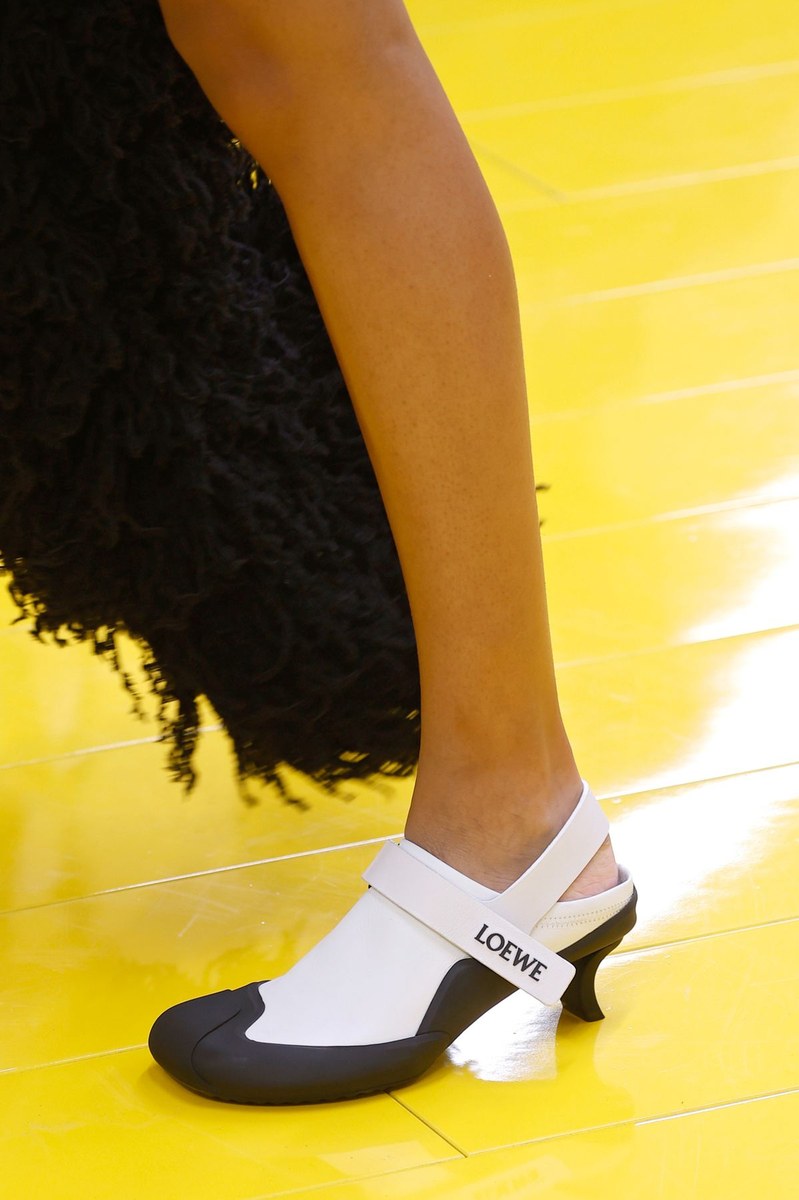
The dominant silhouette is a closed-toe, low kitten heel slingback sitting at approximately 5 to 6 centimeters, with a softly rounded, bulbous toe box that terminates in a hard rubber cap extending up and over the toe. A slender, column-shaped kitten form comprises the heel, with a slightly flared base on several pairs and a more tapered, geometric profile on others, most visibly compared between Shoe 3 and Shoe 16. A wide, flat Velcro strap crosses the midfoot and anchors the construction at the instep, replacing a traditional vamp or lacing system entirely. Shoe 14 breaks from this pattern with a flat ballet silhouette featuring a ribbon tie closure. Shoe 7 stands alone as a tall rubber Wellington boot. Both confirm that the kitten slingback is the collection's commercial center of gravity.
Materials and Finishes
Most slingback styles layer two material languages: a smooth, structured leather upper in white forms the midfoot panel and Velcro strap, while a molded rubber shell wraps the toe cap, sole unit, and heel in a contrasting color. Suede upper panels appear on Shoes 6, 10, 13, and 15, replacing the leather mid-section with a matte, napped finish and deepening the color saturation on the brighter accent tones. Rather than a cemented or stitched construction, the rubber sole unit reads as a single molded component, giving the toe cap and platform a cohesive, almost protective quality. Shoe 7 uses translucent gradient rubber throughout its Wellington shaft, a distinct technical material choice that separates it from the rest of the lineup.
Color Direction
Black and white two-tone dominates and appears across Shoes 1, 2, 3, 5, 8, 9, 11, and 17, with the rubber shell always in black and the leather mid-panel in white. Accent colorways push into saturated brights: electric purple suede in Shoes 6 and 13, vivid orange suede in Shoe 15, acid yellow and cobalt blue in Shoes 12 and 18, and the gradient orange-to-red Wellington in Shoe 7. All-black monochrome versions in Shoes 4, 16, and Shoe 10's dark brown suede provide commercial depth options for buyers who need range flexibility without committing to color. Primary-influenced and graphic, the palette as a whole reads as a strong indicator for SS carry-over potential in the brights and year-round viability in the black-and-white base.
Key Models and Details
The hero model is a kitten-heel rubber-and-leather slingback with a wide Velcro closure strap embossed or printed with the Loewe wordmark in a serif typeface, positioned at center front of the strap for maximum visibility at the instep. Across the entire slingback lineup, the branding treatment remains consistent, making the strap the primary logo vehicle rather than a sole stamp or lining label. Shoe 14 introduces a second distinct model: a flat rubber-soled ballet with a thin rope or cord tie at the vamp in a black-and-white colorway, which reads as a lower price-point or secondary silhouette entry. Carrying the Loewe wordmark debossed directly into the shaft, the Wellington boot in Shoe 7 demonstrates that the brand's branding system works across multiple construction types without relying on applied hardware.
Shoe by Shoe Highlights
Shoe 1 The clearest hero reference shot shows the full Velcro strap construction, rubber toe cap, and white leather mid-panel in sharp detail. It makes the strongest image for range planning documentation.

Shoe 3 A two-pairs-on-floor angle confirms the heel geometry from multiple points of view, critical for last approval and heel attachment verification before production sign-off.

Shoe 6 Purple suede and black rubber combine in the most directional colorway in the lineup. The suede nap creates a strong tactile contrast against the molded rubber shell that specialty retail buyers will find commercially viable.

Shoe 7 Standing as the collection's single construction outlier, the gradient orange Wellington is a translucent rubber boot with a debossed logo on the shaft that opens a separate wholesale conversation from the slingback range entirely.

Shoe 12 Acid yellow and cobalt blue pair on a bare leg to create the highest-impact color contrast in the collection. The absence of hosiery confirms that this colorway is designed to read as a standalone statement against skin rather than layered styling.

Shoe 14 A flat ballet with cord tie represents the only non-heeled, non-boot silhouette in the lineup, a low-resistance entry point for customers who want the brand's rubber-cap construction language without a heel. It's a strong candidate for gifting or entry-tier positioning.

Shoe 18 Yellow ribbed knee sock styled inside the yellow-and-blue slingback creates a tonal sock-shoe moment that buyers should note as a bundling or shop-the-look opportunity, particularly for accounts with strong accessories or hosiery business.

Shoe 10 Dark brown suede panel with near-black rubber shell delivers the most understated colorway in the range. Likely the strongest performer in European wholesale accounts that trend toward tonal, low-contrast palettes in footwear.

Operational Insights
Last consolidation: The entire slingback lineup appears to share one last, which reduces tooling costs significantly. Buyers and product managers should confirm with Loewe whether all rubber-cap styles run on a single last to assess MOQ flexibility across colorways.
Velcro closure durability: As the primary closure system and branding vehicle simultaneously, the wide Velcro strap demands attention from QA teams. Hook-and-loop cycle testing should be prioritized, and the embossed or printed wordmark must survive repeated wear without degrading, since the strap is the most visible branded element on the shoe.
Colorway phasing: Black-and-white base and all-black monochrome options provide safe open-buy candidates, while the brights, specifically purple, orange, yellow, and blue, are better suited to forward-order or pre-sell given their trend dependency and narrower customer base.
Rubber sole unit sourcing: The molded rubber toe cap and sole appear to be a single unified component rather than a cemented assembly, pointing toward injection molding or compression molding rather than traditional shoe construction. Buyers sourcing for private label or licensed product should factor in longer tooling lead times if replicating this construction approach.
Secondary silhouette opportunity: Shoe 14's flat ballet with cord tie and Shoe 7's Wellington represent two silhouette categories outside the hero slingback. Retail buyers with footwear floors broad enough to support a full brand story should consider requesting both as depth options rather than treating the collection as a single-silhouette buy.
More Shoes
More Shoes
More Shoes


✦ This report was generated with AI — combining human editorial vision with Claude by Anthropic. Because the future of fashion intelligence is already here.