Loewe FW26 Women Looks Report
Paris Fashion Week
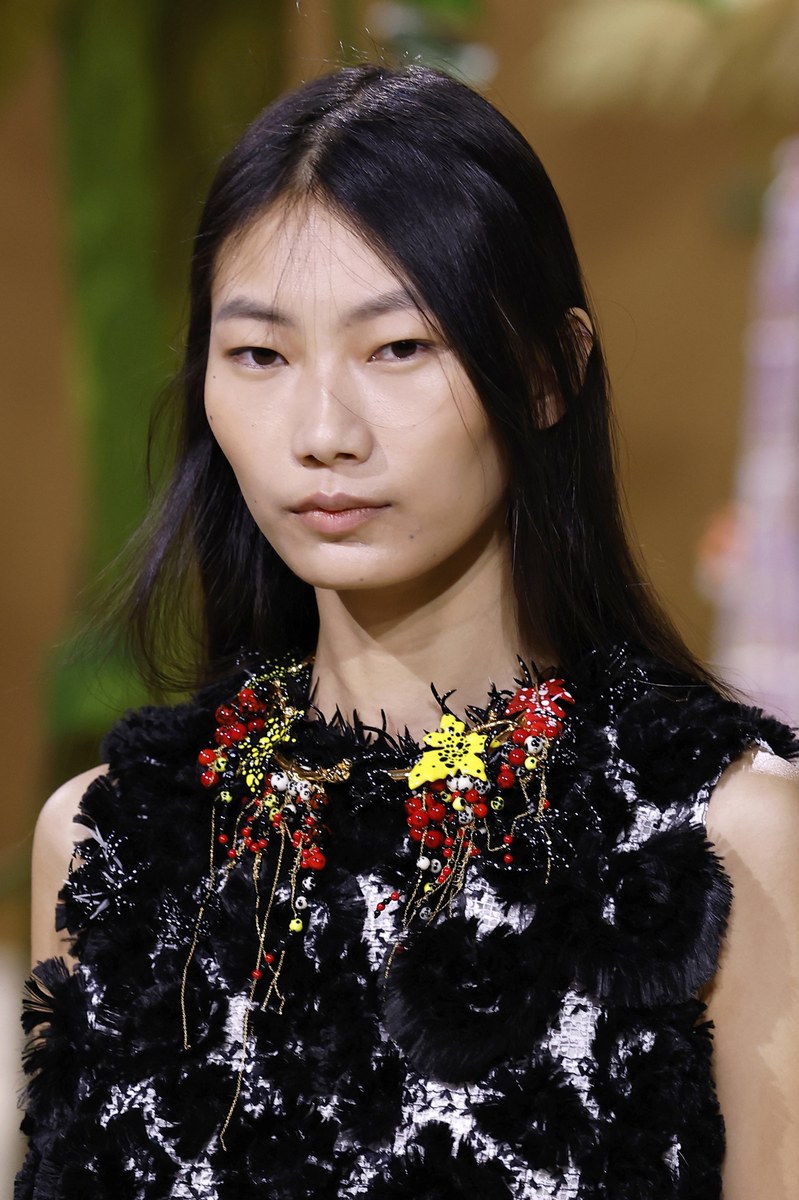
Loewe FW26 collapses the boundary between utility outerwear and sculptural textile art, running fringed, shearling, and plissé constructions through both menswear and womenswear silhouettes on a single runway. For buyers, this signals a deliberate push toward gender-neutral product lines that carry high visual drama without relying on embellishment in the traditional sense.
Silhouette and Volume
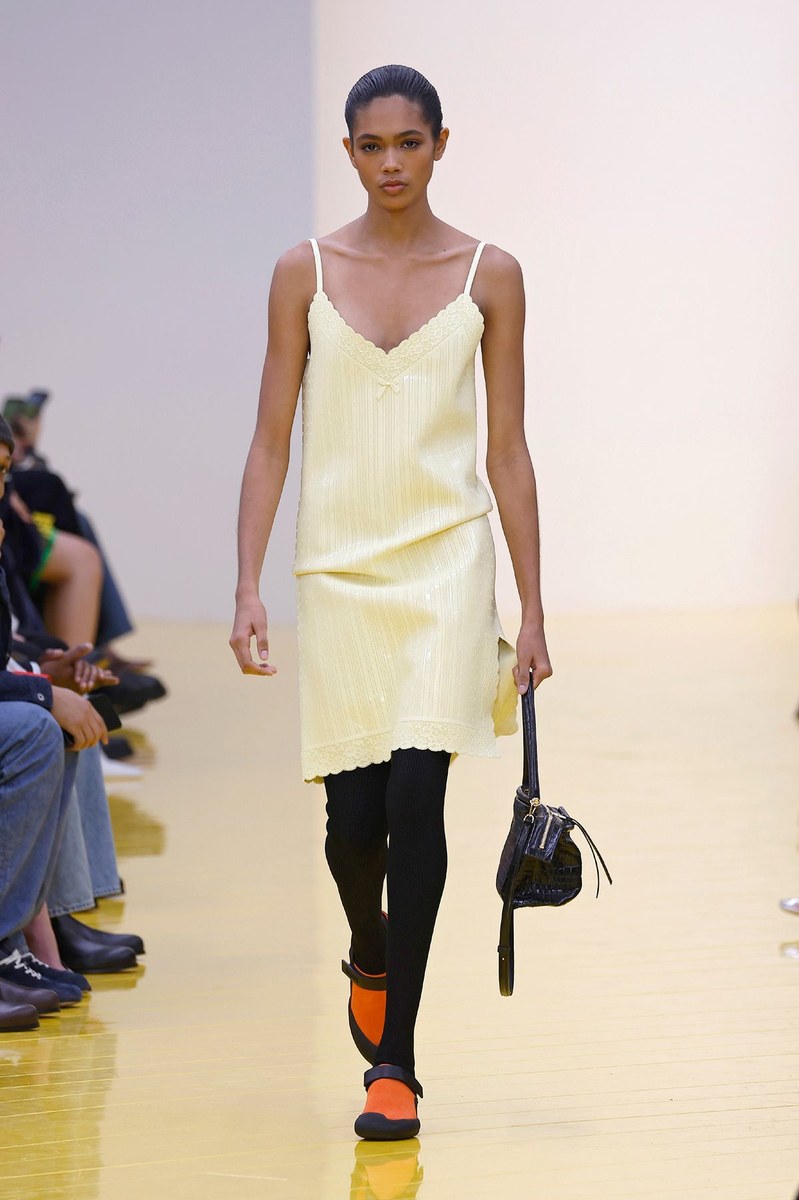
Body-skimming plissé slip dresses cut just above the knee anchor one end of the spectrum (Looks 1, 4, 58, 64), while dramatically oversized outerwear capes and coats with quilted, gingham-lined hems that balloon outward as the model walks occupy the other (Looks 40, 41, 63, 65). Waists disappear entirely in the cocoon shearling jackets (Looks 2, 8, 22), or get deliberately exposed, as with the tartan bandeau tied at the chest in Look 43. Fringe and shaggy-texture dresses (Looks 17, 19, 50, 52, 54, 56) read more as sculptural objects than garments, their hemlines dissolving into trailing tendrils. Menswear-adjacent cuts appear without modification on women, particularly the wide-leg corduroy trousers and boxy ribbed pullovers.
Color Palette
Acid yellow anchors the collection from the runway floor upward. It appears in latex-look trousers (Look 5), a head-to-toe ribbed coat and skirt (Look 7), and as recurring tight and sock accents across at least twenty looks. Saturated brights punch through the lineup: cobalt blue (Look 14), electric violet (Look 17, 34), neon orange (Looks 21, 31, 38), and vivid red (Looks 4, 31). Against these, the collection's quieter naturals settle in: oat white (Looks 18, 46), tobacco corduroy (Looks 3, 51), and warm toffee shearling (Looks 20, 22). Deep espresso brown functions as the collection's neutral anchor, appearing in at least eight looks across fringe dresses, shearling, and suiting. Pairing black garments with single-color opaque tights in orange, yellow, or red (Looks 26, 30, 33) creates deliberately graphic, almost sportswear-coded energy.

Materials and Textures
Plissé, a heat-set micro-pleated fabric with a wet, slightly reflective surface, defines the slip-dress category and cropped pullovers (Looks 1, 3, 4, 58, 62, 64), reading as simultaneously lingerie-adjacent and technical. Shearling presents in two registers: the flat, short-pile sueded face used for the ombré jackets (Looks 2, 8, 22, 48) and the longer, looser curl pile used for collars, cuffs, and trim throughout. Fringed capes (Looks 9, 31, 49) appear to use cut rubber or dense knit strips rather than woven fringe, giving them a heavy, matted quality that reads closer to thatching than textile. Woven boucle-adjacent tweeds in brown-and-white and red-and-yellow (Looks 23, 25) contrast sharply with the draped, fluid satin-weight fabrics in the strapless asymmetric dresses (Looks 30, 32, 33).
Styling and Layering
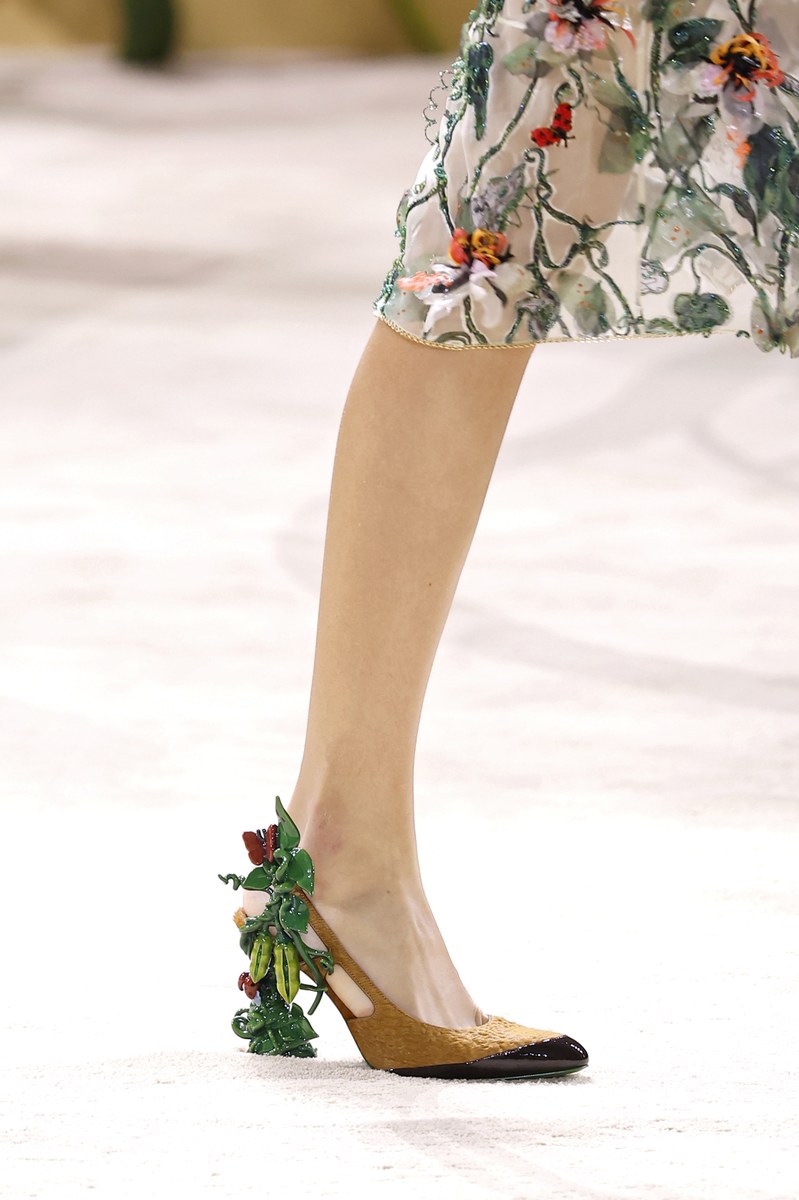
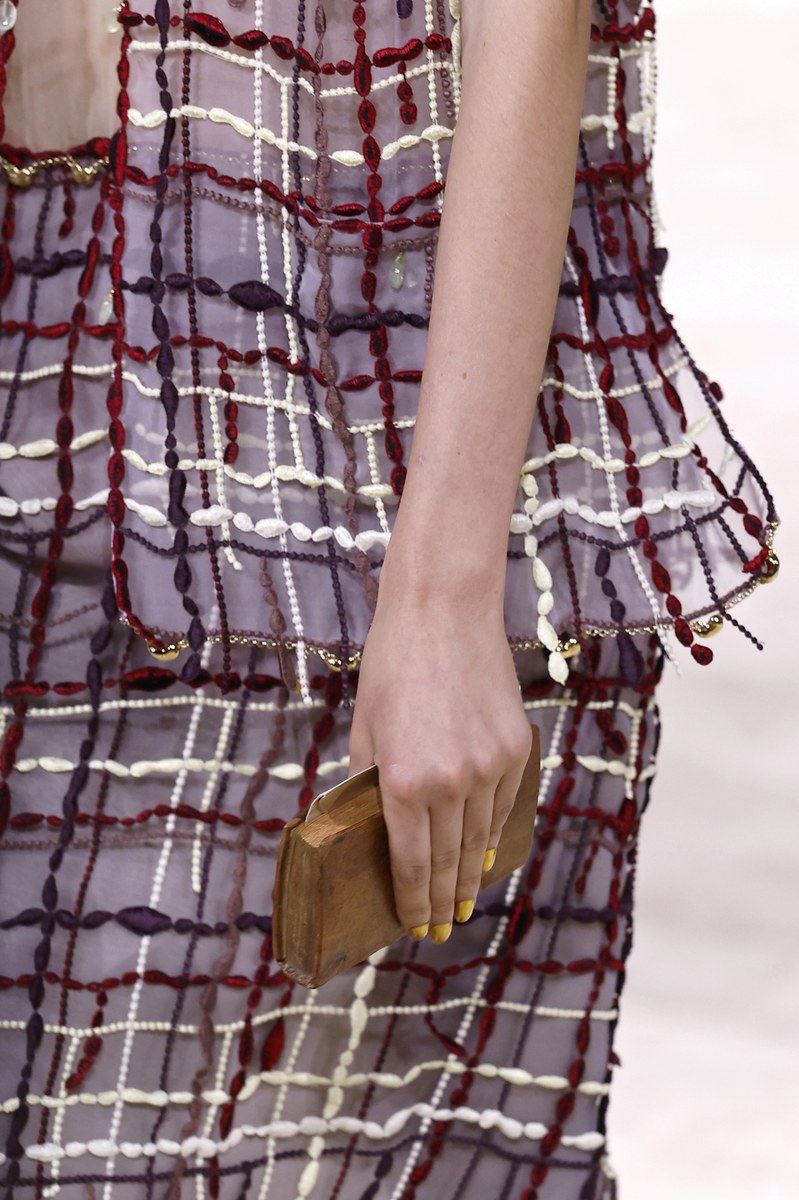
Bold, opaque colored tights paired with the signature two-tone molded Mary Jane flat form the collection's defining styling move. This shoe appears in black-and-white, black-and-orange, black-and-yellow, and black-and-red configurations across the entire show, functioning as the collection's connective tissue and tying menswear, womenswear, outerwear, and eveningwear into a single visual language. Hood-within-hood layering, an interior nylon hood worn under an outer shearling or structured collar, appears in Looks 5, 20, 22, 27, and 29, creating a stacked neckline that photographs as architecture. Bags are carried by hand rather than worn, with the house's saddle-adjacent structured styles (Looks 6, 22, 36) appearing alongside softer drawstring fur pouches (Look 43) and large sportswear totes (Looks 35, 37, 57).
Look by Look Highlights
Look 7 delivers the strongest single-color story in the collection, pairing a ribbed lemon-yellow coat with a matching skirt and inner hood. It makes the clearest commercial argument for monochrome dressing in a statement hue.

Look 9 sends a full-length black rubber-fringe cape over a matching hood, creating a silhouette with zero visible construction detail and maximum retail impact for buyers seeking conversation-piece outerwear.

Look 17 presents a violet loop-knit fringed dress with a spiraling hem that extends into a floor-trailing panel. This reads as the most technically demanding piece in the womenswear lineup and a clear candidate for editorial and VIP placement.

Look 23 cuts a structured sleeveless top and asymmetric mini skirt in brown-and-white boucle tweed with strong shoulder padding, producing a daytime-to-evening piece that translates across multiple retail contexts.

Look 40 pairs an oversized single-button grey wool coat with a navy gingham quilted underskirt that billows from the coat's open hem. The quilted lining acts as the garment's visual payload when the coat moves.

Look 46 wraps a cream neoprene-weight coat in a self-fabric inflated bow at the collar that obscures the lower face. This marks the most extreme volume proposition in the outerwear category and signals to buyers planning installation-level window display.

Look 50 uses dense white ostrich-like fringe across a sleeveless column dress paired with orange tights and the signature black-and-orange Mary Jane, translating a craft-heavy construction into a wearable, colorblocked evening look.

Look 54 builds a strapless top from hundreds of looped green beaded or rubberized strands that fall unevenly to mid-thigh. It produces a piece that sits between jewelry and garment and requires minimal additional styling investment at retail.

Operational Insights
Footwear dependency: The two-tone molded Mary Jane flat drives visual coherence across all 65 looks. Buyers should treat it as a mandatory cross-buy alongside any apparel selection, as the shoe actively completes the colorblocking logic of individual garments.
Shearling volume: At least eight distinct shearling or shearling-trim styles appear across both genders. Buyers should note the ombré dyeing technique (dark crown to light hem) as the differentiating production detail, and confirm lead times and dye-lot consistency early.
Colorblocking via hosiery: Opaque tights in yellow, orange, and red function as a design element rather than an accessory afterthought. Style directors building floor sets or lookbooks should source tight colors to match the specific Loewe palette rather than approximate, as the contrast ratios are tight.
Gender-neutral carry-over: At least twelve silhouettes, including the corduroy trouser, the ribbed plissé pullover, and the gingham blouson, appear on both male and female models without modification. Product managers can plan mixed-gender floor presentation without requiring separate buys.
Textile statement pieces: Rubber-fringe capes (Looks 9, 31, 49) and the beaded strand top (Look 54) carry the highest production complexity in the lineup. Buyers prioritizing these for key-item status should place orders early and plan for limited depth, positioning them as traffic-driving hero pieces rather than volume drivers.
Complete Collection


Fashion Designer

Jack McCollough grew up in New Jersey after spending his early childhood in Japan, a displacement he described as a culture shock that never quite resolved itself. Before landing at Parsons School of Design in Manhattan, he had studied at the San Francisco Art Institute and put in time learning glassblowing, a craft detour that says something about where his instincts were pointing. Lazaro Hernandez came from a different angle: raised in Miami, he had enrolled in pre-med at the University of Miami before abandoning it for fashion, seduced early by the physical reality of design rather than the abstract promise of medicine. They met at Parsons around 1999, and it was immediately clear that something more durable than a school friendship was forming.
Their entry into the industry is one of the genuinely clean origin stories fashion still tells. They persuaded their professors to let them collaborate on a joint senior thesis, produced a collection, and named it after their mothers' maiden names: Proenza and Schouler. Barneys New York bought the entire thing before they had graduated. Lazaro, during this same period, had passed a note to Anna Wintour on a plane pitching himself as a devotee of her work; two weeks later, an internship at Michael Kors materialized. From that standing start, they spent twenty-three years building Proenza Schouler into a pillar of American fashion, collecting five CFDA awards along the way and launching the PS1 bag, which became one of the few accessories of its era to actually warrant the word "iconic."
Their references have always been more art-room than archive. Jack has cited Helmut Lang as the designer who shaped his teenage understanding of what clothes could be, drawn to the way Lang walked away from his own success at its height and remade himself entirely. Lazaro keeps returning to the late Christian Dior collections from 1957, studying the decade-long arc of a silhouette that began with a cinched waist and ended in total liberation. Donald Judd appears in conversation as a shared touchstone. What they built at Proenza Schouler reflected all of this: clean structural intelligence cut through with something harder to name, a downtown instinct that resisted the predictability of uptown polish.
In April 2025, after stepping down from Proenza Schouler, the couple relocated from Brooklyn to Paris to take over as creative directors of Loewe, succeeding Jonathan Anderson and assuming responsibility for womenswear, menswear, leather goods, and accessories. They presented their debut Spring/Summer 2026 collection for the house in October 2025.
"We were itching for a new chapter. We'd been in New York since we were 18 years old, and we just really did that chapter and had some of the most cherished moments in our lives. But we were ready for something new."
"It is two worlds coming together. If either of us had gone independently in our own direction without having the other side, it gives the work the subversive twist that we love."
✦ This report was generated with AI — combining human editorial vision with Claude by Anthropic. Because the future of fashion intelligence is already here.