Lueder FW26 Details
Lueder FW26 Details Report
Lueder FW26 builds its accessories and detail language around subcultural collision, splicing heavy metal graphics, athletic construction, and deconstructed tailoring into a single coherent wardrobe system. Buyers sourcing for Gen Z and post-streetwear demographics will find direct commercial signals here, particularly in the graphic appliqué work, the reimagined hosiery pairing, and the balaclava-adjacent headwear.
Category Overview
Three categories dominate the detail shots: dress details, eyewear, and headwear. Dress details carry the most narrative weight, moving across pinstripe mini skirts with red contrast topstitching, satin bomber shells covered in mismatched utility patches, ribbed knit separates with open shoulder seaming, and hooded jersey layering. Eyewear appears in one tight shot, Detail 8, functioning as a tone-setter rather than a volume category. Headwear splits between soft ribbed hoods and a structured mesh cap with a black zip-off neoprene neck guard in Details 9, 10, and 11, signaling that this element is functional armor as much as styling.
Material and Construction
Pinstripe suiting cloth, ribbed cotton jersey, liquid-finish satin, and open-structure mesh all appear across the dress details, each treated with visible raw edges or exposed seaming rather than clean finishing. Red topstitching on the pinstripe mini in Detail 7 reads as a direct denim-construction reference applied to suiting weight fabric. Detail 5 layers mismatched patch fabrics, including khaki canvas, woven jacquard, mylar-finish tape, and what appears to be embroidered military cloth, onto a coral-red satin base without any attempt to unify their edges or textures. Combining a pale grey mesh cap with a black ribbed zip-front neck panel, the balaclava piece in Detail 10 uses a hardware-forward closure that will require specific sourcing decisions for any production adaptation.

Color and Finish Direction
Black and white ground the dominant palette, visible in the pinstripe separates, ribbed knits, and jersey hoodies. Coral red and saturated red appear as the collection's primary accent, visible in the satin bomber of Detail 5, the contrast shorts of Detail 6, and the topstitching throughout Detail 7. Warm red-orange woven ribbon trim running alongside dual zipper tracks in the graphic hoodies of Detail 2 adds a craft-market warmth that cuts against the otherwise cold black base. Metallic mylar strips in Detail 5 provide the only high-shine moment outside of the satin ground itself.

Key Pieces and Details
Most commercially transferable across the detail set is the pinstripe asymmetric skirt, readable in Details 1 and 7. Its low-rise cut, red contrast topstitching, and asymmetric hem length give buyers a clear product story that sits between tailoring and denim-influenced separates without requiring specialist manufacturing. Editorial value lives in the patch-covered satin bomber of Detail 5, and while direct production replication is complex, the individual patch motifs, particularly the circular logo badge and the barcode-strip woven tape, are licensable graphic directions worth tracking. For accessories buyers working in the performance-adjacent or techwear space, the zip-neck mesh cap in Detail 10 is the headwear buy to watch.
Detail by Detail Highlights
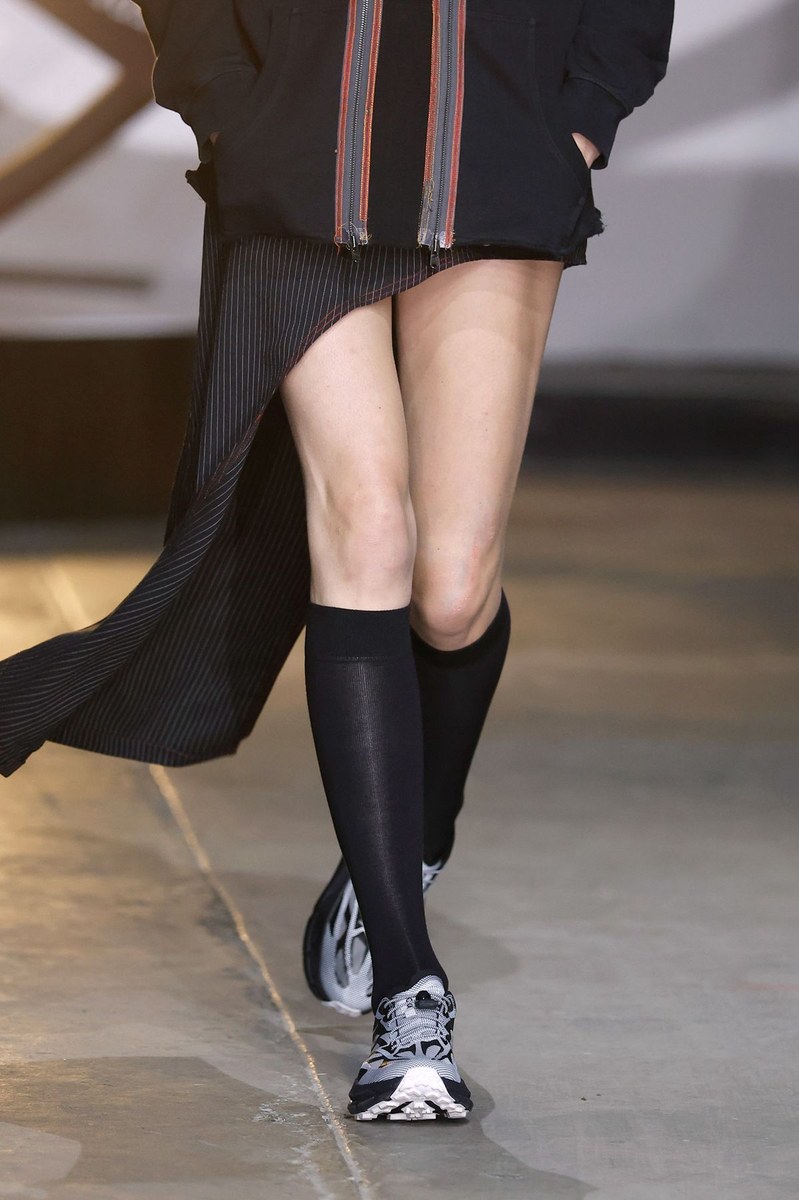
Detail 1 (Dress Detail) The asymmetric pinstripe hem, worn mid-thigh on one side and dropped low on the other, is styled over black knee-high compression socks and grey chunky trainers, locking in a proportional language that connects tailoring to athletic hosiery.

Detail 2 (Dress Detail) Two parallel red-orange woven ribbon trims run the full length of double zip tracks on a black graphic hoodie, with the ribbon appearing to be hand-applied or loosely stitched rather than machine-finished, creating a deliberately imprecise surface quality.

Detail 3 (Dress Detail) A white cotton T-shirt carries an oversized black outline appliqué of gothic lettering, cut in a rough irregular silhouette and stitched only at the edges, so the interior letter forms remain unbacked and slightly raised.

Detail 4 (Dress Detail) A white ribbed tank displays a large red-on-black gothic script appliqué patch reading "Lueder," with the patch itself cut in a melting or dripping border shape and the red outline stitched in tight satin stitch against a black felt or woven ground.

Detail 5 (Dress Detail) The coral satin bomber shell carries at least eight distinct patch types in khaki, grey, black, and mylar finishes, positioned asymmetrically across the chest with no attempt at grid alignment, a deliberate anti-curation logic that reads as archive or vintage accumulation.
Detail 7 (Dress Detail) The pinstripe low-rise mini skirt uses red topstitching at every seam line including pocket mouths and waistband, a construction choice that recontextualizes denim workwear stitching within formal suiting fabric weight.
Detail 8 (Eyewear) Narrow rectangular black acetate frames with flat dark lenses sit low on the nose against the red satin bomber, a silhouette that references late-1990s micro-frame shapes without the oval softness of that era.
Detail 10 (Headwear) A pale grey open-weave mesh cap with visible seam lines connects to a black ribbed neoprene or jersey neck panel that closes with a silver metal zipper pull, creating a hybrid between a swimming cap, a balaclava, and a cycling collar.

Operational Insights
Graphic appliqué sourcing: Letter-form appliqués in Details 3 and 4 require vendors with cut-and-sew patch capability in both woven and felt substrates. Audit current patch suppliers for capacity to handle irregular, non-rectangular outlines before placing production orders.
Topstitching as brand language: Red contrast topstitching in Detail 7 is a low-cost, high-visibility detail that product managers can apply across a tailoring range without significant material cost increase. Thread color selection will be the primary variable to control across SKUs.
Hosiery as category extension: Knee-high black compression socks in Detail 1 position themselves as an integral styling component of the skirt look. Consider whether socks belong in the owned assortment or in a curated third-party partnership for the season.
Patch hardware complexity: Mixed-media patches in Detail 5 include eyelets, fabric-wrapped buttons, and what appear to be woven ribbon elements, each requiring separate sourcing streams. Map each patch type individually before costing any bomber-adjacent styles.
Headwear construction crossover: Detail 10 requires at least two distinct material vendors, mesh cap fabric and ribbed neoprene or jersey for the neck panel, plus metal zipper hardware. Accessories directors evaluating this piece for retail should build a three-vendor sourcing model and confirm zipper gauge compatibility with the ribbed panel weight before sampling.
More Details


✦ This report was generated with AI — combining human editorial vision with Claude by Anthropic. Because the future of fashion intelligence is already here.