Lueder FW26 Shoes
Lueder FW26 Shoes Report
Lueder FW26 splits its footwear between two distinct directions: chunky technical trail runners built on maximal midsoles and flat-soled suede lace-up boots featuring a motorsport-derived ankle collar construction. Buyers and product managers should pay close attention. Both tracks speak to the growing consumer demand for performance-coded footwear that reads as fashion-forward without sacrificing wearability.
Silhouettes and Construction
At least eight of the thirteen looks feature the trail runner silhouette, built on thick injected EVA midsoles with aggressive lug outsoles and low-profile toe boxes that run slightly rounded at the tip. Boot construction appears in three variations (Shoes 3, 5, and 8), all mid-calf height with flat rubber outsoles, zero heel drop, and a rigid metallic ankle collar that sits above the suede upper like a separate structural component. Shoe 6 breaks both categories entirely, a slip-on sitting low to the ground on a minimal outsole with no heel counter and embossed paneling across the vamp.
Materials and Finishes
Trail runners combine open-weave technical mesh with TPU or bonded synthetic overlays in geometric stripe patterns, visible most clearly on Shoes 2 and 10. Shoes 3, 5, and 8 are constructed from unlined or lightly lined suede in a consistent olive-grey colorway, with thick braided round-cord laces and a quilted or paneled stitching pattern on the suede body. The ankle collar reads as metallic-coated neoprene or rigid PU, functioning as both aesthetic statement and structural ankle support. Shoe 6 uses what appears to be a molded rubber or thermoplastic outer shell with a raised filigree or swirl relief pattern pressed directly into the surface.
Color Direction
Black anchors the collection, appearing across Shoes 1, 6, 11, and 12 in full tonal executions with no contrast detailing beyond subtle reflective piping. Red, used for Shoes 7, 9, and 13, is a saturated primary red paired with black midsoles and purple hardware accents, signaling a bold secondary palette that will drive visual traffic in retail environments. Grey-white graphic knit on Shoes 2 and 10 functions as a midpoint between the black and red extremes, neutral enough for broader buy depths but still directional. Olive-grey on the suede boots stands apart as the most commercially transferable tone across multiple consumer segments.
Key Models and Details
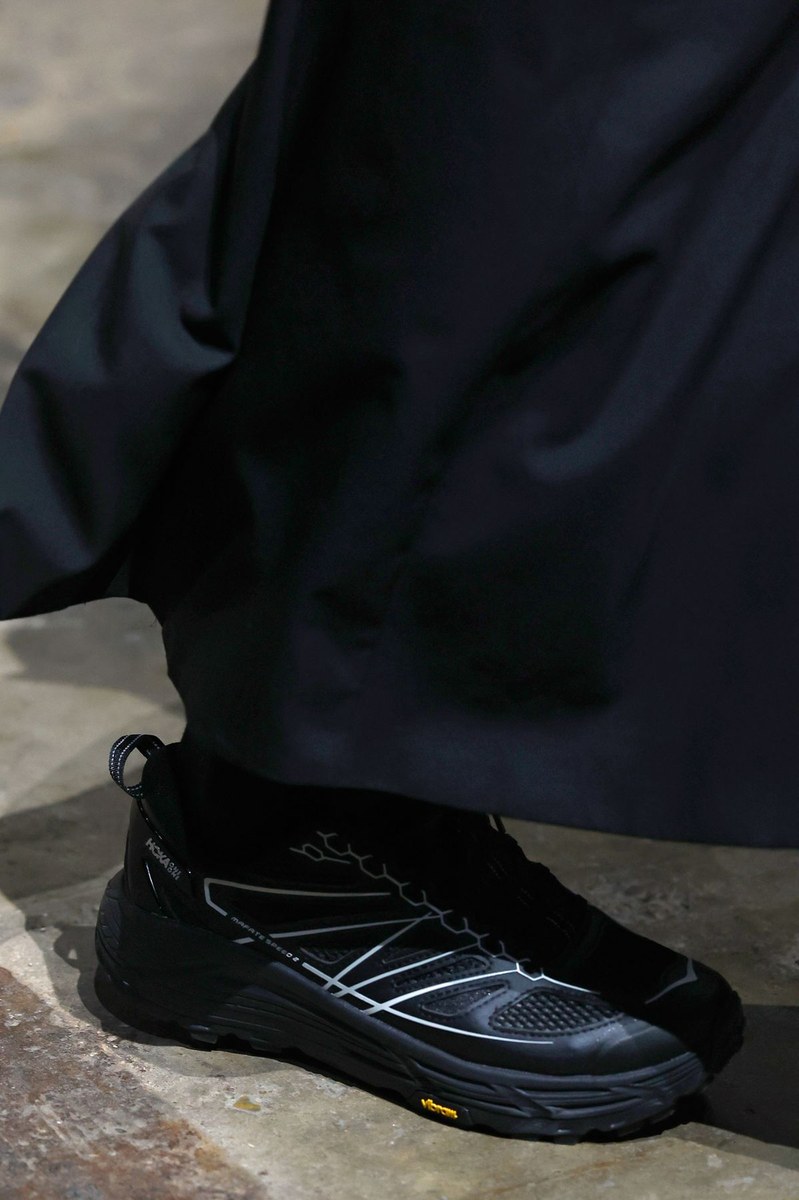
Trail runners shared across Shoes 1, 11, and 12 appear to be a collaboration with or direct derivative of Hoka's Mafate silhouette, identifiable by the ribbed EVA midsole geometry, the pull-loop at the heel, and the Vibram-style outsole with yellow heel plug. Shoes 2 and 10 present what reads as a sock-integrated version of a similar trail platform, where the knitted upper extends past the ankle collar into a sock cuff, eliminating the tongue-and-collar distinction entirely. Red runners (Shoes 7, 9, and 13) use a different base model with a smoother, more contoured midsole and rope-style toggle lacing hardware in purple, a closure system that removes the need for traditional tie-off. Branding on all trail runners is kept minimal, pressed or woven into the upper rather than applied as a standalone badge.
Shoe by Shoe Highlights
Shoe 1 Full tonal black execution of the Mafate-derived trail runner with reflective white piping along the overlay seams. This is the most retail-ready style in the collection for buyers targeting a monochrome performance consumer.

Shoe 2 The grey-white graphic knit trail runner with sock-cuff integration represents the highest construction complexity in the collection and will require careful spec review around knit bonding and midsole attachment points.

Shoe 4 Mint-green and black pairing introduces the only truly unexpected colorway in the lineup, combining a pale iridescent green upper with a matte black midsole and subtle metallic overlay at the toe box.

Shoe 6 All-black slip-on with molded filigree relief stands as the outlier of the collection, a flat, laceless style that borrows its surface texture from decorative craft traditions and sits in a completely different commercial category from every other look.

Shoe 7 Red trail runner with knee-high black compression socks anchors the strongest editorial image of the collection. The purple toggle-lace hardware against the red upper is a production detail worth isolating for broader colorway testing.

Shoe 8 Tall suede boot with metallic collar demonstrates the most precise construction in the boot group, with quilted panel stitching on the suede body adding structure without adding weight. The flat rubber outsole keeps the overall silhouette grounded.

Shoe 10 Sock-integrated grey knit runner photographed from the front angle reveals the BOA-style lace closure system most clearly, a mechanical tightening dial at the throat that signals a premium price point and a technically sophisticated consumer.

Shoe 13 Red runner from the side angle confirms the midsole is a distinct shape from the Mafate base used in Shoes 1, 11, and 12, with a smoother lateral wall and a tighter outsole lug pattern. This suggests a second distinct trail model within the same collection.

Operational Insights
Midsole sourcing: Two distinct trail midsole constructions appear across the collection. Buyers need to confirm with the brand whether these represent two separate manufacturing partners or one factory running two toolings, as this will affect minimum order quantities and lead times differently.
Hoka collaboration confirmation: Multiple trail runners align closely with existing Hoka silhouettes in both midsole geometry and outsole construction. Product managers should clarify licensing or collaboration status before presenting to retail partners, as this affects how the product is positioned and priced at wholesale.
Knit upper complexity: Sock-integrated runners (Shoes 2 and 10) require knit factories with seamless or circular knit capability bonded to performance midsoles, a process that typically extends development timelines by six to ten weeks. Plan accordingly for FW26 delivery windows.
Color buy depth: Black (four styles) and red (three styles) represent the clearest volume buy opportunities. Mint green (Shoe 4) and the grey knit (Shoes 2 and 10) carry higher fashion risk and are better suited to limited or allocation buys for trend-forward accounts.
Boot collar material: The metallic ankle collar on Shoes 3, 5, and 8 is the construction element most likely to create fit or comfort issues at the consumer level. Footwear directors should request wear-test data on the collar's flex and pressure points before committing to production, particularly for markets with wider ankle profiles.
More Shoes
More Shoes
More Shoes


✦ This report was generated with AI — combining human editorial vision with Claude by Anthropic. Because the future of fashion intelligence is already here.