Luisa Spagnoli FW26 Women Looks Report
Milan Fashion Week
Luisa Spagnoli FW26 builds a wardrobe around the architecture of restraint, proposing a woman who dresses with authority through tailoring, layering systems and a palette rooted in earth and nature. For buyers, this collection arrives at the exact moment the market is absorbing customer fatigue with maximalism and returning to investment-grade pieces with clear seasonal utility.
Silhouette and Volume
Two poles define the silhouette strategy here: long, floor-grazing coats and dresses that project formality, balanced against short, thigh-baring mini silhouettes paired with voluminous knitwear on top. Structured shoulders appear consistently across blazers and coats, giving even the more relaxed shapes a controlled authority. Wide-leg trousers in Looks 2, 9 and 14 add a third volume language, one that sits between the extremes and carries the strongest commercial weight. Most directional is the proportional contrast between oversized tops and exposed legs, visible in Looks 10, 11 and 13, a commercial bet worth watching.
Color Palette
Dark forest green and burgundy carry the collection's emotional core, appearing across coats, knits, trousers and caps in Looks 3, 7, 8, 9 and 10. Herringbone grey and warm camel anchor the tailoring. Sharp mustard yellow in Looks 16 and 17 functions as the season's accent disruptor. Chalk white shirts thread through nearly every look, acting as a neutral separator that keeps the darker tones from closing in. Look 12 goes fully monochromatic in mint green, a calculated risk that gives buyers a clear conversation piece for window and editorial use.

Materials and Textures
Herringbone wool dominates the tailoring, appearing in dark green, grey and brown weights that drape with enough body to hold structured silhouettes without internal boning. The curly bouclé-style knit jacket in Look 10 and the full coat version in Look 12 introduce a high-pile looped texture that reads as tactile and premium at retail. Velvet appears in Look 2 as a full-length dark brown coat, and its matte depth contrasts effectively against the sharper wool pieces. A black duchess satin coat in Look 19 is the sole evening-adjacent material in the lineup, providing clear occasion dressing anchor for a collection that is otherwise entirely daywear.

Styling and Layering
Every look builds from the same foundation: a white poplin button-down shirt with a visible spread collar, worn over or under a fine-gauge ribbed turtleneck in a contrasting color. This two-base-layer formula creates consistent warmth logic and gives the collection a coherent retail story around building-block separates. Belts, almost always in python-print or smooth leather, define the waist in otherwise generous silhouettes across Looks 4, 7, 8, 14, 16 and 17. Dark brown loafers and pointed-toe pumps in reptile or tonal leather close most looks, keeping footwear commercial and avoiding any styling choices that would limit the customer's own wardrobe application.
Look by Look Highlights
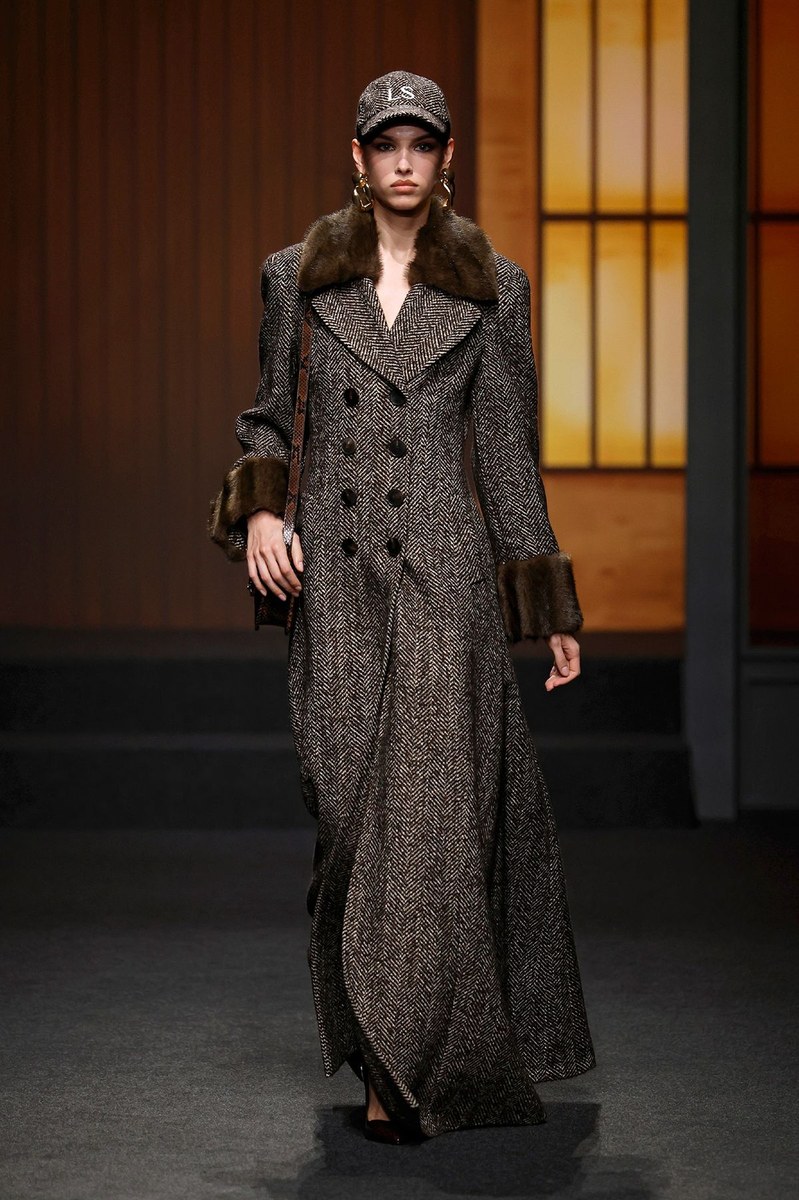
Look 1 A floor-length double-breasted herringbone coat with mink-trim collar and cuffs delivers the collection's most elevated outerwear proposition, a direct target for outerwear buyers seeking a hero piece with fur-trim detail at accessible luxury price positioning.

Look 2 The dark chocolate velvet maxi coat worn open over wide herringbone trousers and a layered white shirt and camel turtleneck establishes the strongest three-piece separates story and points toward a high-converting outerwear-plus-trouser set for floor display.

Look 5 A head-to-toe oatmeal herringbone, collarless, floor-length coat worn as a single unbroken column delivers the quietest and most architecturally rigorous piece in the lineup, and its monastic simplicity will perform for minimalist-leaning customers without alienating the broader buyer.

Look 7 The burgundy ribbed midi dress with gold snap buttons, a brown leather belt and a matching branded cap creates a complete ready-to-wear look requiring zero additional styling, which makes it a strong candidate for e-commerce photography where simplicity drives conversion.

Look 12 A mint green oversized looped-knit coat worn as a dress, with no separates underneath, is the boldest single-item statement in the collection and will function as an editorial pull and social content driver even if sell-through volume remains moderate.
Look 16 The grey herringbone belted wrap blazer with a high-slit pencil skirt, mustard turtleneck, matching gloves and cap demonstrates the most complete color-blocking formula of the collection, giving style directors a ready-made visual for trend-led campaign content.

Look 17 A full mustard yellow ribbed knit set comprising a high-neck button-front top and fitted leggings, cinched with a wide brown leather belt, is the collection's strongest knitwear statement and its cleanest pitch to buyers who need head-to-toe knit solutions for mid-season.

Look 19 The black duchess satin wrap coat with sharp shoulders and a deep front slit is the only piece that crosses into evening territory, and its structural precision means it can carry a higher price point without requiring additional styling investment from the retailer.

Operational Insights
White shirt as system anchor: The poplin button-down appears in nearly every look and functions as the connective tissue of the entire collection. Buyers should treat it as a must-have replenishment basic and negotiate volume on it alongside hero outerwear to protect margin.
Knitwear as a tiered category: Three distinct knitwear registers run through the collection: fine-gauge ribbed turtlenecks, mid-weight chunky cardigans and high-pile looped bouclé jackets. Product managers should build buys across all three tiers rather than concentrating on one, as the price architecture supports a ladder from entry to premium.
Belts as a conversion accessory: Python-print and smooth leather belts appear in over half the looks and actively change the silhouette of otherwise boxy pieces. Stocking these as a coordinated accessory add-on alongside coats and blazers creates a natural upsell mechanism at point of sale.
Monochromatic mini looks for traffic generation: Looks 12 and 17 are full head-to-toe single-color statements that read loudly on the floor and online. Buyers with strong visual merchandising programs should pull both for window installations even if the volume buy concentrates on the more conservative tailoring.
Logo cap as an entry price point: The branded "LS" cap appears across Looks 1, 3, 5, 7, 16 and 19, spanning the collection's tonal range from charcoal to burgundy to cream. This is the lowest barrier-to-entry branded piece in the collection and should be bought with depth to capture logo-driven customers who cannot commit to the outerwear price point.
Complete Collection


About the Designer
Nicoletta Spagnoli was born in Perugia on July 24, 1955, the great-granddaughter of Luisa Spagnoli, who in 1928 had founded a fashion house from the unlikely starting point of combing angora rabbits in the Umbrian countryside. Growing up inside a family whose history was inseparable from the city around it, Nicoletta absorbed the company the way other children absorb a language: through proximity, repetition, and an early and persistent compulsion to draw. She recalls visiting the company's stylists as a young child, watching and sketching, and her father Lino having a garment made from one of her drawings when she was around ten years old. Despite this pull, her formal education took a deliberately different direction. She studied pharmacy at the University of Perugia, then pursued postgraduate pharmaceutical chemistry research in the United States, spending five years at the University of California San Diego, where she was offered a doctorate. In 1983, her father called her back to Perugia. She declined the research position and returned.
She entered the company not as an heir claiming authority but, as she has said, as a simple designer, stamping tags like any other employee. Two years later, in 1986, Lino Spagnoli died suddenly and prematurely, and at thirty years old Nicoletta found herself at the head of a company that was already a well-established name in Italian women's clothing. She took on the role of CEO alongside her brother Mario, assuming personal responsibility for the collections as well as the business strategy. The transition was abrupt in circumstance but not in preparation: the decades of domestic apprenticeship meant she understood the company's identity at a granular level. What she set in motion was a thorough repositioning, replacing a certain provincial self-containment with a more deliberate glamour without abandoning the values of quality and wearability her great-grandmother had built the brand on. Revenue grew from 90 billion lire in 1986 to over 117 million euros by 2006. In 2021 Luisa Spagnoli entered the official Milan Fashion Week calendar for the first time.
Today Nicoletta holds all three titles simultaneously: president, CEO, and creative director. She designs clothes that she herself wants to wear and places quality of construction, especially in knitwear and in the angora tradition that remains the house's founding material, at the center of every collection. The brand's seasonal references tend toward women who moved with purpose through their world: the 1970s icons, the urban professional, the woman who requires nothing to be spectacular in order to be worn. In February 2024, her son Nicola Barbarani Spagnoli was named Executive Vice President, marking the beginning of the fifth generation's involvement in the company her great-grandmother built nearly a century ago.
"Drawing has always been my greatest real deep passion, something that I have breathed since I was a child. I design clothes that I like and that can make women feel good about themselves."
"Luisa was passionate, courageous, determined, and kind. She left a mark through her visionary spirit. I find my great-grandmother's character traits in me."
✦ This report was generated with AI — combining human editorial vision with Claude by Anthropic. Because the future of fashion intelligence is already here.