Marie Adam Leenaerdt FW26 Details
Marie Adam Leenaerdt FW26 Details Report
Marie Adam Leenaerdt FW26 builds its accessories and detail language around deliberate material collision, pairing raw craft references with restrained construction to create tension between the domestic and the directional. For buyers and product managers navigating a market hungry for texture-led storytelling, this collection provides a clear commercial framework grounded in contrast, not novelty.
Category Overview
Three categories shape the collection: dress details, gloves, and headwear, each anchored in a distinct material register but unified by a recurring interest in layering and volume control. Dress details dominate the image count and carry the heaviest conceptual load, working across appliqué, patchwork, lace overlay, faux fur, and structured quilting. Leather and satin pair rather than stand alone in the glove category, while a single black velvet hood functions as outerwear rather than adornment in headwear. The three categories suggest a house prioritizing wearable craft over graphic accessory impact.
Material and Construction
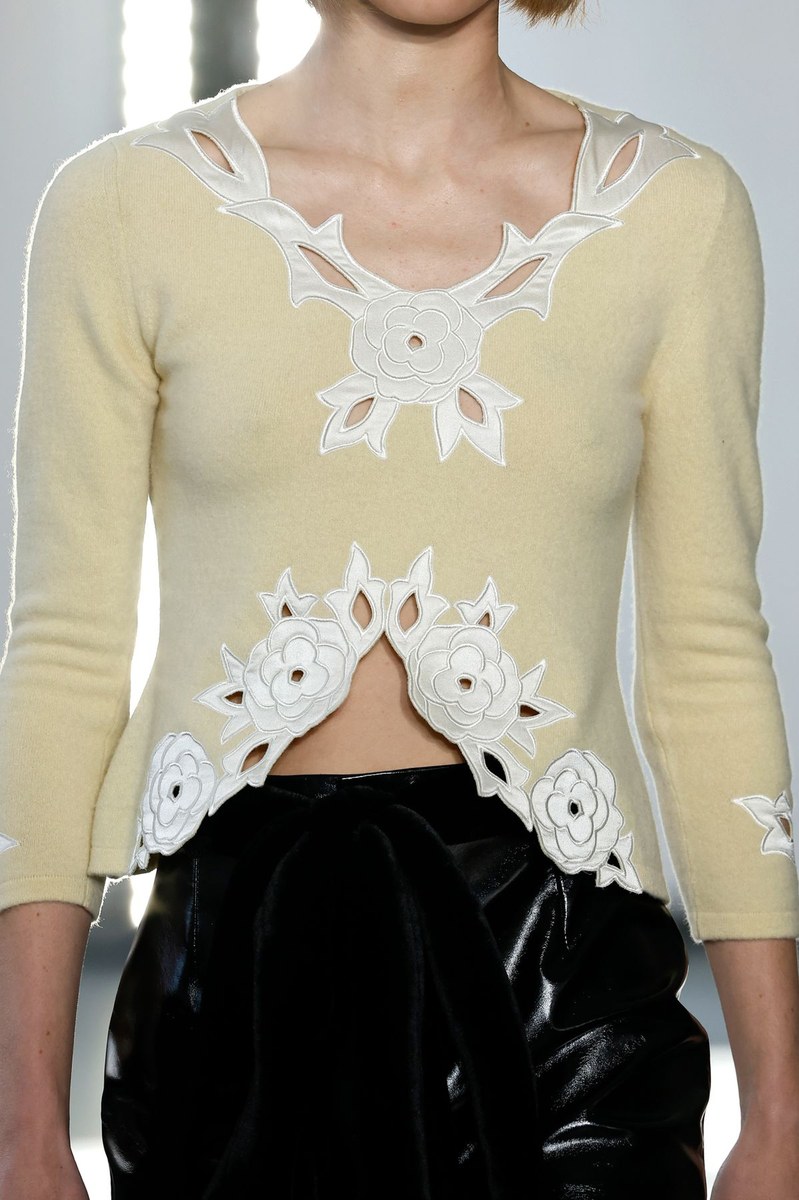
White leather appliqué in Detail 1 and Detail 6 is cut into rose and leaf silhouettes and stitched flat onto a cream bouclé knit, with cutwork panels creating negative space between motifs. Dense, long-pile faux fur in off-white appears in Detail 2, the texture directional and thick enough to read as outerwear-weight. A mini skirt in Detail 4 constructs from rectangular patchwork panels in satin, gingham, houndstooth, floral cotton and plaid, each seamed flush without topstitching. Detail 13 pairs a fingerless tan leather glove secured with a silver snap closure against a gathered neon lime satin cuff, a construction detail with real visual bite.

Color and Finish Direction
White, cream and blush dominate across Detail 1, Detail 2, Detail 6, Detail 8, Detail 10 and Detail 14, establishing a cool, pared-back ground tone for the season. Hot pink enters as the primary accent color across Detail 3, Detail 5, Detail 7 and Detail 12, a saturated fuchsia-adjacent tone that reads commercial and wearable rather than conceptual. Neon lime in Detail 13 serves as the single sharp contrast note, paired with deep black to prevent it from reading costume. Matte or low-sheen surfaces dominate the finish direction, with satin panels and the pink velour in Detail 12 providing the few moments of gloss.
Key Pieces and Details
Detail 14 stands out immediately for buyers, as the white leather long glove worn ruched and bunched down the forearm repositions gloves as a volume accessory rather than a fine one, which opens up production conversations around hardware-free leather goods with a deliberately casual handle. Detail 1 and Detail 6 together form the commercial center of the dress detail category, the appliqué rose system being modular enough to license or adapt across knitwear, denim or outerwear programs. Detail 4 offers the strongest patchwork reference in the collection, using varied fabric weights and pattern scales in a format tight enough to sit within a contemporary RTW price architecture.

Detail by Detail Highlights
Detail 1 (Dress Detail) White leather rose and leaf appliqués are stitched onto a cream bouclé crop top with cutwork panels that pull light through the knit, giving the garment a three-dimensional surface without embroidery weight.
Detail 3 (Dress Detail) A fuchsia lace overlay sits on a silver-tone base fabric with structured seam lines beneath and a small keyhole back closure tied with a narrow satin ribbon, the layered construction adding depth to what reads as a single fabric on first glance.

Detail 4 (Dress Detail) The patchwork mini combines black-and-white gingham, chartreuse satin, yellow glazed cotton, floral print, plaid and houndstooth in equal-sized rectangular blocks, the varied surface finishes creating texture contrast without altering the silhouette.

Detail 12 (Dress Detail) A bubblegum pink distressed cashmere zip hoodie sits over a lighter pink jersey crop, the deliberate mismatch in pink tones and the visible worn texture of the cashmere reading as luxury-casual with production relevance for knitwear buyers.

Detail 13 (Glove) A tan fingerless leather driving glove with a single silver snap closure at the wrist is worn against a gathered neon lime satin sleeve cuff, the contrast between utilitarian leather and glossy satin creating a proportion story that is directly transferable to glove and sleeve pairings.

Detail 14 (Glove) The white leather elbow-length glove is worn bunched and collapsed down the arm rather than pulled taut, a styling decision that reframes long gloves as slouch accessories and signals a relaxed direction for the category that differs from current evening-wear references.
Detail 15 (Headwear) A black velvet zip-front hood is layered under a white padded coat collar, the velvet pile dense and the fit close enough to frame the face without draping, functioning as a structural headpiece rather than an informal layer.

Detail 7 (Dress Detail) An oversized white quilted shell jacket with a knotted bow closure at the collarbone and ruched sleeve ends at the wrists reads as outerwear with an intentional undone quality, the gathered cuff detail carrying direct relevance for outerwear sleeve finishing in a contemporary sportswear context.

Operational Insights
Appliqué modular systems Buyers should assess the rose appliqué from Detail 1 and Detail 6 as a transferable embellishment unit. Flat leather-on-knit construction is reproducible at scale and adaptable across denim, jersey and wool ground fabrics without requiring specialist atelier facilities.
Glove volume direction Detail 14 establishes a commercial case for long leather gloves worn deliberately deconstructed. Product managers working in leather goods should note the absence of hardware and the simplicity of the cut, which reduces production cost while retaining visual authority.
Patchwork fabric sourcing Detail 4 requires a multi-supplier fabric sourcing model to execute authentically. Buyers considering patchwork programs should plan for fabric deadstock sourcing partnerships to keep material costs viable while preserving the aesthetic variety that makes the detail legible.
Pink tone calibration At least three distinct pink registers appear throughout the collection, from fuchsia in Detail 3 to bubblegum in Detail 12 to blush in Detail 10. Colorway directors should treat these as separate seasonal commitments rather than a single pink story, as each sits in a different customer and occasion context.
Layering as construction logic Across Detail 5, Detail 11 and Detail 12, layering functions as the primary construction method rather than a styling afterthought. Production teams building layered garment systems should plan for weight distribution across layers at the development stage to avoid bulk at seam junctions.

More Details


✦ This report was generated with AI — combining human editorial vision with Claude by Anthropic. Because the future of fashion intelligence is already here.