Marie Adam-Leenaerdt FW26 Women Looks Report
Paris Fashion Week
Marie Adam-Leenaerdt built FW26 around a deliberate collision between domestic softness and structural aggression, pulling quilt patterns, sewing-kit prints, lace lingerie, and oversized outerwear into the same room without smoothing the tension between them. For buyers, this speaks directly to the appetite for wardrobe friction, pieces that resist easy categorization and reward a customer who builds looks rather than buys them.
Silhouette and Volume
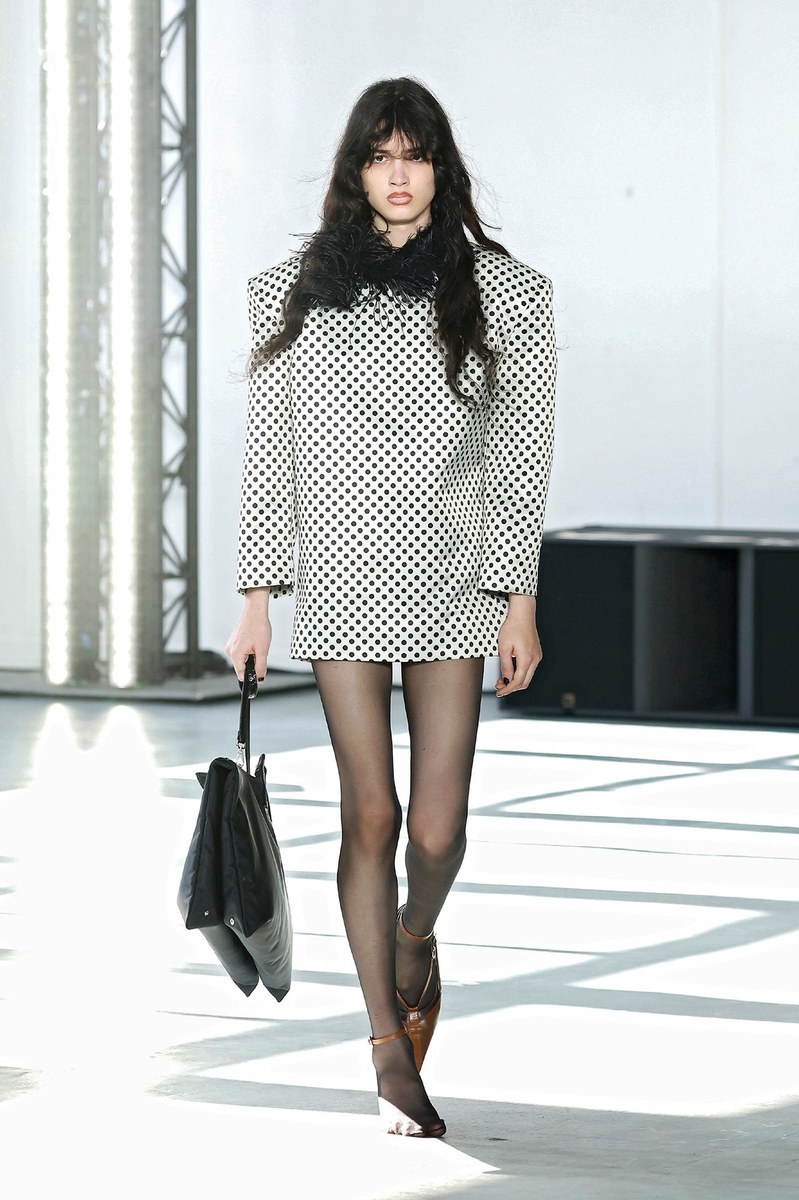
The collection swings between two poles: compressed, square-shouldered mini proportions as in Looks 1 and 44, and engulfing wrap and robe shapes that consume the body entirely, as in Looks 10, 11, and 15. Structured padding at the shoulder recurs across coats, mini dresses, and draped silk forms, creating a unified architectural signature even across wildly different garment categories. Lengths split cleanly between above-the-knee and floor-grazing, with almost nothing in between.
Color Palette
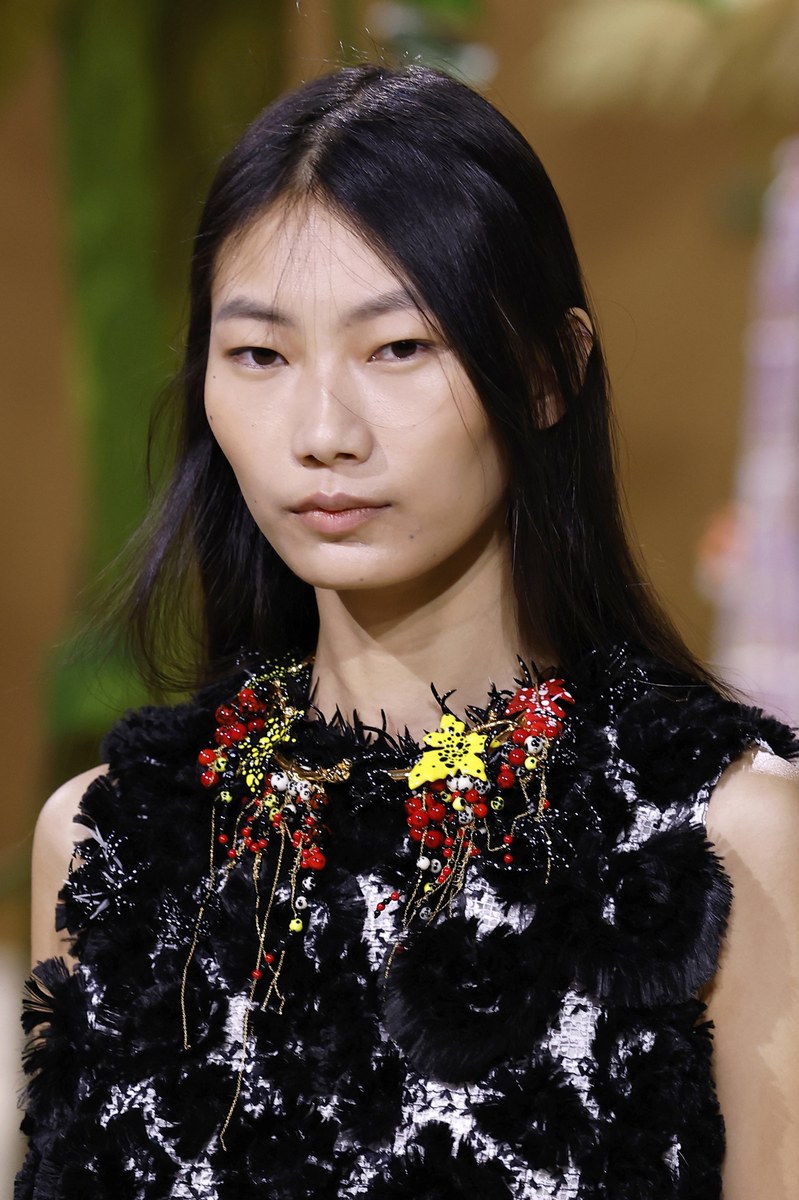
Black anchors the collection and appears in roughly a third of the looks, from matte wool to high-gloss patent to sheer crushed velvet. Neon yellow-green (Looks 3, 14, 44) and hot pink (Looks 6, 16, 21, 30, 39, 43) function as the collection's voltage, landing in saturated, unmodulated blocks that read immediately on a rack. Chalk white, warm sand, and chocolate brown (Looks 9, 36, 38) provide the quieter commercial tier. Bubblegum pink satin against dark brown faux fur in Looks 16 and 39 represents the boldest pairing, and it's the combination most likely to drive editorial placement and conversion simultaneously.
Materials and Textures
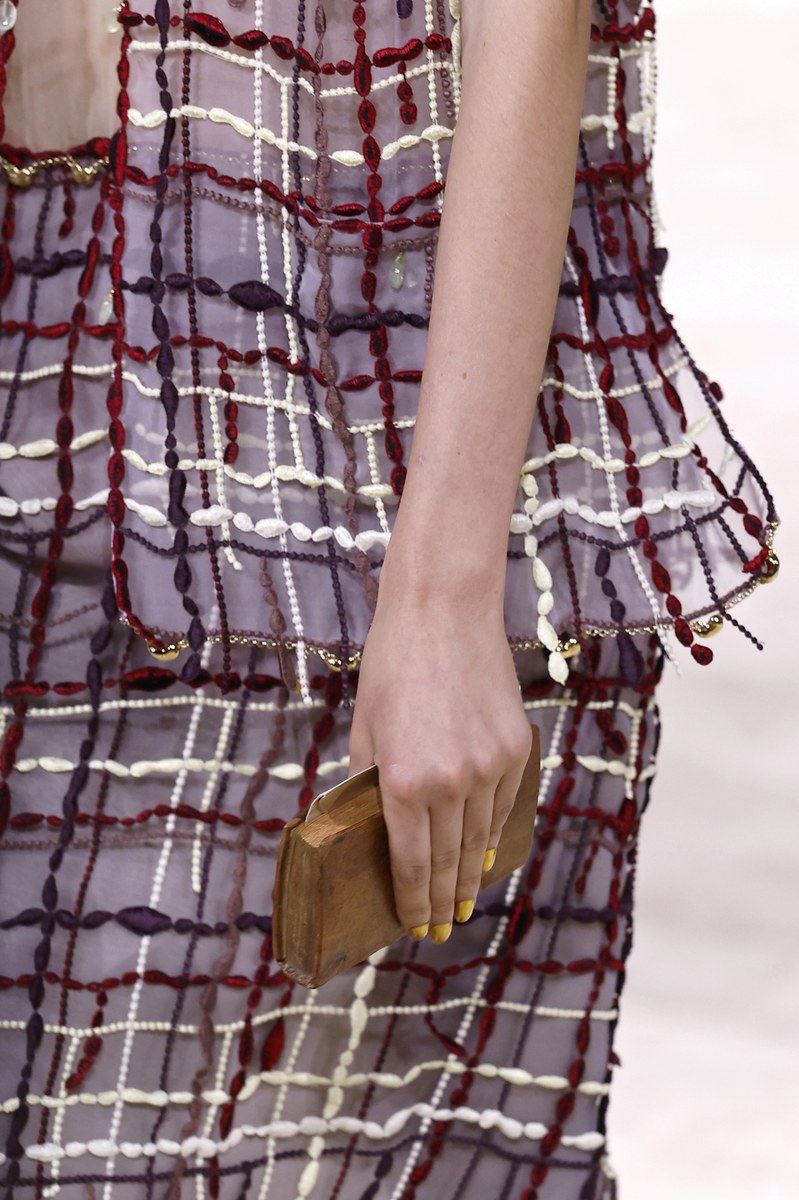
A wide material register runs through the collection, from rigid patent vinyl in Looks 8 and 32 to sheer crushed silk in Looks 36, 37, and 41, with the contrast in surface weight doing significant design work. Faux fur in white (Look 13) and dark brown (Looks 16, 39) carries real covetability. Lace appears in at least three distinct weights, from the stiff structured lace of Look 45 to the soft ivory slip lace of Look 40 and the metallic pink lace of Look 17, confirming it as a collection-wide material commitment rather than a single statement. Sewing-pattern printed trousers in Looks 5, 6, and 7 use cotton or cotton-blend fabric printed with actual pattern-cutting instructions, a conceptual textile play that is production-ready and photographically strong.

Styling and Layering
Layering logic here is additive and deliberate: a hooded zip-up under an oversized plaid wrap coat in Look 10, a gingham shirt beneath a tan puffer in Look 15, a neon jacket over black tights with a yellow skirt bleeding through in Look 14. What emerges reads as intentional collision rather than wardrobe accident, which gives buyers a clear story to tell on the floor. Footwear oscillates between two modes: sleek pointed-toe kitten heels or pumps in silver, black, or animal print, and statement knee-high boots in red python (Looks 20, 44) or white leather (Looks 8, 32). Bags lean large and unstructured, including tote-scaled pieces in gingham, zebra print, and navy nylon, anchoring the collection's deliberate rejection of precious accessories.

Look by Look Highlights
Look 1 The white and black polka-dot mini with extreme square shoulders and a black feather collar is the collection's clearest commercial opening, sharp enough for editorial and structured enough to retail as a standalone statement piece.

Look 10 An exploded plaid wrap coat over a white hooded zip-up with yellow-accented boots layers three distinct product categories into one look, giving buyers a clear capsule-selling opportunity around outerwear, knitwear, and footwear.
Look 16 Bubblegum pink satin robe coat trimmed in dark chocolate faux fur, worn over a black lace bodysuit, is the single look most likely to generate press coverage and drive full-price sell-through at specialty retail.

Look 25 A patchwork dress assembled from at least six distinct printed fabrics, including gingham, floral, mesh, and lace, at midi length with sharp puffed shoulders, tests whether the market has appetite for genuinely complex construction at accessible luxury price points.

Look 27 Zebra-print matching set, a boxy blazer-style top and floor-length skirt in high-contrast black and white, is among the most wearable and production-scalable looks in the collection, with strong potential for separates buying.

Look 32 A cropped metallic bouclé puffer jacket paired with a black patent vinyl midi skirt and white knee-high boots demonstrates how the collection handles texture contrast at its most commercially disciplined.

Look 43 Full-length hot pink satin gown with ruched bust, sheer pink overlay at the shoulders, and a red crystal heart brooch at center chest is the collection's formal anchor, a clear candidate for special occasion and resort buying.

Look 45 The halter-neck mermaid gown in ivory and blush lace with a pronounced flare at the hem closes the collection on a technically precise note, signaling that Adam-Leenaerdt can compete in the eveningwear and bridal adjacency market without abandoning her design handwriting.

Operational Insights
Outerwear as hero category: Coats and wraps in Looks 9, 10, 11, 12, 13, 15, 16, and 35 represent the deepest and most varied offering in the collection. Buyers should treat outerwear as the primary traffic driver and plan depth of stock accordingly, particularly in the wrap-robe silhouette and the faux fur styles.
Separates strategy: Sewing-pattern printed trousers (Looks 5, 6, 7), patchwork skirts (Looks 20, 21, 22), and floral patchwork dresses (Looks 25, 26) all function as statement bottoms that can sell against the collection's simpler tops, giving style directors a clear layering story and retailers a higher average transaction value through mix-and-match buying.
Color segmentation: Neon yellow-green and hot pink perform as capsule colors within the wider collection, not accent notes. Product managers should plan minimum buys in these colorways as standalone micro-capsules rather than folding them into a neutral-heavy assortment, since they require dedicated placement and specific customer targeting.
Lace as a cross-category material commitment: With lace appearing in Looks 8, 17, 40, 42, 45, and the knitwear of Looks 8 and 20, buyers have the option to build a coherent lace story across price points and occasions, from the white slip dress at Look 40 to the mermaid gown at Look 45, which supports tiered retail programming.

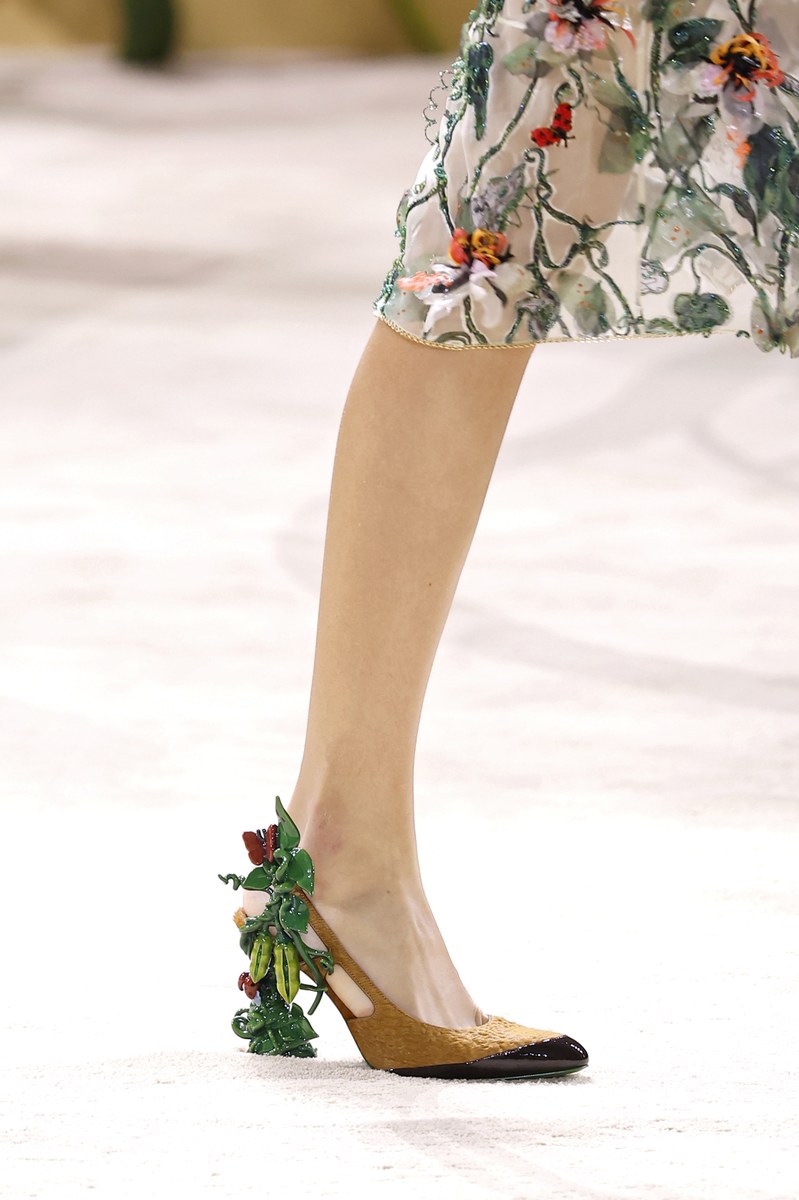
Footwear as a margin opportunity: Shoes in the collection, including red python knee boots, white leather tall boots, metallic kitten heels, and green satin Mary Janes, carry strong visual identity and appear to be designed in-house rather than sourced generically. Style directors negotiating footwear buys should prioritize the red python boot and the pink platform heel from Looks 17 and 40 as the two styles with the strongest standalone sellability outside of the full look context.
Complete Collection


Fashion Designer

Marie Adam-Leenaerdt is Belgian, born around 1995 and based in Schaerbeek, a neighborhood in northeast Brussels where she still lives in a studio at the top of her parents' house. Her mother's side of the family had an influence on how she thought about clothes from early on. She grew up hesitating between business and design until, at eighteen, while enrolled in a Flemish language course in Antwerp, she visited the MoMu, the city's fashion museum, and encountered the work of Martin Margiela and Ann Demeulemeester for the first time. That afternoon settled the question.
She studied at La Cambre in Brussels, graduating in 2020 with a technical, hands-on education built around deconstruction and reconstruction. After graduation she worked entry-level jobs at Balenciaga under Demna and at Givenchy, experiences that taught her organizational rhythm and how large creative machines operate, but left her restless. After six months at Balenciaga she had worked only on clothes, not accessories. She wanted to design the entire wardrobe at once. She never sketches; she works directly with her hands or in Photoshop, manipulating shapes by touch and image before a single line goes down on paper.
She launched her label in February 2023 with a show staged in a conference room at a Crowne Plaza hotel near the République metro stop, the chairs stacked to make a catwalk, tablecloths bought secondhand from a market turned into triangular dresses. The setting was deliberate. Her references are the ordinary things most designers look past: garden chairs, hotel linens, the morning commute, the 1980s home decorating book. She grows twelve varieties of tomatoes in her garden in Brussels, cooks, walks her Labrador, and takes the train or sometimes the longer drive to Paris rather than move there. She was a finalist for the 2024 LVMH Prize. As of 2025 she has shown five collections on the official Paris Fashion Week calendar.
"I like that when you see a garment, you recognize a reference, but you don't know if it's the object's or the garment's. It's a small line between the two."
"It's important for me to give garments a certain status, to provide that strength — because for me, surprise is always important. I think that's what we lose a bit in fashion today."
✦ This report was generated with AI — combining human editorial vision with Claude by Anthropic. Because the future of fashion intelligence is already here.