Marni FW26 Women Looks Report

Marni FW26 Women Looks Report
Did you know? Marni was founded in 1994 by Consuelo Castiglioni as a accessories line before expanding into ready-to-wear, making it one of the few luxury fashion houses established by a woman during the 1990s Milan boom. The brand's signature approach to color blocking and unconventional fabric combinations stems from Castiglioni's background in costume design, which fundamentally shaped its non-traditional approach to silhouettes and surface decoration.

Marni FW26 Women Looks Report

Milan Fashion Week

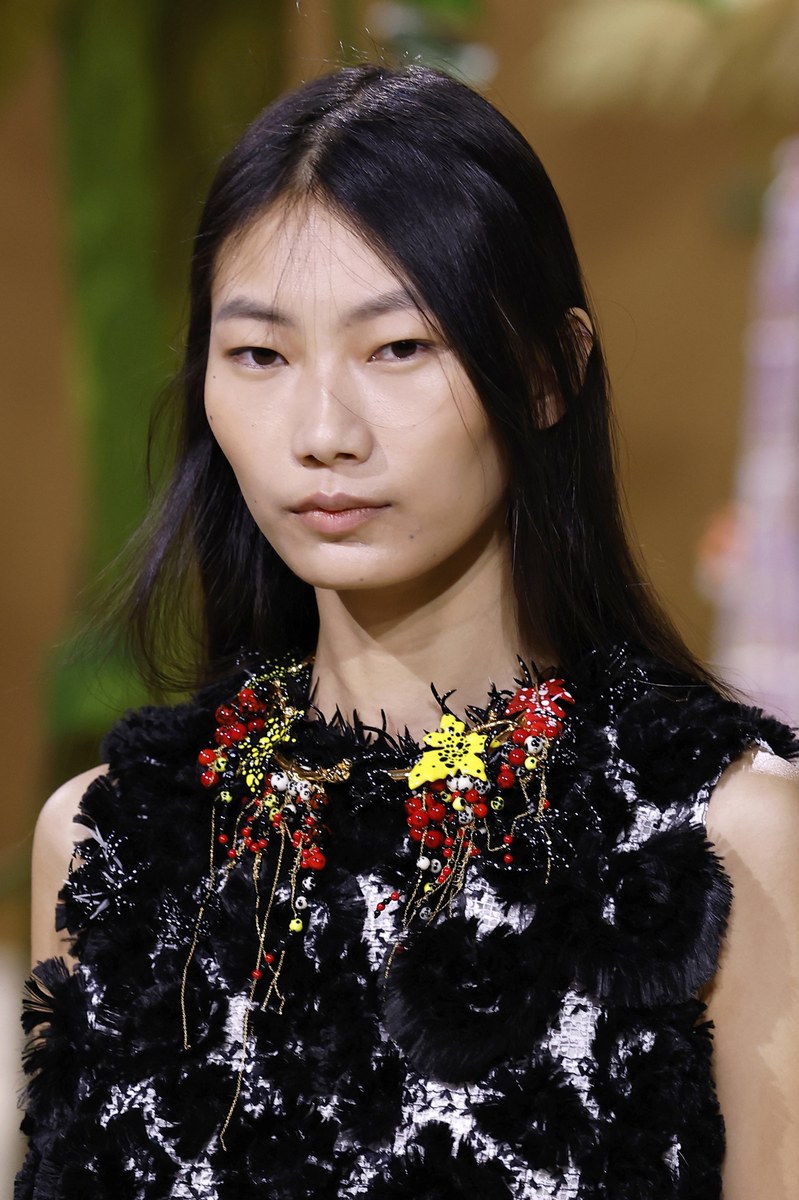
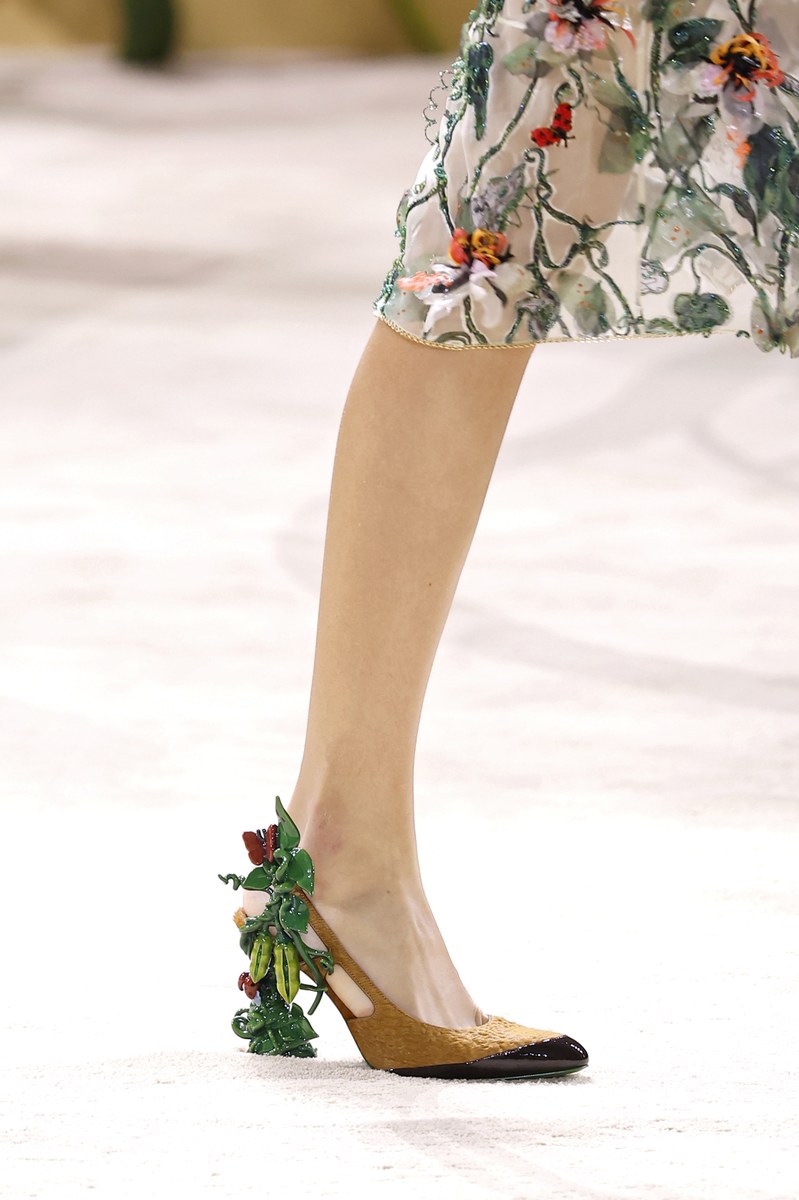
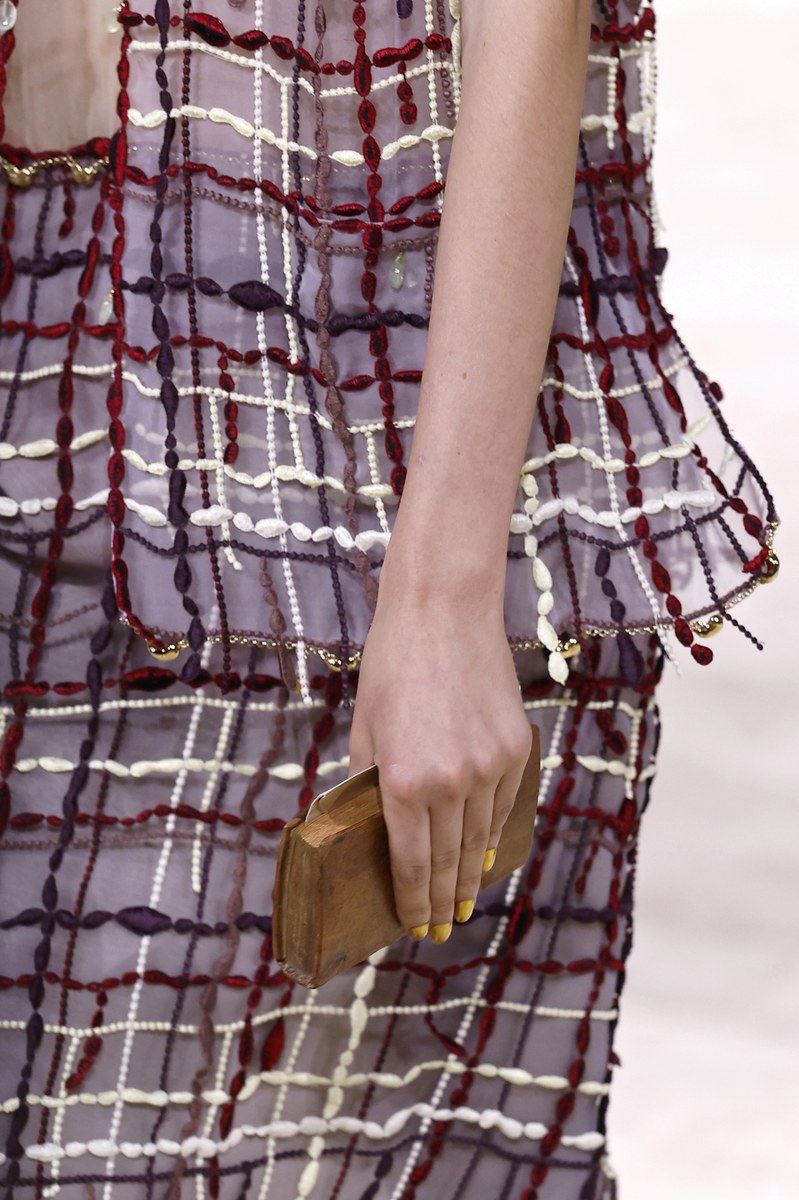
Marni FW26 builds a wardrobe around deliberate misalignment, pairing structured utilitarian pieces with fluid or overtly decorative elements to create looks that feel assembled rather than designed. For buyers, this signals a continued commercial appetite for mix-register dressing, where the customer sources across categories rather than buying complete looks.

Silhouette and Volume

Mid-length hemlines dominate throughout, with skirts and dresses landing consistently at or just below the knee. Tops and outerwear run oversized or boxy against fitted or straight-cut bottoms, creating a top-heavy proportion that recurs across both womenswear and gender-fluid pieces. Look 14 makes the sharpest case for this logic, where volume sits entirely above the hip and the trouser falls clean beneath it. A few silhouettes, notably Looks 7 and 9, pull in the opposite direction with a narrow column dress belted at the natural waist.
Look 14
Look 14

Color Palette

Earthy neutrals anchor the palette, warm taupe (Look 9), tobacco brown (Look 17), and slate grey (Looks 13 and 16), appearing across nearly every garment category. Against these grounds, Marni injects specific doses of saturated color: a brick red belt in Look 1, a kelly green shirt in Look 3, coral polka dots in Look 19, and a dusty pink lace skirt in Look 18. Teal and grey stripe fabric threads through Looks 6, 8, and 10 as a recurring print anchor, giving the collection internal visual coherence without relying on a single hero color. Warm and slightly melancholic, the mood reads commercial enough to photograph well.

Look 9
Look 9

Materials and Textures

Shaggy bouclé coats in Look 1 and the patchwork shearling of Look 19 carry the heaviest surface weight, delivering tactile volume that reads clearly at retail. Leather appears in multiple weights, from the stiff zip-front green skirt in Look 4 to the fluid black trousers in Look 5 and the oversized leather blazer in Look 20. Striped silk-weight shirting recurs across Looks 4, 6, and 16, moving with the body and contrasting the rigidity of the leather and structured wool pieces. A semi-sheer corset panel, used in Looks 2, 7, and 9, introduces deliberately unfinished intimacy to otherwise composed silhouettes.

Look 1
Look 1

Styling and Layering

Layering operates through visible contradiction. A grey plaid button-up shirt sits under an open brown cardigan in Look 5, while a turtleneck scarf emerges from the neckline of a structured khaki shift in Look 11. Look 10 features a chunky knit sweater that disrupts the formality of a long black coat. Footwear runs consistently low, with block-heel pumps, loafers, and flat mules appearing across looks, keeping the overall proportion grounded and practical. Socks worn over tights or pulled high over boots appear in Looks 1, 8, 13, 16, and 18, functioning as a deliberate styling signature rather than an incidental choice. Bags stay structured and mid-sized, with boxy top-handle silhouettes in dark leather or white smooth leather appearing throughout without competing with the garments.

Look 5
Look 5

Look by Look Highlights

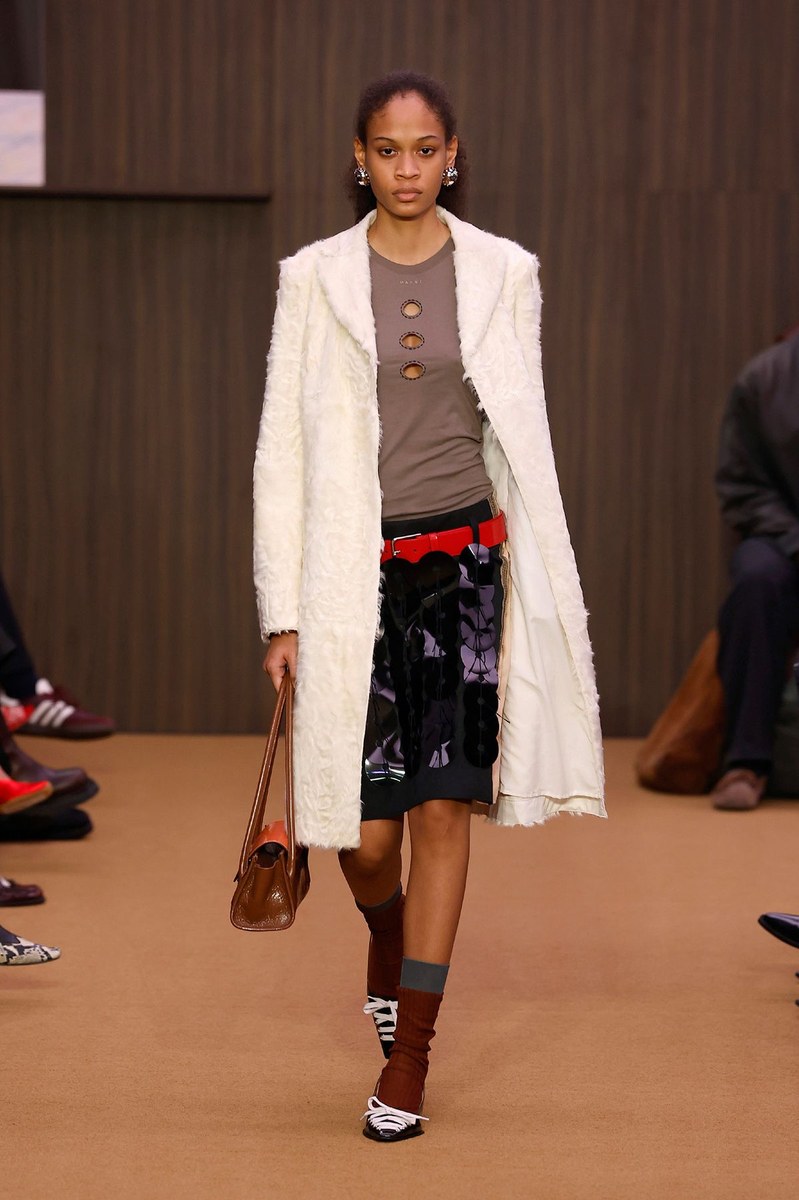
Look 1 The white shaggy coat over a grey graphic tee and velvet-appliqué skirt with a red belt makes the strongest case for mismatched separates as a commercial proposition, where each piece functions independently at retail.

Look 4 An amber and brown vertical-stripe silk shirt tucked into a dark forest green zip-front leather skirt reads as a tight, buyable two-piece combination with strong contrast and a clear styling direction that works without additional layering.

Look 4
Look 4

Look 9 A taupe column dress with a blurred photographic corset panel and a single black belt resolves the collection's tension between utility and softness in the cleanest way, with green patent ankle boots adding a targeted color hit for product photography.

Look 14 The powder blue cropped puffer with fur-trimmed hood and a brown grommet waist panel cut off above the hip is the most directional outerwear piece in the collection, with the truncated volume presenting a design detail worth evaluating for adaptation in commercial outerwear.

Look 15 Straight-leg black trousers with large silver concho buttons running the length of each leg and paired with a grey plaid Western shirt represent the collection's most overt reference to Americana, a detail-driven trouser that would drive conversation in a wholesale context.

Look 15
Look 15

Look 19 A patchwork shearling coat in white and tobacco brown over a red polka-dot top and grey wool mini shorts reads as a high-impact layering look with strong editorial potential, and the coat alone carries enough visual weight to anchor a buying order.

Look 19
Look 19

Look 20 The oversized black leather blazer with burgundy edge-stitching and silver military buttons worn over a cream crochet sweater and green tartan trousers stacks three contrasting codes, Western, military, and collegiate, into a single look that tests the upper limit of the collection's mix-register logic.

Look 20
Look 20

Look 7 A sleeveless black dress with a satin corset panel and single wide leather belt, worn with pale grey mule socks and metallic slip-on shoes, reads as a precise, low-effort styling formula that translates directly to floor presentation for an elevated contemporary customer.

Look 7
Look 7

Operational Insights

Separates strategy: Every look in this collection is built from pieces that read as independently viable. Buyers should prioritize open-stock depth on the stripe shirting, leather skirts, and structured knit cardigans rather than committing to full look buys.

Corset panel construction: The semi-sheer paneled bodice appears in at least three looks (2, 7, 9) and functions as a recurring design module. Product managers should evaluate it as a repeatable construction detail that can be applied across dress and top categories without requiring a full pattern redevelopment each time.

Sock styling as a floor directive: Deliberate sock-over-boot and sock-over-tight styling in Looks 1, 8, 13, 16, and 18 gives visual merchandising teams a low-cost way to animate footwear fixtures. Style directors should document the specific colorways used (rust orange, burgundy, grey) for direct buy recommendations in the hosiery category.

Outerwear volume pivot: Both hero coats (Looks 1 and 19) carry extreme surface texture and mid-length silhouettes rather than sleek or oversized long formats. Buyers planning outerwear assortments for FW26 should weight texture-forward mid-length styles over minimalist long coats based on the directional emphasis here.

Accessories restraint: Bags stay deliberately quiet and consistent in silhouette across the collection, while jewelry, particularly the red feather and charm necklaces in Looks 2 and 5, does the decorative work. Style directors should note this inversion when building accessory buys, investing in statement necklace formats over bag variety for this customer profile.

Complete Collection

Look 2
Look 2
Look 3
Look 3
Look 6
Look 6
Look 8
Look 8
Look 10
Look 10
Look 11
Look 11
Look 12
Look 12
Look 13
Look 13
Look 16
Look 16
Look 17
Look 17
Look 18
Look 18
Look 21
Look 21
Look 22
Look 22
Look 23
Look 23
Look 24
Look 24
Look 25
Look 25
Look 26
Look 26
Look 27
Look 27
Look 28
Look 28
Look 29
Look 29
Look 30
Look 30
Look 31
Look 31
Look 32
Look 32
Look 33
Look 33
Look 34
Look 34
Look 35
Look 35
Look 36
Look 36
Look 37
Look 37
Look 38
Look 38
Look 39
Look 39
Look 40
Look 40
Look 41
Look 41
Look 42
Look 42
Look 43
Look 43
Look 44
Look 44
Look 45
Look 45
Look 46
Look 46
Look 47
Look 47
Look 48
Look 48
Look 49
Look 49
Look 50
Look 50
Look 51
Look 51
Look 52
Look 52
Look 53
Look 53
Look 54
Look 54
Look 55
Look 55
Look 56
Look 56
Look 57
Look 57
Look 58
Look 58
Look 59
Look 59

About the Designer

Meryll Rogge grew up on the outskirts of Ghent, in the flat, quiet Flemish countryside of Belgium, in a household that was not remotely connected to fashion. As a child she wanted to be an illustrator and work for Disney. What redirected her was a moment of classroom inattention: she was caught sketching dresses during an Ancient Greek lesson, and a teacher pointed her toward fashion design instead. She enrolled to study law first, then made the leap toward what she had actually always been heading for, entering the Royal Academy of Fine Arts in Antwerp, where she studied under Walter Van Beirendonck and graduated in 2008. She describes fashion as something she came to relatively late, discovering it properly only around fifteen, but once she did it never left.

Her first job was at Marc Jacobs in New York, where she arrived as a summer intern and stayed for seven years, rising to womenswear designer. She calls those years formative in the most precise sense: she learned how to build a collection from the ground up, how to develop fabric, how to conduct fittings, how to work with suppliers and patternmakers. The Marc Jacobs shows, with their spectacular theatrical ambition, she compared to Broadway productions. She left New York in 2015 for the one person who could have persuaded her to return to Belgium: Dries Van Noten, who she had admired as a student and whose shop in Antwerp she had walked past almost every day. At Dries she became Head of Women's Design for four years, and the experience added another layer entirely, not just making clothes but thinking about shows, about image, about how a designer runs an independent company. She also developed Dries's beauty line. She launched her own eponymous brand in 2020, working from a nineteenth-century barn near Deinze in the Belgian countryside, drawing on deadstock fabrics, upcycling, and a set of references that ran from punk to surrealism to the wallpaper shops of Ghent.

The label gained immediate traction at Net-a-Porter, Nordstrom, SSENSE, and Maxfield, and Rogge accumulated awards in quick succession: Emerging Talent of the Year at the Belgian Fashion Awards in 2021, Designer of the Year in 2024, the first woman to receive that honour, and the ANDAM Grand Prix in June 2025. One month later, OTB and Marni announced her appointment as the house's creative director, the first woman to hold the role since founder Consuelo Castiglioni. She made her debut at Milan Fashion Week in February 2026, twenty hours of which she spent without wondering what the press would make of the show and focused instead on arriving to work on time. She did.

"This is a very Belgian thing to say, but you just do the work and let it go."

"I'm truly honored to join Marni — a house I've long admired for its independent spirit. To take on a role defined by such visionary creative directors is both humbling and inspiring."

✦ This report was generated with AI — combining human editorial vision with Claude by Anthropic. Because the future of fashion intelligence is already here.