Martino Midali FW26 Bags
Martino Midali FW26 Bags Report
Martino Midali's FW26 accessories program splits cleanly into two material worlds: lightweight technical nylon clutches and faux or shearling fur envelope pouches, both carried by hand without traditional straps or shoulder hardware. For buyers and product managers, this hand-carry-only positioning reads as a deliberate anti-bag statement that still functions as a commercial accessory, a difficult balance that deserves close attention.
Silhouettes and Shapes
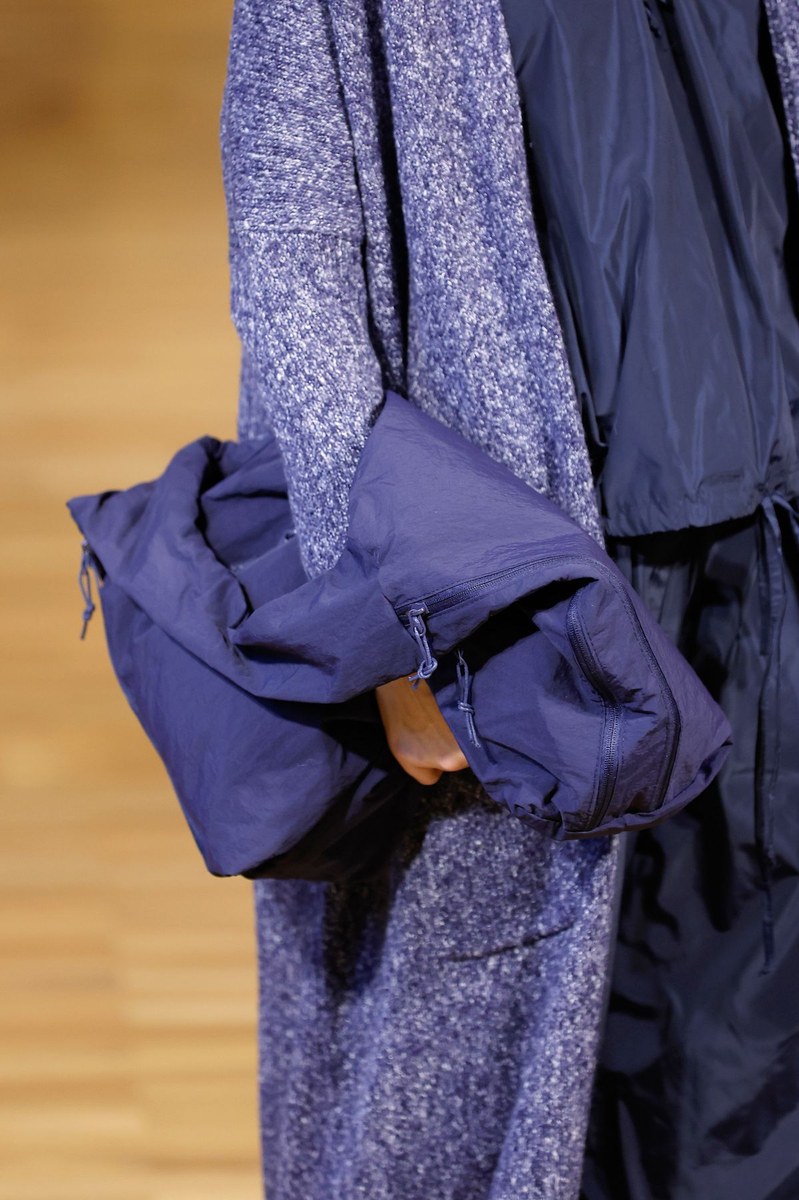
Every bag operates as a clutch or hand-held pouch. No shoulder straps appear, no crossbody chains, no top handles in the conventional sense. The nylon styles (Bag 1, Bag 7) favor a wide, horizontal baguette-adjacent silhouette with generous volume created by gathered fabric rather than structured panels. Fur and faux-fur pieces (Bags 2, 3, 4, 5, 6) sit flatter, closer to an envelope or muff shape, and scale smaller than the nylon group.
Materials and Hardware
A crinkled, lightweight shell fabric anchors the nylon bags, consistent with the same family as packable outerwear and the Midali ready-to-wear it accompanies. Zippers serve as the primary closure, rendered in matte black or tonal finishes with small cord pullers rather than polished zipper pulls, keeping hardware visual weight minimal. Dense, short-pile faux fur in brown-grey tones appears across the fur group, with Bag 6 in black. Bags 2 and 4 incorporate a braided or twisted fabric handle attached through small gold-tone D-rings, the only warm-metal hardware visible across the entire lineup.

Color Direction
The palette is deliberately narrow and low-contrast. Navy dominates the nylon category, appearing in two distinct tones: a slate-purple navy on Bag 1 and a deeper, cooler near-black navy on Bag 7. A consistent mink-brown or taupe-brown range runs through Bags 2, 3, 4, and 5, while Bag 6 introduces the sole neutral anchor of true black. This palette signals a season built around tonal dressing rather than accessory-as-statement, which has direct implications for how these bags will photograph and sell against the broader coat-focused collection.
Key Models and Details
Two distinct bag models emerge. A continuous zipper runs across the top opening and curves down toward the base on the nylon pouch (Bags 1 and 7), creating the rounded gathered volume when open or loosely closed. The fur envelope clutch, repeated across Bags 2, 3, 4, 5, and 6, has no visible external closure on the simpler versions (Bags 3, 5) and relies entirely on the compression of the hand grip to secure contents. Bags 2, 4, and 6 add a short twisted or braided carry loop threaded through D-rings, providing the only structural hardware element in the fur group.
Bag by Bag Highlights
Bag 1 The slate-purple navy nylon pouch with its tonal zipper and cord pullers coordinates directly with the mixed-media outerwear look, making it a strong candidate for a runway-matched bundle at retail.
Bag 2 The brown faux-fur envelope with gold D-ring hardware and braided handle introduces the only warm-metal accent in the collection, giving buyers a slightly more commercial entry point within the fur group.

Bag 3 This brown fur clutch worn with pinstripe suiting strips back all hardware, presenting the starkest version of the fur-as-hand-warmer concept and the lowest production-cost option in the lineup.

Bag 4 Shot from a wider angle against the striped mohair coat, it confirms that the fur envelope reads well at a distance and holds its proportions when styled with voluminous outerwear.

Bag 5 Against a second pinstripe look, the fur clutch reinforces that Midali intends this silhouette to work across both tailored and relaxed contexts, broadening its potential placement in a buying assortment.

Bag 6 The black faux-fur pouch with black braided handle and gold D-rings is the most wearable, most versatile, and most likely to perform outside a strict Midali editorial context, making it the clearest candidate for broader wholesale placement.
Bag 7 The larger navy nylon pouch in near-black navy reads almost genderless and carries a functional, almost archive-sportswear credibility that positions it well for accounts targeting a younger, utility-minded customer.

Operational Insights
Material sourcing: Both the crinkled nylon and the short-pile faux fur are widely available at multiple price points, which means margins can be protected without compromising the runway aesthetic.
Hardware minimalism: The near-total absence of traditional bag hardware (chains, clasps, logo plates) keeps tooling costs low but also removes the premium hardware signals that justify higher retail price points. Product managers should resolve this tension before commercialization.
Carry functionality: The hand-carry-only format limits consumer utility for full-day wear, so buyers should position these as secondary or occasion bags within a broader accessories assortment rather than primary carry solutions.
Color editing: The navy and brown-mink palette integrates cleanly with FW26 outerwear trends across the market, but the absence of any neutral ivory, camel, or burgundy option means the line lacks internal range for multi-door distribution without additional colorway development.
Retail pairing: The runway explicitly styles each bag against a specific Midali outerwear piece, which suggests strong potential for co-merchandised mannequin looks and digital outfit-bundle content, particularly for accounts carrying both the RTW and accessories lines.
✦ This report was generated with AI — combining human editorial vision with Claude by Anthropic. Because the future of fashion intelligence is already here.