Martino Midali FW26 Women Looks Report

Martino Midali FW26 Women Looks Report
Martino Midali FW26 Women Looks Report

Milan Fashion Week

Martino Midali FW26 builds a complete wardrobe system around volume, layering, and a strict chromatic journey from white through grey, navy, and deep brown-black. For buyers and style directors operating in a market where the customer wants comfort with authority, this delivers a coherent, commercially legible proposition.

Silhouette and Volume

Generous, non-body-conscious shapes anchor the entire lineup. Cocoon coats, wide-leg trousers with drawstring or drape closures, and cape-like shoulder constructions repeat from opening to close, establishing volume as a design constant rather than an accent. Look 3 takes this furthest with a boxy pull-on top and floor-length wide trousers in crisp white cotton. Look 19 closes the dark chapter with a sweeping black taffeta cape coat that billows dramatically on the runway. Cropped lengths appear only at the jacket level in Look 14, keeping the overall proportion long and enveloping.
Look 3
Look 3

Color Palette

Four distinct color blocks structure the progression. Looks 1 through 4 are white, ranging from optical cotton white to a softer cream-ivory, creating a clinical yet serene opening. Mid-toned grey dominates Looks 5 through 9, which then deepens and absorbs blue from Looks 10 through 13 in a slate-to-navy progression. Moss green, tobacco brown, dark chocolate, and near-black fill Looks 14 through 19, giving buyers a built-in floor-set architecture.

Materials and Textures

Technical taffeta and crisp cotton poplin carry the white and navy looks, giving them a structured, slightly stiff drape that holds volume without padding. Fluffy faux fur and shaggy pile textures appear in Look 4, Looks 8 and 13, Look 16, and Look 17, providing tactile contrast against the flat, smooth base fabrics. A mohair-blend stripe fabric runs through Looks 12, 13, 14, and 15 in two colorways, serving as the collection's key print story. Chunky rib knit in Look 9 and a sparkle-fleck knit in Look 18 add weight and warmth without adding bulk to the silhouette.

Look 4
Look 4

Styling and Layering

Layers read as stacked garments with visible logic. A shirt under a coat under a scarf, each piece readable on its own, is the consistent formula. Footwear stays flat throughout: soft ballet flats in matching or tonal shades, fuzzy slip-on mules in white for the opening looks, and suede block-heel pumps in grey and taupe for the midpoint looks. Accessories concentrate on one strong piece per look, either a bold sculptural necklace with graduated disc or sphere motifs, a fur-trimmed hat, or a fur cuff, never more than one at a time.

Look by Look Highlights

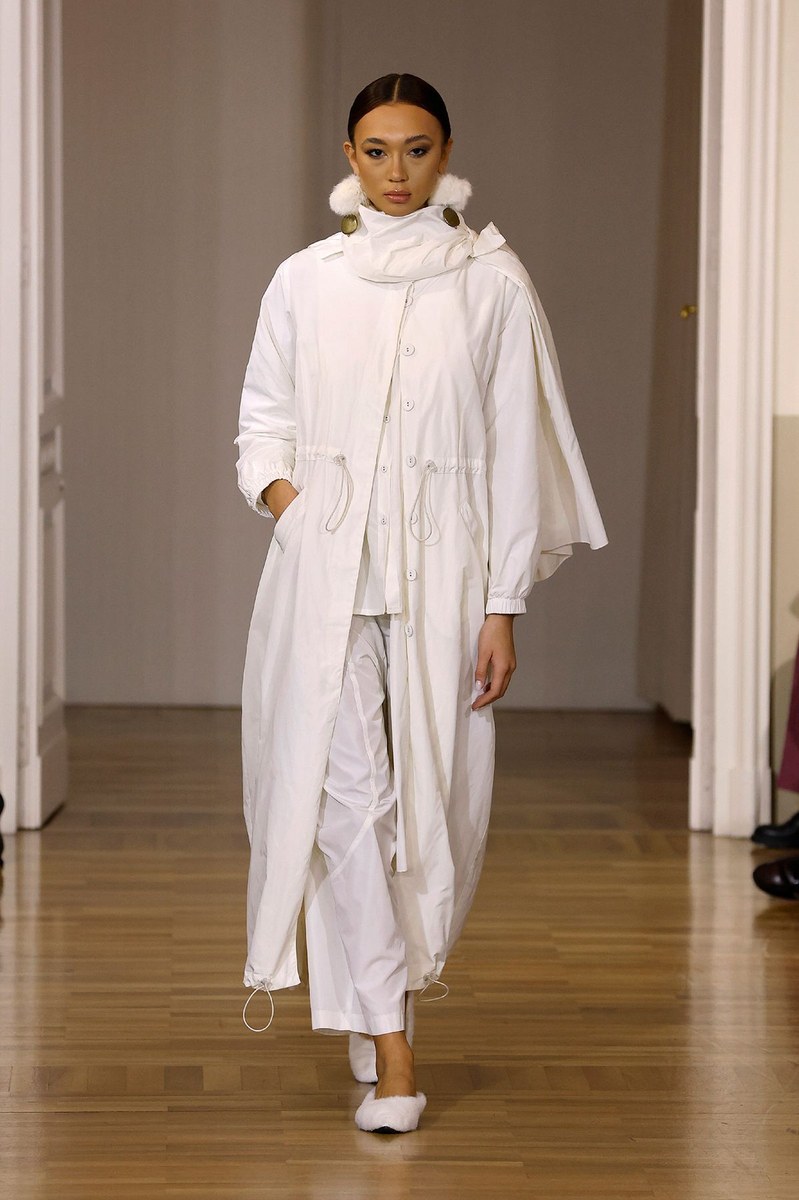
Look 1 opens with a full white cotton parka layered over a white shirt and drawstring trouser, establishing the volume and monochromatic logic that governs everything that follows.

Look 1
Look 1

Look 4 pairs a shaggy white faux-fur crop jacket with wide ivory trousers and a draped scarf-collar layer, making it the most commercially wearable fur-texture piece in the lineup for contemporary buyers.

Look 6 delivers a complete grey melange tweed suit with ballooned trousers and a layered jacket, accessorized with a grey fur bucket hat and matching fur clutch, presenting a strong head-to-toe gifting or editorial opportunity.

Look 6
Look 6

Look 9 mixes a heather grey ribbed knit sweater with a voluminous grey taffeta skirt and an oversized sculptural bead necklace, producing the strongest knit-into-suiting translation in the collection.

Look 9
Look 9

Look 12 layers a blue and grey horizontal-stripe mohair coat over a navy shirt and wide trouser, with a graduated blue disc necklace, making it the most versatile coat style for wholesale given its pattern, length, and layering potential.

Look 12
Look 12

Look 15 puts the moss-and-tobacco stripe mohair coat in its full-length version with a fur bucket hat in mink brown and a chunky amber bead necklace, functioning as the statement outerwear key look for the brown chapter.

Look 15
Look 15

Look 19 closes with a floor-length black taffeta cape coat worn over a black shirt and cropped wide trouser in total darkness, functioning as a strong anchor piece for buyers building a black outerwear capsule.

Look 19
Look 19

Operational Insights

Stripe mohair fabric: The horizontal stripe mohair-blend cloth appears across at least four looks in two colorways, green-tobacco and blue-grey, signaling it as a key fabric investment. Early orders on this cloth make sense given it likely runs in limited yardage.

Fur trim strategy: Real and faux fur appear as detachable or accessory-level elements, hats, cuffs, and clutches, rather than as full garment construction. Product managers can plan these as add-on SKUs at a lower price tier to drive attachment rate.

Color floor-set logic: Four chapters, white, grey, navy, and brown-black, map directly onto a seasonal floor-set plan with clear visual breaks. Style directors should consider presenting these as separate capsules rather than mixing across the color story.

Drawstring waist construction: Drawstring closures appear on trousers, coats, and tops across multiple looks, reducing the need for precise sizing in production. This construction detail supports a wider size run with fewer fit variables, which matters for brands expanding into extended sizing.

Taffeta and technical fabric repeat: The same crisp taffeta appears in white, navy, and black across Looks 1, 11, 17, and 19, suggesting a single base cloth dyed to purpose. Buyers sourcing the line should ask about cross-dye availability to maximize margin on a shared material.

Complete Collection

Look 2
Look 2
Look 5
Look 5
Look 7
Look 7
Look 8
Look 8
Look 10
Look 10
Look 11
Look 11
Look 13
Look 13
Look 14
Look 14
Look 16
Look 16
Look 17
Look 17
Look 18
Look 18
Look 20
Look 20
Look 21
Look 21
Look 22
Look 22
Look 23
Look 23
Look 24
Look 24
Look 25
Look 25
Look 26
Look 26
Look 27
Martino Midali

About the Designer

Martino Midali was born on May 4, 1952, in Mignete, a small village in the province of Lodi, in a family he has described as simple. He moved to Milan young, worked a series of jobs, and found his way toward fashion not through any formal education or institutional path but through an instinct he was slow to name. He was looking, as he has said, for a way of earning a living that was also a way of being alive. What he found, almost by accident, was print. In the late 1970s he began designing T-shirts printed with the iconography of New York: the yellow taxis, the skyscrapers, the faces of rock stars, the visual grammar of a city that represented freedom and modernity to a generation of young Italians. The shirts circulated. Boutiques wanted them. He had not planned to build a company, but a company had begun to build itself around him.

The leap from T-shirts to a proper fashion line came in the early 1980s, and the decision that defined everything that followed was a technical one: he began using jersey and knitwear to make jackets, skirts, and trousers, at a moment when those fabrics were considered incompatible with structured tailoring. He became, in his own understated account, a precursor of the elastic waistband, a small but consequential act of democratization in how Italian women were allowed to dress. The clothes wrapped and moved and required nothing from the body wearing them. The waistband did not grip. The jacket did not force. His customer was not a type or an age bracket but any woman who wanted to feel her own shape rather than a garment's expectations. From the first store in Corso di Porta Ticinese in Milan, the business expanded across Italy and eventually into New York, reaching more than fifty monobrand stores at its peak.

Nearly fifty years after his first collection, Midali continues to design the brand entirely himself. His SS26 collection, titled "Midali-tude," shown at Milan Fashion Week in October 2025, was built around the concept of attitude as identity, the idea that wearing his clothes should feel like a physical expression of a woman's particular way of being in the world. He has written a biography, "La Stoffa della Mia Vita," in which he traces the arc from Mignete to Milan, and credits a chance encounter with a loyal customer who told him she had worn the brand for twenty years without ever knowing what face was behind it. She asked him to write his story. He did.

"I wanted to find a job that was a way of life, an activity that would allow me to be happy. That's why I started designing T-shirts. I certainly didn't think of setting up a company like this."

"I don't just sell a dress, but a shape to wear and decode."

✦ This report was generated with AI — combining human editorial vision with Claude by Anthropic. Because the future of fashion intelligence is already here.