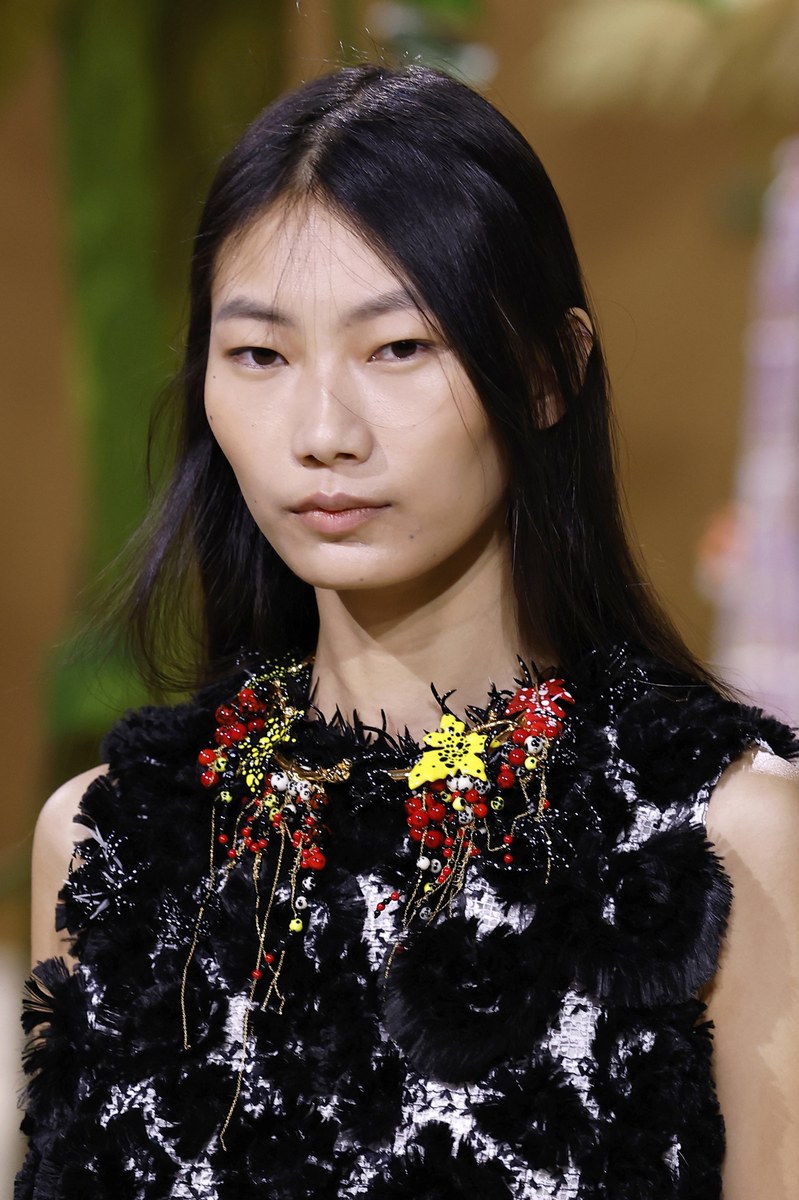
Masha Popova FW26 Women Looks Report

Masha Popova FW26 Women Looks Report
Masha Popova FW26 Women Looks Report

London Fashion Week

Masha Popova builds FW26 around the collision of worn denim, blurred tie-dye silk, and body-exposing silhouettes that treat exposure and coverage as equal design tools rather than opposing choices. For buyers navigating a market saturated with quiet luxury, here's the counter-offer, one that sells on visual noise, craft-heavy surface work, and a Gen Z customer already primed by the brand's online following.

Silhouette and Volume

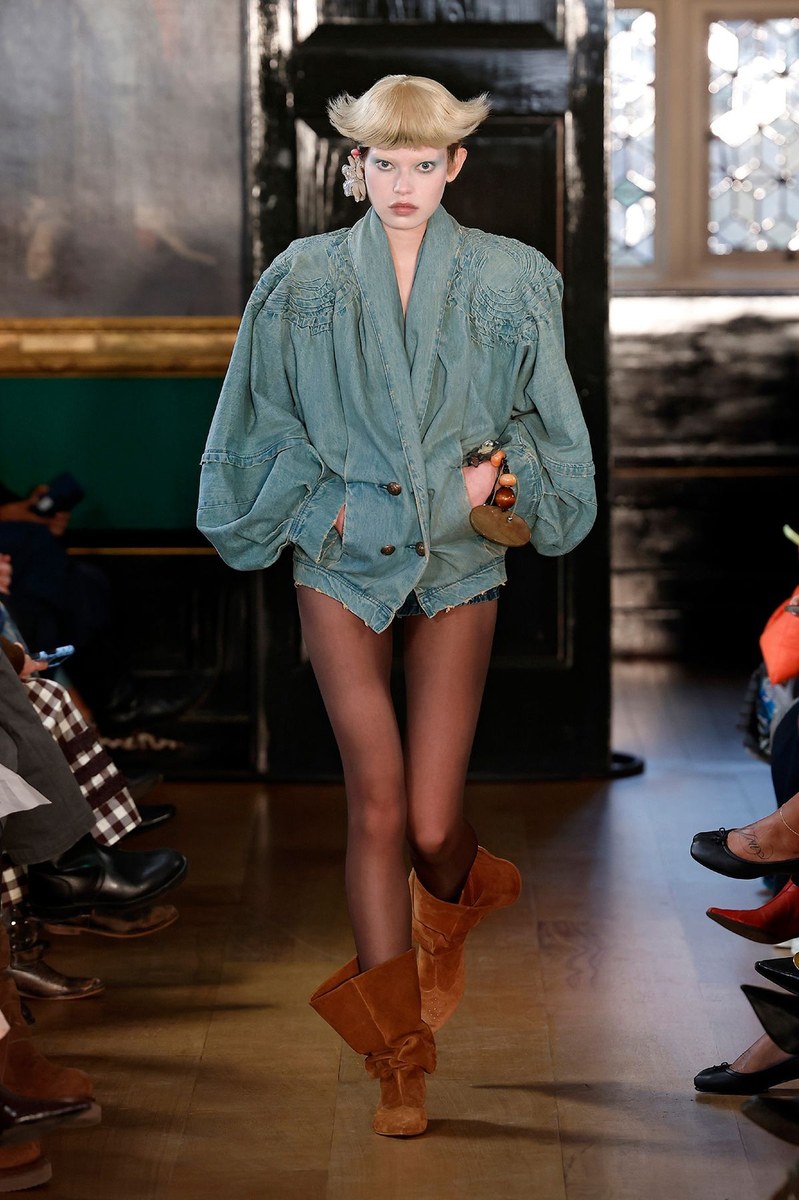
The collection splits between two poles: extreme volume through ballooned sleeves and oversized outerwear, and radical compression through micro shorts, halter knots, and body-skimming minis. Look 1 carries puffed kimono sleeves on a denim jacket cut just above the hip, while Look 6 repeats that ballooned-arm logic in khaki taffeta. Coats in Look 11 and Look 19 swing to full-length cocoon shapes, both belted at the waist to prevent total formlessness. Proportional contrast is the recurring formula, one volume-heavy piece anchored against bare legs and slouched knee-high boots.
Look 1
Look 1

Color Palette

Washed indigo and mid-blue denim anchor across at least six looks, ranging from faded pale to saturated medium wash. Tie-dye silk pieces in Look 7, Look 8, Look 13, and Look 14 share a recurring aurora palette of lavender, sage green, and teal that bleeds into warm amber and rust at the edges. Look 12 breaks the cool register entirely with an off-shoulder mini in scalded orange and red with powder-blue pooling. Camel suede boots thread through nearly the entire collection as a warm neutral that prevents the cooler tones from reading as too cold.

Look 7
Look 7

Materials and Textures

Denim is the primary medium, appearing in multiple constructions: rigid structured corsetry in Look 16, draped and gathered skirt masses in Look 9, and softened laser-etched botanical prints in Look 2. Tie-dye pieces read as lightweight satin or charmeuse, with enough fluidity to drape and cling simultaneously, as seen in the wrap coat of Look 13 and the ruffled halter of Look 8. Look 5 introduces a heavily textured knit in ochre with a distressed, almost felted surface that reads as reclaimed. Look 19 uses what appears to be terry cloth or velour in hot pink, a deliberately domestic, bathrobesourced reference executed at coat scale.

Look 16
Look 16

Styling and Layering

A voluminous or structured top layer sits over almost nothing beneath, relying on sheer dark hosiery to bridge the gap between outerwear and bare skin. Look 4 layers an oversized belted trench over a striped shirt and wide-leg trousers, the one look that builds coverage from the bottom up rather than the top down. Accessories run toward sculptural resin and stone necklaces, mismatched earrings, and chain belts, all functioning as artisanal punctuation rather than polished finishing. Camel suede knee-high boots appear in at least eight looks, functioning as a house signature shoe and a production priority for wholesale.

Look 4
Look 4

Look by Look Highlights

Look 2 pairs a denim halter bow with wide-leg denim trousers printed with leaf motifs in a darker indigo, making it the strongest candidate for editorial placement and the most direct denim-on-denim commercial proposition.

Look 2
Look 2

Look 9 constructs a draped denim maxi skirt from what appears to be deconstructed jeans panels, worn with a one-shoulder printed knit top, positioning it as the statement runway piece that communicates the brand's upcycling aesthetic most legibly to press.

Look 9
Look 9

Look 10 pairs a shearling-collared aviator jacket in washed blue leather with painted denim trousers and a leather harness belt, making it the strongest outerwear buy for markets where utilitarian layering drives volume.

Look 10
Look 10

Look 11 sends a single-button oversized wool-blend coat in slate blue down the runway with only pink thigh-high socks and gold loafers underneath. That reduction makes it the most directly wearable and retailer-friendly piece in the lineup.

Look 11
Look 11

Look 13 layers a gold and blue abstract-print charmeuse wrap coat over matching printed leggings, creating a total-look print coordination that translates well into curated online retail where full-look imagery drives conversion.

Look 13
Look 13

Look 16 constructs a full denim look from a lace-up corset bodice, open-shoulder sleeves, and a floor-length skirt assembled from multiple denim pieces, making it the most complex production ask and the strongest candidate for a limited-run capsule.

Look 19 delivers a floor-length hot pink terry robe coat belted at the waist with camel suede boots visible at the hem. The contrast between the domestic fabric and the runway context is the clearest single-look distillation of Popova's brand humor.

Look 19
Look 19

Look 12 presents a strapless off-shoulder mini dress in orange, red, and blue tie-dye with a smocked bodice, combining print intensity with a construction technique that compresses well into e-commerce thumbnails and performs reliably in social content.

Look 12
Look 12

Operational Insights

Denim development: Multiple finishes within the same material are essential, including laser etching, panel deconstruction, rigid corset boning channels, and soft draping weights. Buyers should confirm whether Popova produces these in-house or through specialist denim mills before committing to reorder minimums.

The camel suede boot: This single shoe style appears across more than half the collection and functions as a commercial anchor. Style directors should treat it as a hero SKU with strong cross-look versatility and negotiate early on production quantities given lead times for suede sourcing.

Tie-dye silk capsule: Looks 7, 8, 13, and 14 share a print family that reads as a cohesive drop-ready capsule. Product managers should isolate these four looks as a standalone deliverable for Q3 digital marketing, where the aurora colorway and fluid drape photograph cleanly against neutral backdrops.

Sizing and exposure calibration: Multiple looks build their proportional impact on minimal bottom coverage and sheer hosiery. Buyers for markets with conservative sizing conventions should flag this early and discuss adaptation options, specifically whether the brand offers alternative bottom weights or length extensions without destroying the silhouette logic.

Accessories as margin builders: Sculptural necklaces, resin earrings, and chain belts appear throughout and are low-cost, high-visual-impact additions that carry the brand's craft language into an accessible price tier. Style directors should push for these to be sold as standalone accessories, also as runway styling, to capture incremental margin from customers who buy into the aesthetic before committing to a full garment.

Complete Collection

Look 3
Look 3
Look 5
Look 5
Look 6
Look 6
Look 8
Look 8
Look 14
Look 14
Look 15
Look 15
Look 17
Look 17
Look 18
Look 18
Look 20
Look 20
Look 21
Look 21
Look 22
Look 22
Look 23
Look 23
Look 24
Look 24
Look 25
Look 25

About the Designer

Childhood in post-Soviet Ukraine formed the foundation of Masha Popova's approach to fashion, though she arrived at design through an unexpected route. Growing up first near a railway depot where her father worked, then later in the coastal city of Odesa, she encountered a world where mainstream fashion brands were absent and second-hand markets ruled. Without access to Zara or H&M, mixing and mismatching became second nature, creating a formative relationship with clothing that valued transformation over trend-following.

Architecture came first. Popova studied the discipline while working alongside her studies, but the monotonous survey work left her unfulfilled. The transition to fashion happened when she applied to Central Saint Martins, moving to London to pursue what would become both bachelor's and master's degrees. Her architectural background provided a structural, process-driven approach that would later distinguish her work. At CSM, she discovered fashion's visual language through archive magazines and films, compensating for what had been a deliberately limited cultural exposure during her Ukrainian upbringing.

The designer's internships at Celine under Phoebe Philo and Maison Margiela with John Galliano provided technical grounding, though she admits to not initially knowing Galliano's work when she started at CSM. Her aesthetic draws from this collision of references: the raw energy of 90s and 2000s culture, childhood memories of industrial landscapes, and the subversive beauty found in imperfection. David Cronenberg, Madame Grès, and Henri de Toulouse-Lautrec represent her creative touchstones, while her design process centers on working directly with mannequins and fabric experimentation rather than preliminary sketching.

Today, Popova operates her eponymous brand from London, where she has become known for deconstructed denim pieces that blend fantasy with Ukrainian heritage. Selected as a BFC NEWGEN designer, her work has found favor with celebrities including Dua Lipa, Billie Eilish, and Bella Hadid. Her collections interrogate concepts of luxury and sensuality while maintaining wearability, often incorporating techniques like bleaching, deconstruction, and hand manipulation of materials. Recent collaborations include a partnership with Desigual to reinterpret their archive through her denim expertise.

"I don't like to do techniques I'm comfortable with. When I experiment, I often prefer how mistakes look. I like the risk." "Fashion is a message we use to communicate visually with the world. And if the message isn't powerful enough, what's the point in sending it?"

✦ This report was generated with AI — combining human editorial vision with Claude by Anthropic. Because the future of fashion intelligence is already here.