
Max Mara FW26 Shoes

Max Mara FW26 Shoes
Did you know? Max Mara's iconic camel coat, introduced in 1951, became the first luxury ready-to-wear outerwear piece to achieve widespread professional and cultural status comparable to haute couture, establishing the template for modern luxury sportswear that still dominates designer collections today. The coat's success fundamentally shifted how the industry valued ready-to-wear construction and materials, proving that mass production could maintain the craftsmanship standards previously reserved for bespoke tailoring.

Max Mara FW26 Shoes Report

Max Mara FW26 commits entirely to the flat over-the-knee boot, presenting a single silhouette across eight looks in two colorways with controlled variation in height and drape. For buyers and product managers, this level of focus signals a deliberate commercial bet on the flat boot as a season-defining hero unit, not a runway footnote.

Silhouettes and Construction

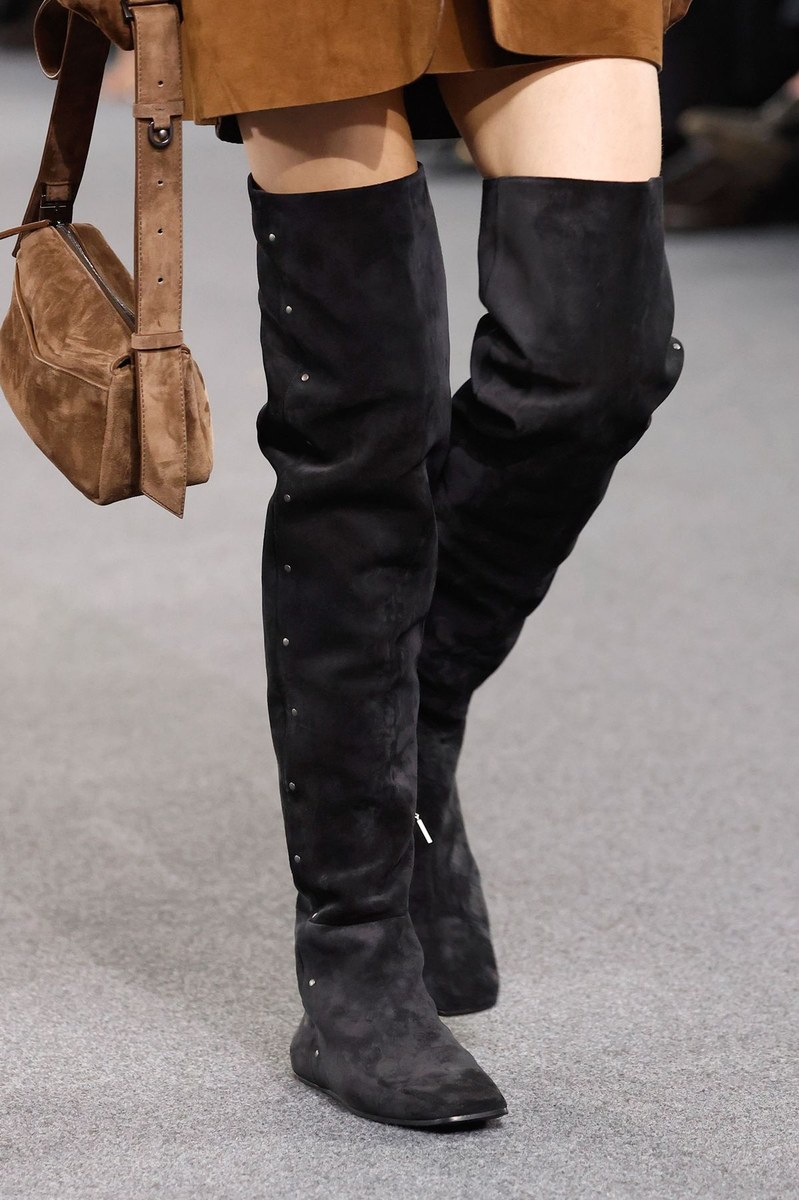
Every boot sits at zero heel, built on a flat leather outsole with a squared-off, slightly blunted toe. Heights range from just above the knee in Shoes 4 and 5 to a mid-thigh column in Shoes 1 and 2, with the remaining styles landing at varying points between those two poles. The leg shaft is cut in soft, unstructured suede that relies entirely on the leg for shape, with no boning, elastic, or stiffening panel visible in any model. A seam runs along the outer shaft from toe to top, serving as both a structural and decorative line.
Materials and Finishes

All eight boots appear to be constructed from a matte, mid-weight suede with a slightly napped, lived-in surface texture rather than a pristine finish. Natural variation in tone across the shaft reads as intentional, giving each boot a worn-in character consistent with the broader aesthetic at play. Outsoles appear to be thin, flat leather with a minimal profile and no visible rubber insert or lug. No visible lining, buckles, or straps appear anywhere across the range.

Color Direction

The palette is strictly limited to three tones. Black appears in Shoes 1, 3, and 6, with slight charcoal variation visible in the lower shaft suggesting the suede has not been uniformly dyed. Taupe grey covers Shoes 2 and 7, a warm, dusty tone that sits closer to mole than true grey. Cognac tan dominates Shoes 4, 5, and 8, a medium brown with warm red undertones that connects directly to the suede bag and outerwear in the same looks. This reinforces a head-to-toe tonal strategy that buyers should note as a cross-category opportunity.

Key Models and Details

A vertical line of small, silver-toned dome studs runs along the outer seam from the ankle upward across all eight boots, approximately 2.5 to 3 centimeters apart. These studs appear in every colorway and height variation, functioning as the collection's primary hardware signature. The closures are not immediately visible in most shots, but a small zipper pull appears at the inner ankle on Shoes 1, 3, and 6, suggesting a short zip entry rather than a full-length zip. No visible logo or branding placement appears on the exterior of any boot.

Shoe by Shoe Highlights

Shoe 1 Reaches mid-thigh in black suede with the stud detail running the full outer seam length, making it the most editorial height in the lineup and the strongest candidate for press and window display.

Shoe 1
Shoe 1

Shoe 2 Presents the same mid-thigh height in taupe grey suede, the single most commercially versatile colorway given its ability to read as a neutral across both warm and cool wardrobes.

Shoe 2
Shoe 2

Shoe 3 Captures the boot in motion in black, revealing how the unstructured shaft collapses and folds at the knee. This matters for buyers evaluating fit consistency across size runs.

Shoe 3
Shoe 3

Shoe 4 Shows the cognac boot at its most structured, rising just above the knee with a clean, upright shaft that demonstrates how the suede performs when the leg fills the boot fully.

Shoe 4
Shoe 4

Shoe 5 Displays the cognac version in a slightly taller format with the shaft sitting smooth and column-like against a neutral coat, confirming the tone coordinates directly with camel and oatmeal outerwear.

Shoe 5
Shoe 5

Shoe 6 Presents the black boot at approximately knee height with visible bunching at the upper shaft, illustrating a deliberate oversized fit. Product managers should size up in the pattern to replicate this correctly.

Shoe 6
Shoe 6

Shoe 7 Shows the taupe grey version folded down at the top, revealing that the boot can be worn as a below-knee style as well. This doubles the styling flexibility and the retail story.

Shoe 7
Shoe 7

Shoe 8 Appears in cognac partially hidden beneath a shearling hem, but the ankle and toe box construction are fully visible, confirming the squared toe shape and the flat outsole profile consistently across the range.

Shoe 8
Shoe 8

Operational Insights

Stud sourcing: The dome studs appear consistently across all eight boots in the same finish, indicating a single hardware component used at scale. Buyers should plan for high-volume stud sourcing with a silver or gunmetal finish and confirm the attachment method, riveted versus sewn, before locking production.

Suede grade: The surface texture and natural tonal variation across the shaft suggest a mid to full-grain suede rather than a split suede or suede-effect synthetic. Product managers should specify nap direction and finishing standards carefully to replicate the tonal depth visible in the photos.

Shaft height grading: Three distinct heights appear across the eight looks. Treat these as separate SKUs rather than size variants, since the over-the-knee, at-the-knee, and below-the-knee reads each serve a different consumer and a different price tier.

Colorway priority: Cognac appears across three looks, black across three, and taupe grey across two. A buy ratio of 40 percent cognac, 40 percent black, and 20 percent taupe grey reflects the runway weighting and covers both the warm-neutral and classic-dark customer segments.

Flat sole durability: A flat leather outsole with no rubber layer will wear quickly on urban pavement. Buyers selling into mid-tier retail or direct-to-consumer channels should push vendors to add a thin rubber half-sole or at minimum a rubber toe tap to reduce return rates related to sole wear.

✦ This report was generated with AI — combining human editorial vision with Claude by Anthropic. Because the future of fashion intelligence is already here.