Max Mara FW26 Women Looks Report
Milan Fashion Week
Max Mara FW26 builds a wardrobe around one sustained argument: that luxury lives in material weight, tonal restraint, and silhouettes generous enough to move without effort. For buyers operating in a market fatigued by maximalism, this collection lands as a direct and commercially legible alternative.
Silhouette and Volume
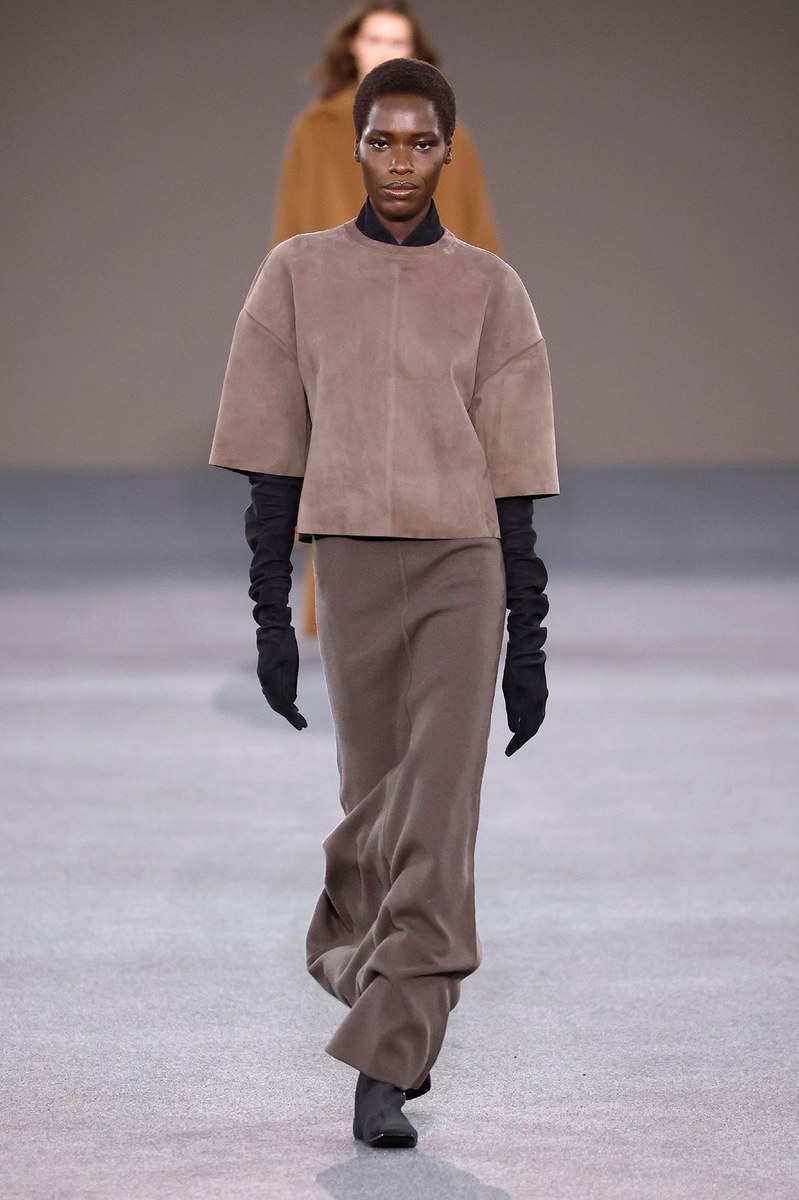
Volume dominates at the shoulder and through the leg, with cropped or boxy tops paired against floor-length or thigh-high bottoms across nearly every grouping. Look 1 sets the template early, a squared suede top over wide-leg trousers, and the logic repeats with variation through Look 16 and Look 17. Cocoon coats in Looks 2, 6, and 15 carry the bulk outward rather than inward, creating drape rather than structure. Look 4 breaks rank with a fitted turtleneck dress featuring a ruffled hem, introducing the body as a deliberate counterpoint to the prevailing looseness everywhere else.
Color Palette
An almost unbroken line runs from warm camel and tobacco through taupe and khaki to deep espresso brown, with black arriving late as a punctuation mark in Looks 14 and 20. Look 9 pulls the warmest note, a pure amber suede that reads closer to burnt ochre than standard camel. Grey-taupe groupings in Looks 12, 13, 17, and 18 form a cooler mid-chapter that prevents the collection from reading as monolithic. Rather than recurring throughout, black functions as a closing statement, which keeps the overall mood rooted in earth rather than contrast.

Materials and Textures
Suede dominates. It appears as outerwear in Looks 3, 5, and 9, as structured short tops in Look 1, and as a paneling accent on the shoulders of Looks 10, 11, and 12, where it combines with heavy wool melton or alpaca-blend coatings. Heavy wool fabrics carry visible weight and close nap, reading matte and dense rather than fluid. Look 8 introduces cognac nappa leather in a long zipped dress with visible topstitching, the sole slick surface in an otherwise entirely matte collection. Satin enters the edit in Looks 19 and 20, a fluid chocolate charmeuse gown and a black bias-cut column, which shift the texture register entirely for an evening proposition.
Styling and Layering
Long suede gloves recur as the single most consistent accessory, appearing in at least twelve looks and functioning as a layering piece rather than a decorative add-on. They extend the sleeve line, fill the gap between coat hem and hand, and in Look 7 they match the camel tone of the full fleece tracksuit precisely enough to read as part of the garment. Footwear splits between thigh-high suede boots in matching or near-matching tones, seen in Looks 3, 5, 9, 12, 13, and 18, and flat square-toe ankle boots or loafers that let the trouser hem fall cleanly. A recurring suede bag, structured in a duffle-adjacent silhouette with strap knots, carries across multiple looks and tones without variation in shape, signaling a clear hero bag strategy.

Look by Look Highlights
Look 2 delivers the collection's purest outerwear statement, a floor-length camel double-faced wool coat with a collapsed lapel worn over a tonal suede dress, making it a standalone top-of-range piece for coat buyers.

Look 4 stands apart for its body-conscious turtleneck dress in taupe-brown boiled wool with a built-in ruffle sweep at the hem, the one silhouette in the collection with direct eveningwear and occasion crossover potential.

Look 6 presents the cape as a volume alternative to the coat, in clean camel with a zip closure at the neck and wide-leg matching trousers visible beneath, giving product managers a strong separates-or-set story to work with.

Look 8 is the collection's most production-intensive piece, a cognac nappa leather zip-front midi dress with curved topstitching seams, low in versatility but high in editorial and wholesale headline value.

Look 9 reads as the season's strongest single-material look, amber suede from glove to thigh-high boot to wrap mini dress, creating a head-to-toe tone match that makes the accessories the margin play for buyers.
Look 13 combines a grey-taupe alpaca open coat with a ribbed knit shorts set and a belted waist, the most directional proportioning in the collection and the strongest entry point for buyers targeting a younger or more trend-forward door.

Look 19 introduces silk-faced charmeuse in a deep tobacco brown turtleneck gown with a fur-trimmed yoke, giving the collection an evening exit that stays within the palette logic and does not require a separate capsule strategy.

Look 20 closes with a black bias satin column gown worn under a cropped leather bolero with a shearling collar, a deliberate contrast of hard and liquid that positions Max Mara in the formal market without abandoning the material codes of the broader collection.

Operational Insights
Gloves as a category driver: Long suede gloves appear across roughly twelve looks in brown, taupe, black, and camel colorways and are already styled as a functional layering piece rather than an accessory flourish. Buyers should treat this as a standalone SKU with strong attachment potential at point of sale.
Hero bag consolidation: A single duffle-silhouette suede bag with knotted straps recurs throughout the collection in four to five color variants. This signals a single-style strategy that simplifies assortment planning and concentrates demand on one reproducible form.
Suede as the primary fabrication: Outerwear, footwear, bags, gloves, dresses, and paneling on wool coats all feature suede. Product managers should evaluate suede sourcing and capacity early, as this material throughline will drive demand across multiple categories simultaneously.
Tonal dressing as a merchandising system: The collection is built almost entirely on same-tone or adjacent-tone pairings rather than contrast. Style directors can use this as a floor presentation logic, grouping by color family across tops, bottoms, outerwear, and accessories to increase units per transaction.
Evening as a capsule exit: Looks 19 and 20 introduce satin fabrication and formal silhouettes that sit cleanly within the collection's palette but serve a distinct occasion need. Buyers with formal or occasionwear floor space should consider pulling these two looks as a focused two-piece capsule rather than integrating them into the main ready-to-wear assortment.
Complete Collection


About the Designer
Ian Griffiths Creative Director, Max Mara
Ian Griffiths grew up in England during the era when Manchester was producing music that rewired the cultural imagination of an entire generation. The late 1970s and early 1980s, the era of post-punk, New Wave, and the Factory Records scene, shaped his understanding of the relationship between subcultural energy and visual identity. He was bleach-haired and Bowie-obsessed as a young man, the kind of person whose aesthetic formation had nothing to do with luxury and everything to do with the raw, argumentative spirit of the city's clubs and record shops. He enrolled at architecture school before switching to fashion, a sequence that turned out to be formative rather than accidental. The architectural training taught him to design for the end user rather than for himself, and that principle has been the backbone of everything he has made since.
His tutor at Manchester Polytechnic, the legendary Ossie Clark, recognized something in him and pushed him toward the Royal College of Art. It was during his first term at the RCA, in 1985, that Max Mara presented a design competition to the students. Griffiths entered without expecting much, nearly abandoned the project at two in the morning when his black marker ran out, was saved by a flatmate returning from a nightclub with a spare pen in her bag, and won. The connection to the house the competition established led to his joining Max Mara as a designer upon graduating with his MA in 1987. He has not left since, which he acknowledges is the shortest CV in the industry. His first decade at the brand was spent operating anonymously inside the company's tradition of keeping designers unnamed. It was only in 2005, with the Maramotti family's blessing, that he emerged publicly as the lead creative voice.
In the nearly four decades since, Griffiths has created some of the house's most enduring pieces, including the Teddy Bear coat, launched in 2013, now one of the most recognized garments in the brand's extensive archive. His creative process is grounded in literary and historical research: collections have been built around Colette, around the 1970s feminist movement, around the architecture of Venice, the last of which brought him to recreate for the Resort 2025 collection pieces he had originally designed as a student in 1985, pulled from his loft and found to be still relevant. He reads, he annotates, he maintains mood boards heavy with photography, and he insists that his role is not to impose vision but to help a woman forget what she's wearing and get on with her life.
"Manchester taught me about raw energy and creativity, but the RCA taught me how to channel that energy into making something useful. It's where I developed my commitment to good design."
"Over the 30 plus years I've been with the brand, I've got to know the Max Mara woman as if she were my best friend. I want the best for her."
✦ This report was generated with AI — combining human editorial vision with Claude by Anthropic. Because the future of fashion intelligence is already here.