Max Zara Sterck FW26 Women Looks Report
Milan Fashion Week
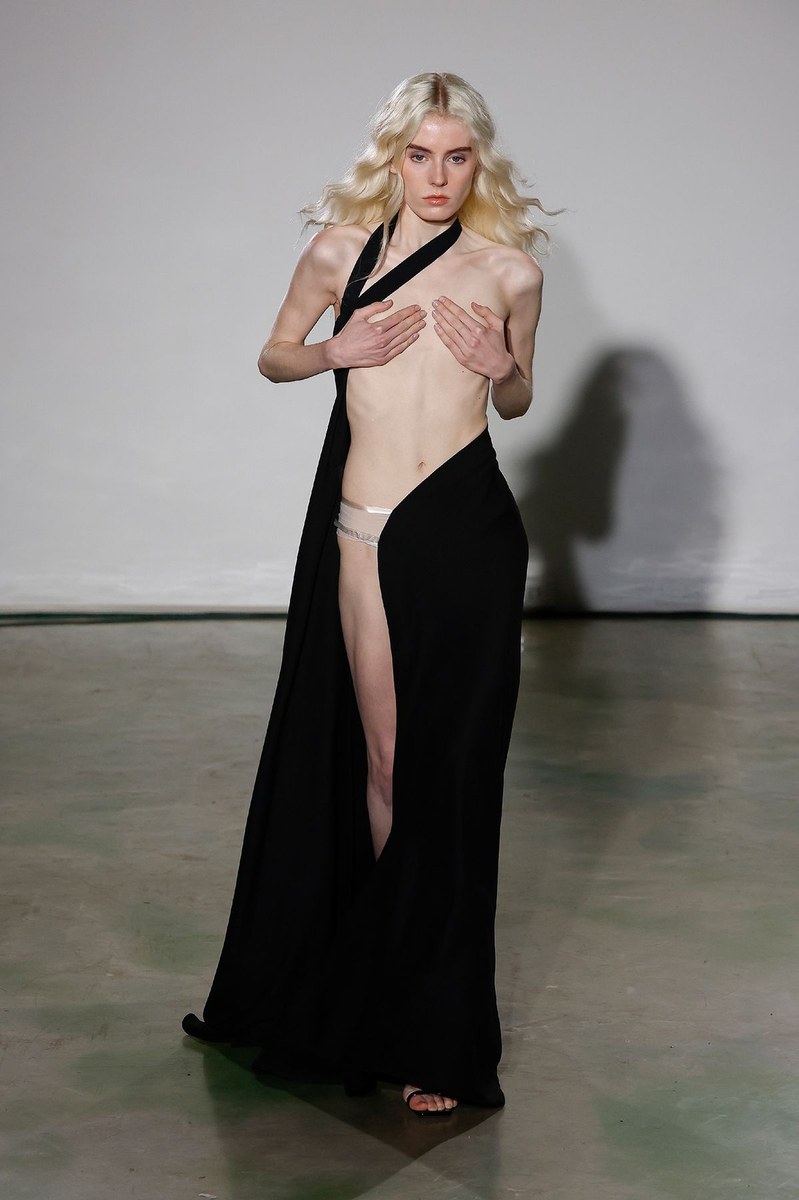
Max Zara Sterck builds FW26 around the body as an exposed architectural structure, using strategic negative space, binding, and sheer layering to make absence of fabric as deliberate as presence. For buyers operating in a market where quiet luxury has plateaued, this collection repositions sensuality as a construction problem, not a styling afterthought.
Silhouette and Volume
The collection splits cleanly between two registers: floor-length columns with deep slits or sheer panels (Looks 1, 3, 4, 12) and cropped-to-high-waist pairings over wide or straight trousers (Looks 7, 10, 13, 16). Neither reads as maximalist. Volume, when it appears in Look 8's draped white wide-leg trousers, is controlled and low to the ground, pulling weight downward rather than outward. Sharp shoulder architecture comes through in the truncated blazer and turtleneck crops of Looks 7 and 5, grounding the otherwise body-forward vocabulary at play throughout.
Color Palette
Black dominates with near-total authority, running across matte crepe, sheer mesh, liquid faux leather, and structured wool in Looks 1 through 7 and 11 through 19. An off-white that reads closer to bone or oyster than true white punctuates the lineup, appearing in Looks 6, 8, 13, and the satin mini skirt of Look 9. Black-and-white combinations in Looks 8 and 9 create the sharpest contrast moments, forming a graphic binary that could translate directly into a commercial capsule. Look 10's nude bodice, studded with black oval embellishments, stands as the single most chromatic departure and also the most editorial.

Materials and Textures
Sterck works primarily in matte fluid crepe, sheer silk-weight mesh, and high-gloss faux or genuine leather, with each material assigned a specific structural role rather than used interchangeably. Sheer mesh in Looks 9 and 12 is lightweight enough to drape without collapsing, maintaining a body-skimming silhouette that reads as a second skin rather than outerwear. Three distinct leather applications appear across the collection: the belted trench construction of Look 14, the longer shearling-collared coat of Look 17, and the laser-cut or slashed strip detailing on the mini skirt and trousers of Looks 15 and 16. Most commercially unexpected is the organza slip skirt in Look 18, its brown transparency sitting between the structured and the dissolved.

Styling and Layering
Footwear runs consistently minimal throughout: strappy barely-there sandals with thin ankle wraps (Looks 2, 6, 11) and sharp-toed patent pumps (Looks 8, 13, 16, 18, 19), with ankle boots appearing only in Look 17 where the heavier leather coat justifies the weight. Long black patent leather gloves thread through Looks 5, 7, 14, and 17, functioning as the collection's primary accessory logic and reinforcing the body-as-architecture theme. Layering is minimal and purposeful throughout: the blazer fragment in Look 18 is wrapped and knotted at the waist rather than worn as a jacket, and Look 7's cropped turtleneck sits above the trouser waistband to expose a deliberate strip of midriff. Hair is pulled severely upward in tight buns for the more structured looks and left loose and undone for the more fluid ones, creating a clear styling syntax between the two collection registers.

Look by Look Highlights
Look 1 The black halter-wrap gown with a front slit to the hip and a crystal-chain waist detail is the collection's opener for a reason: it sets the exposure-as-construction thesis immediately and reads as a red-carpet commercial proposition despite its conceptual framing.

Look 5 The structured black power jacket with exaggerated padded shoulders and a deep plunge worn over wide-leg trousers and patent gloves is the collection's most directly sellable tailoring moment, requiring no styling translation for a buyer targeting power-dressing clients.

Look 9 The sheer long-sleeve black mesh top layered over a bandeau, paired with a white satin draped mini skirt with ribbon detailing trailing behind, is the look with the highest editorial placement potential and the clearest argument for multi-piece purchasing.
Look 10 Black oval embellishments applied directly to a nude-toned body stocking above low-slung navy trousers is the collection's most production-intensive piece and the one most likely to anchor a campaign shoot or showroom display rather than enter a broad retail buy.

Look 14 The belted black leather trench with a mid-thigh slit, worn with long leather gloves and strappy heeled sandals, is the most immediately wearable outerwear piece and the strongest argument for a leather investment in a category where the market for structured topcoats remains active.
Look 15 The strapless black bandeau top with laser-cut leather strip detailing cascading across the midriff and wrapping the leather mini skirt below is the most technically complex construction in the collection and the piece most likely to generate press attention per unit cost.

Look 17 The long black leather coat with shearling lapels, black tights, and ankle boots with hardware detailing addresses a colder-climate buyer directly and carries the most straightforward outerwear commercial logic of the entire lineup.
Look 19 A navy satin triangle bralette with a cut-out connecting detail above a voluminous gathered black taffeta midi skirt worn over black opaque tights reads as the collection's most accessible evening proposition and the most likely candidate for a standalone hero piece in a resort or pre-fall edit.

Operational Insights
MOQ and construction complexity: Looks 10 and 15 involve applied embellishment and multi-material assembly that will carry high minimum order quantities and long lead times. Buyers should flag these as limited-run editorial anchors rather than depth SKUs.
Leather category commitment: Three distinct leather silhouettes (Looks 14, 15, 16, 17) across trench, mini skirt, and trouser formats suggest Sterck is positioning leather as a seasonal pillar, not an accent. Style directors should assess whether this signals a broader label shift toward outerwear expansion.
Sheer and body-con risk calibration: Looks 1, 12, and 15 require careful market segmentation. Exposure level is deliberate and consistent, not incidental, which means retail buyers should assess their client demographic before placing orders on these styles rather than expecting broad floor performance.
Black-and-white capsule extraction: Looks 8, 9, and 13 form a coherent black-and-white sub-capsule with strong graphic retail logic. Product managers could pitch these three looks as a standalone capsule buy for accounts where the more body-forward pieces present merchandising challenges.
Accessories as margin opportunity: Black patent leather gloves recur across at least four looks (5, 7, 14, 17) and carry strong commercial logic as a standalone accessory proposition. If the label produces these as a retail SKU, buyers should treat them as a high-margin add-on with broad outfit applicability beyond the runway context.
Complete Collection


About the Designer
Max Zara Sterck grew up in the Netherlands with a childhood shaped by two very different physical experiences. One was sport: she trained as a competitive gymnast from an early age and pursued it professionally until an injury ended that chapter. The other was a private, persistent visual habit she has described as pareidolia, seeing objects and shapes in everyday things, a crumpled candy wrapper, a plastic bottle, and sketching the silhouette of a female body around them. These two tendencies, the gymnast's intimate knowledge of how a body moves under tension, and the designer's instinct to find structure in random form, became the twin engines of everything she would eventually make. When she was young she was already draping fabric on dolls, which she remembers mostly being bras.
She studied fashion design at ArtEZ University of the Arts in Arnhem, graduating in 2015. The education was followed by a methodical immersion in the industry across three houses of very different registers. At La Perla she learned to work with the body's architecture at close range, developing bra construction and sculptural ready-to-wear and being given the freedom to develop a collection independently over extended time. At JW Anderson she was exposed to the research-led, conceptually rigorous approach that defines that studio. At Alexander McQueen she encountered the tradition of treating garment construction as a form of structural engineering. The combination proved decisive. She left to build her own brand, based between London and Amsterdam, with the understanding that what she wanted to make was not something she could create inside someone else's system.
The brand she founded operates on a deliberately narrow set of constraints: black and white only, focused entirely on shape, volume, draping, and movement. She works with dancers in the studio rather than static mannequins, observing how fabric behaves in motion and sketching from what she sees. Fabric sourcing is built on sustainability from the ground up, using deadstock materials from major fashion houses and developing new textiles including experiments with pineapple leather. She has shown at London Fashion Week through the British Fashion Council's digital selection programme, at Paris Fashion Week, at Amsterdam Fashion Week, and in February 2026 made her Milan Fashion Week debut with a collection titled "Rituals," showing sheath dresses, trousers, haute couture bras, and redingotes in silk, taffeta, wool, and leather.
"The female body in movement turned out to be my endless source and focus of inspiration. I want to unite the designs with the body and its flow, like a second skin, to experience freedom of movement."
"I noticed their posture changing, increasing their confidence. It almost seemed like a change in their attitude."
✦ This report was generated with AI — combining human editorial vision with Claude by Anthropic. Because the future of fashion intelligence is already here.