McDowell FW26 Details
Mcdowell FW26 Details Report
Mcdowell FW26 builds its accessories and dress detail language around two opposing poles: the austere severity of black structured suiting and the liquid softness of ivory and white bias-cut silhouettes. For buyers and product managers, this binary creates clear segmentation opportunities across both formal occasionwear and bridal-adjacent categories.
Category Overview
All seven details fall within dress construction and garment embellishment, with no standalone accessories present. The strategy is entirely intrinsic, meaning the garment itself carries the decorative and functional weight through buttons, belts, embroidery and fabric manipulation. Construction rather than add-on hardware or external accessories is where the product value lives. Buyers should read this as an investment in craftsmanship-forward pieces with elevated price-point justification baked into the sewing room.
Material and Construction
The collection moves between crisp white cotton poplin (Detail 1), matte black wool crepe (Detail 2), ivory satin (Detail 3), black duchess satin (Details 4 and 5) and black matte crepe with satin lapel contrast (Detail 6). White silk taffeta with gathered bodice construction anchors the bridal close in Detail 7. Button closures appear across four of the seven looks, confirming that functional front fastenings are a structural and visual signature throughout the range. Precise flat-fell engineering visible in the black cap-collar construction of Details 4 and 5 will carry significant production cost.

Color and Finish Direction
The dominant palette is binary: optic white and matte black, with ivory and champagne satin as the transitional third tone. Black appears in both matte crepe and high-shine duchess satin finishes, creating within-color contrast that adds visual complexity without introducing new hues. White and ivory serves the bridal and occasion market, while the all-black suiting range targets the formal and contemporary wardrobe. No color print appears until Detail 5, where a deep magenta and grey floral-print skirt peeks below the black jacket, providing the collection's only chromatic release.

Key Pieces and Details
The crystal floral buttons recurring across Details 2, 4 and 5 are the single most commercially transferable design element in the collection. They read as jewel-like hardware with a diamanté cluster set in a flower silhouette, and they function as both closure and embellishment simultaneously. Both the wide wrapped sash belt in Detail 1 and the satin ribbon tie in Detail 3 point to a waist-definition trend that product managers should track for belt and accessory adjacency planning. A gathered strapless bodice in Detail 7, rendered in champagne silk taffeta with floral appliqué trim at the hem break, positions the finale look as a direct commercial bridal proposal.
Detail by Detail Highlights
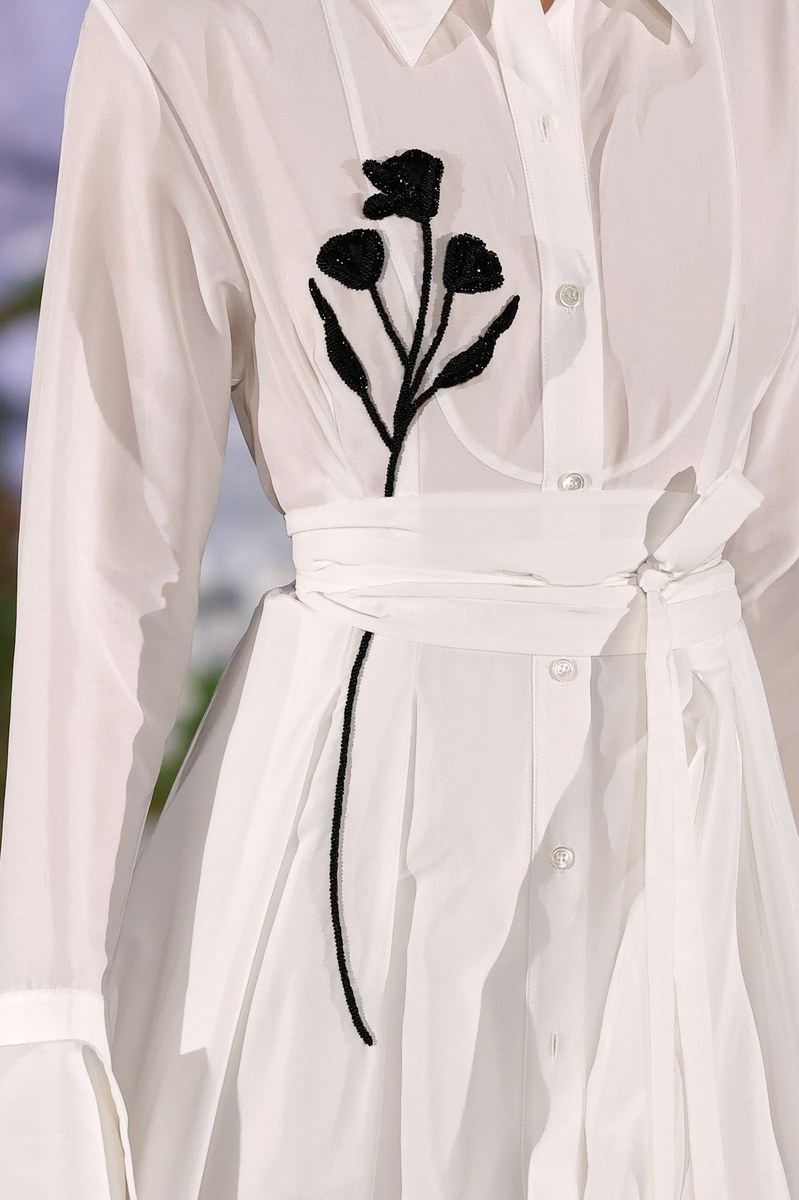
Detail 1 (Dress Detail) The white cotton poplin shirt dress carries black beaded floral embroidery at the chest and a black velvet stem that continues below the wide wrapped belt, creating a motif that reads in two registers simultaneously.
Detail 2 (Dress Detail) A black matte wool crepe jacket closes with five crystal floral cluster buttons in a diamanté silver setting, set against a clean single-breasted lapel that lets the hardware read as the primary design statement.

Detail 3 (Dress Detail) An ivory bias-cut satin skirt pairs with a ruched satin waistband that secures at the back with a narrow satin ribbon tie, the entire construction depending on fabric weight and drape to hold its form.

Detail 4 (Dress Detail) Black duchess satin is used for both a long-line button-front dress and a wide flat-folded cape collar that sits off the shoulder, the high sheen of the fabric amplifying the structural contrast between the two layers.

Detail 5 (Dress Detail) The same crystal floral button closure and cape-collar architecture from Detail 4 appears here in a jacket silhouette over a magenta floral-print skirt, confirming these construction signatures as a recurring collection code rather than a one-off gesture.
Detail 6 (Dress Detail) A black halter bodice drops to a deep V with satin-faced lapel inserts and closes below the décolletage with four large matte black domed buttons, the combination of deep neckline and buttoned closure creating deliberate tension between exposure and restraint.

Detail 7 (Dress Detail) The bridal finale bodice in champagne silk taffeta gathers into a sweetheart neckline with a central fold construction, worn with a fine gold chain necklace carrying a large flat oval pendant in white enamel and pavé diamond trim.

Operational Insights
Crystal Button Sourcing The diamanté floral cluster buttons in Details 2, 4 and 5 will require a specialist button manufacturer, likely Czechoslovakian or Japanese crystal fabrication, and buyers should confirm minimum order quantities early given the lead time on custom floral-set hardware.
Waist Emphasis Both the wide fabric sash in Detail 1 and the satin ribbon tie in Detail 3 confirm wrap-and-tie waist constructions as a repeat pattern, giving belt and waist-accessory buyers a clear signal to develop complementary standalone belts in white poplin and ivory satin for retail adjacency.
Bridal Adjacency Detail 7 presents a direct commercial bridal proposition with the taffeta gathered bodice, tulle veil and enamel pendant necklace read as a complete capsule, and bridal buyers should assess all three components as a coordinated assortment rather than individual SKUs.
Black Satin Production Cost The duchess satin cape-collar construction in Details 4 and 5 involves complex flat seaming and structural boning support beneath the collar fold, and production managers should build in additional costing for the internal structure required to maintain the collar's geometric silhouette on the body.
Print Placement Opportunity The magenta and grey floral print visible on the skirt in Detail 5 is the collection's only color print and its pairing with the all-black jacket creates a strong contrast-dressing commercial formula that print product managers and buyers can adapt into a broader separates strategy for the season.
✦ This report was generated with AI — combining human editorial vision with Claude by Anthropic. Because the future of fashion intelligence is already here.