MM6 Maison Margiela FW26 Shoes

MM6 Maison Margiela FW26 Shoes
Did you know? MM6 Maison Margiela's signature deconstruction technique involves reverse-engineering garments to expose internal seams, structural elements, and construction methods that are typically hidden from view. This design philosophy transforms manufacturing processes into visible design statements, making production transparency a core brand aesthetic rather than a hidden backend function.

MM6 Maison Margiela FW26 Shoes Report

MM6 Maison Margiela FW26 builds its footwear program around two opposing ideas: austere, pull-on riding boots stripped of hardware, and sculptural gathered-leather constructions that treat the boot shaft as a draped textile. For buyers and product managers, this split signals a clear commercial opportunity across two distinct customer profiles, the minimalist and the conceptual, within a single brand purchase order.

Silhouettes and Construction

The collection divides cleanly into three silhouette families: flat knee-high riding boots, block-heel knee-high boots ranging from approximately 6 to 8 cm, and low-cut pointed-toe pumps with a tapered cylindrical heel of roughly 9 to 10 cm. Several boots introduce elasticated gathered panels at the ankle and at the shaft opening, creating a pouched, billowing volume that reads closer to draped fabric than molded leather. Shoes 1, 9, 11, and 15 use the riding boot silhouette with a round toe, flat sole, and a clean shaft with no visible zipper or closure, relying entirely on the pull-on structure for fit. Pump silhouettes in Shoes 5, 6, 7, and 14 carry a deep-cut vamp that exposes significant foot volume, pushing the shoe toward a slipper-pump hybrid construction.
Materials and Finishes

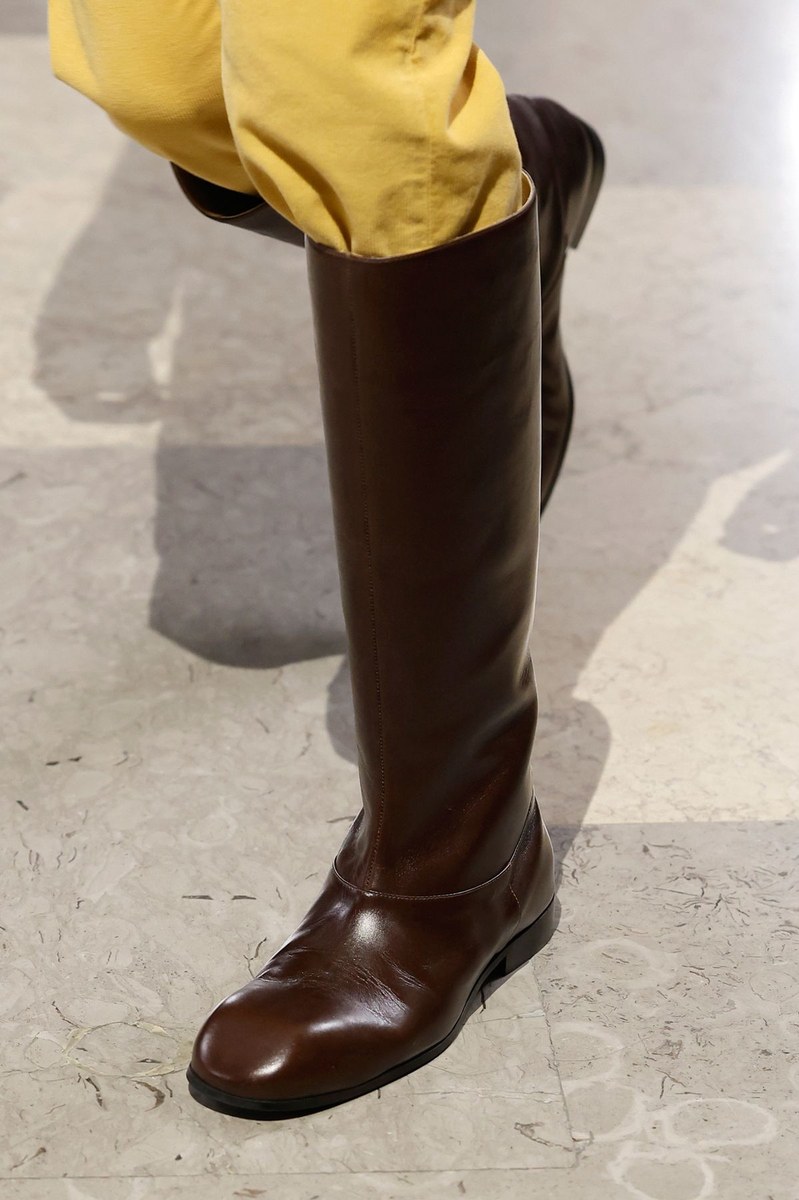
Smooth polished calf leather dominates the boot program in dark chocolate brown, appearing in Shoes 1, 4, 8, 9, 10, 11, and 15 with a semi-gloss finish that reads as refined without tipping into patent territory. High-gloss patent leather surfaces in Shoes 12 and 13 in black and white respectively, providing the sharpest surface contrast in the lineup. A matte cotton or canvas fabric appears in Shoes 2 and 3 with raw-edge gathered elastication at multiple points along the shaft, a textile construction that is structurally unusual for boots at this price positioning. Cut velvet in olive and deep burgundy appears in Shoes 5 and 6, with the nap direction creating tonal variation across the vamp, while Shoe 14 uses a crinkled or embossed leather in a muted taupe that catches light differently from every angle.

Color Direction

Dark chocolate brown anchors the collection and appears across more than half the footwear styles, establishing it as the season's primary investment neutral. Crisp white surfaces in both patent and matte leather finishes across Shoes 13, 16, 2, and 3, functioning as a sharp counterpoint that reads commercial for spring delivery but directional for a fall lineup. Black appears in Shoe 12 in a high-shine patent, and the velvet pumps in Shoes 5 and 6 bring olive and deep wine into the palette as accent tones that align tightly with the knitwear and outerwear directions already showing across FW26 market appointments. Tight and deliberate, this palette contains no metallics, no neutrals lighter than white, and no brights, which makes inventory planning considerably more straightforward than prior seasons.

Key Models and Details

The flat riding boot, represented by Shoes 1, 9, 11, and 16, is the most commercially repeatable model in the collection. Round toe, stacked flat sole of 1.5 to 2 cm, smooth uninterrupted shaft with a single horizontal seam line near the ankle, no external closure, zipper, or buckle. Shoes 2, 3, 4, and 8 use the gathered boot model with elastic ruching at the shaft opening and at the ankle break as both a functional and aesthetic device, producing excess material that pools and drapes between the two points. Shoes 10 and 15 bridge the two boot families by pairing the clean, undecorated shaft of the riding boot with a cylindrical block heel of approximately 6 to 7 cm, making them the most wearable and broadly commercial option in the lineup.

Shoe by Shoe Highlights

Shoe 1 The flat dark-brown riding boot with a round toe and hardware-free pull-on shaft is the most reorder-friendly silhouette in the collection, likely to perform across contemporary and luxury contemporary retailers without significant styling support.

Shoe 1
Shoe 1

Shoe 3 The white matte canvas gathered boot with a chunky cylindrical heel and multiple elasticated ruche points is the single most production-complex model shown, requiring sourcing for stretch-bound textile shaft construction alongside a traditional heel block.

Shoe 3
Shoe 3

Shoe 7 The pointed taupe leather pump with a stiletto heel of approximately 10 cm, worn with a heavy knit leg warmer held in place by a slim leather ankle strap with a rectangular buckle, combines two separate SKUs into one runway look that buyers should evaluate as independent pieces rather than a set.

Shoe 7
Shoe 7

Shoe 8 The dark brown gathered leather knee boot with a block heel introduces the ruching construction in the same colorway as the clean riding boot, which means a brand can offer both in a single seasonal brown leather story without visual redundancy.

Shoe 8
Shoe 8

Shoe 12 The black patent knee-high boot with a block heel and gathered ankle panel is the highest-contrast piece in the collection, and the patent finish raises both unit cost and visual impact considerably compared to the matte calf styles.

Shoe 12
Shoe 12

Shoe 6 The deep burgundy velvet pump with a pointed toe and a 9 cm cylindrical heel, worn against a matching ribbed knee-high sock, demonstrates how the vamp-forward pump silhouette relies on leg coverage to complete the proportion, which has direct implications for how this shoe should be merchandised on the floor.

Shoe 6
Shoe 6

Shoe 14 The taupe crinkled leather pump with a deep-cut vamp, a wooden-effect stacked heel, and no ankle strap offers a genderless, directional option that sits outside the boot-dominant narrative and may represent the strongest opening price point in the pumps category.

Shoe 14
Shoe 14

Shoe 13 The white patent flat riding boot with a tan leather sole is the most seasonally disruptive piece shown, functioning as a winter-white statement that challenges the conventional brown-and-black boot palette and will require targeted marketing support to move at retail.

Shoe 13
Shoe 13

Operational Insights

Heel architecture: The cylindrical block heel in approximately 6 to 8 cm appears across brown leather boots in Shoes 8, 10, 15, and the white styles in Shoes 2 and 3, suggesting a single heel last can service multiple upper constructions and reduce tooling costs across colorways.

Material consolidation: Dark chocolate brown calf leather appears in seven or more styles, which means a buyer placing a multi-style order can negotiate volume pricing on a single hide specification and reduce material variance across the boot program.

Textile boot risk: The gathered canvas or cotton boots in Shoes 2 and 3 carry elevated construction complexity and a shorter perceived seasonal window than leather styles; product managers should assess sell-through velocity carefully before committing to deep inventory on these models.

White boot positioning: Shoes 13 and 16 in white patent and matte leather respectively are directional rather than core commercial styles; placing them as limited-depth statement units against a stronger chocolate brown foundation will protect margin and reduce markdown exposure.

Pump category entry: The pointed-toe pumps in Shoes 5, 6, 7, and 14 offer a lower production cost entry into the MM6 footwear assortment relative to the tall-boot styles; for multi-door buyers, these styles carry stronger flexibility for styling across both apparel and footwear-focused floor sets.

More Shoes

More Shoes

More Shoes

Shoe 2
Shoe 2
Shoe 4
Shoe 4
Shoe 5
Shoe 5
Shoe 9
Shoe 9
Shoe 10
Shoe 10
Shoe 11
Shoe 11
Shoe 15
Shoe 15
Shoe 16
Shoe 16

✦ This report was generated with AI — combining human editorial vision with Claude by Anthropic. Because the future of fashion intelligence is already here.