Mossi FW26 Women Looks Report

Mossi FW26 Women Looks Report
Mossi FW26 Women Looks Report

Paris Fashion Week

Mossi FW26 builds a wardrobe around the idea of authority, pulling from the visual language of legal robes, academic dress and bureaucratic suiting to construct a collection that is simultaneously sculptural and wearable. For buyers operating in a market hungry for statement outerwear and separates with strong cultural legibility, this arrives at exactly the right moment.

Silhouette and Volume

Volume concentrates at the shoulder and upper body across nearly every look, with billowing gathered blouses, ballooned sleeves and cape-like overlays dominating the top half while skirts and trousers sweep wide at the hem. Looks 16 and 29 push this furthest, with exaggerated gathered wool bodices that balloon away from the torso before cinching at the wrist, creating an almost architectural mass. The silhouette consistently reads wide-shouldered and long-bodied. Asymmetric hems appear in Looks 5, 9, 10, 14, 17, 24 and 28, all of them draped or cut to fall at an angle rather than a straight line. Trousers run extremely wide-leg, as in Looks 3, 11, 23 and 26, grounding the upper volume with an equally generous floor-skimming base.
Color Palette

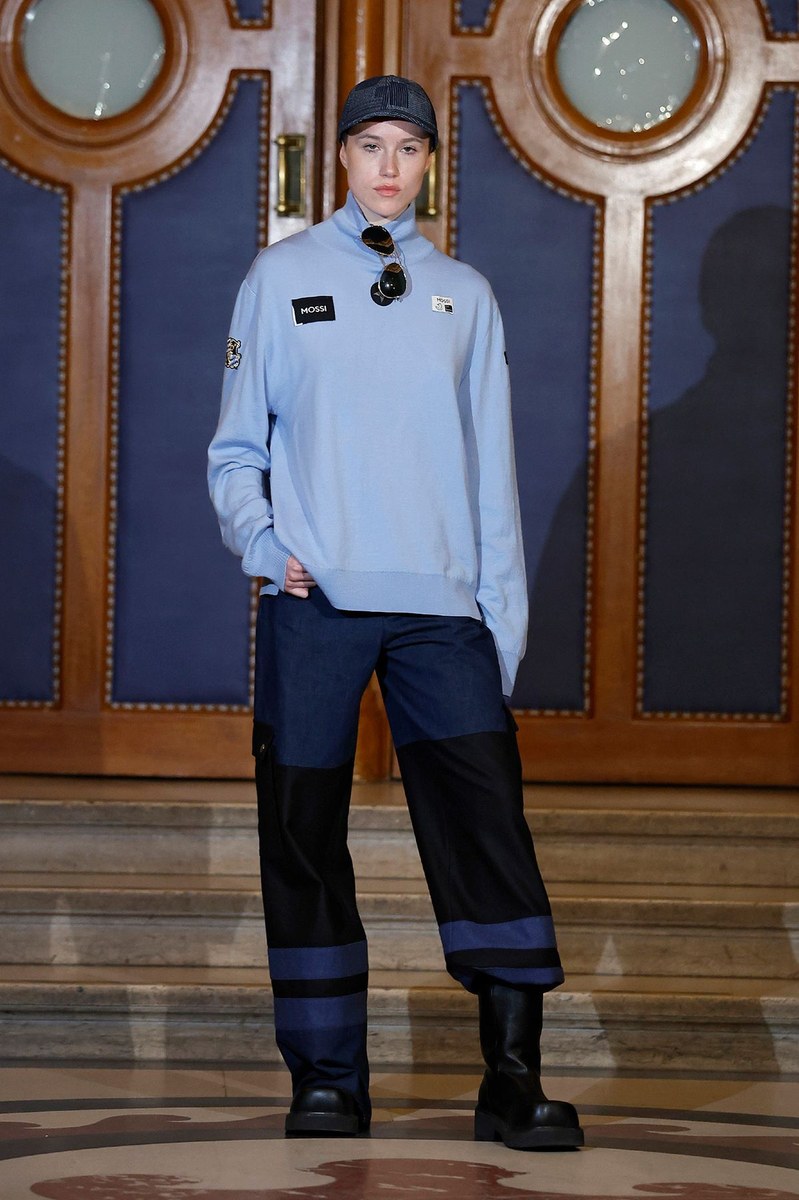
Black, navy and chalk white anchor the collection, appearing across more than two thirds of the looks. Warm earth tones run as a secondary register that gives real warmth without softening the severity: raw sienna brown in Look 2, khaki olive in Looks 6 and 24, camel in Looks 28 and 29, and tobacco in Looks 16 and 20. Periwinkle blue appears in Looks 1, 12, 14 and 26, functioning as the collection's single recurring accent color and the closest approach to a commercial color story for retail buyers. Rounding out the palette are the ivory halter gown of Look 13 and the beige deconstructed knit of Look 15, sitting at the pale neutral end. What emerges is disciplined, deep and appropriate for a premium autumn delivery window.

Look 2
Look 2

Materials and Textures

Wool, denim and silk-weight fluid fabrics carry the most weight across the collection, often appearing within the same look in deliberate contrast. Heavy suiting wools show up in the pinstripe overcoat of Look 4 and the glen plaid belted coat of Look 8, both with substantial body and structure. Fluid silk or silk-like fabrics pool and drape in Looks 10, 29 and 30, producing the kind of gathered puddle hems that require careful production planning for consistent retail presentation. Denim appears in a structured wide-leg format in Looks 3, 23 and 27, functioning more like a fabric choice than a category signal, alongside fine jersey and cotton poplin rather than other casual references.

Look 4
Look 4

Styling and Layering

A structured outer piece layered over a white shirt or blouse is the most consistent styling logic here, visible in Looks 4, 17, 22, 23, 24 and 30, where crisp white cotton grounds otherwise complex outer volumes. Footwear runs almost exclusively to low kitten heels and pointed-toe flats in black suede or leather. Looks 5 and 9 add stiletto pumps while Look 1 closes on chunky platform boots, the only real divergence. Accessories are deployed sparingly but with intention: the suede structured tote in Look 7, the quilted leather bag in Look 8, the oversized transparent clutch with printed motif in Look 21 and the hard-sided briefcase in Look 24 all signal a professional woman archetype. During his bow, the designer wore handcuffs, a gesture that frames the entire collection's legal and institutional references as something deliberate, political and worth reading carefully.

Look 1
Look 1

Look by Look Highlights

Look 2 The full-length chocolate brown wool coat with cape overlay, fedora and walking cane is the single strongest outerwear statement in the collection and the most immediately production-ready archetype for a coat-focused buyer.

Look 4 A black pinstripe oversize overcoat layered over a navy double-breasted dress and white shirt operates as a complete three-piece outfit system that translates directly into a curated multi-unit buy.

Look 9 The tiered navy wool cape top with asymmetric hem, worn with black satin trousers and stiletto ankle boots, is the most editorial-ready look in the collection and the strongest candidate for press placement.

Look 9
Look 9

Look 12 A cornflower blue pleated bomber jacket over a matching high-neck long dress, worn by a plus-size model with waist-length braids and neon yellow-green nails, is the most commercially inclusive look and the most likely to generate social media traction at retail.

Look 12
Look 12

Look 16 The exaggerated gathered brown wool turtleneck top, ballooning dramatically from neck to hip before cinching at the ribbed cuff, paired with a flared dark chocolate mini skirt and printed tights, is the collection's most technically complex construction and signals a real knitwear investment.

Look 16
Look 16

Look 19 White long-sleeve top with asymmetric white panel skirt and layered pearl and beaded necklace against a glen plaid maxi skirt panel reads as a wearable occasion look with strong bridal or event adjacent potential.

Look 19
Look 19

Look 30 The white gathered cape blouse with barrister-style pleated bib, worn over a draped black satin skirt with oxford loafers and white socks, is the clearest distillation of the legal robe reference and the look most likely to define the collection in retrospect.

Look 30
Look 30

Look 6 An olive green suede belted jacket with matching wide-leg trousers, interrupted by a draped black chiffon inner layer, produces a two-tone color-block effect that gives buyers a concrete color story for a coordinated suiting order.

Look 6
Look 6

Operational Insights

Outerwear depth: At least eight distinct coat and jacket silhouettes populate the collection, from the glen plaid asymmetric belted coat of Look 8 to the pinstripe overcoat of Look 4 to the olive suede belted jacket of Look 6. Outerwear buyers will find real breadth to build a focused capsule order without redundancy.

Look 8
Look 8

Fabric sourcing complexity: The mix of structured suiting wools, fluid silk-weight fabrics and stiff cotton poplin within single looks will require multi-supplier coordination and careful fabric-to-silhouette mapping during production, particularly for Looks 29 and 30 where drape and structure coexist in the same garment.

Color story scalability: Periwinkle blue threads through Looks 1, 12, 14 and 26, presenting the collection's most commercially accessible accent and the clearest candidate for a focused colorway story in a retail buy, especially for buyers targeting a younger professional customer.

Size range signal: Look 12 presents a full runway look on a plus-size body without modification or reduction of the collection's visual language. Style directors should factor inclusive grading into production conversations from the outset rather than treating it as a retrofit.

Accessory opportunity: Bags in Looks 7, 8, 21 and 24 span suede structured totes, quilted leather, transparent printed clutches and hard-sided briefcases, a range wide enough to support a standalone accessories order or a coordinated accessories story that reinforces the collection's professional authority theme at the point of sale.

Complete Collection

Look 3
Look 3
Look 5
Look 5
Look 7
Look 7
Look 10
Look 10
Look 11
Look 11
Look 13
Look 13
Look 14
Look 14
Look 15
Look 15
Look 17
Look 17
Look 18
Look 18
Look 20
Look 20
Look 21
Look 21
Look 22
Look 22
Look 23
Look 23
Look 24
Look 24
Look 25
Look 25
Look 26
Look 26
Look 27
Look 27
Look 28
Look 28
Look 29
Look 29
Look 31
Look 31

Fashion Designer

Mossi Traoré was born in 1985 in the 18th arrondissement of Paris, into a family of Malian origin. His father was a garbage collector, his mother a cleaning woman. The family moved to Villiers-sur-Marne, a suburb east of Paris, in the neighbourhood of Hautes-Noues, where he grew up surrounded by friends from dozens of different cultures, religions and countries. Nothing pointed him toward fashion. He imagined himself as a footballer. The shift came in high school, when clothing became a means of building his own identity in a place where standing out required a certain courage.

He enrolled at Mod'Art International in 2005, but the decisive moment came earlier: sent to see a Yohji Yamamoto exhibition at the Musée des Arts Décoratifs as part of his school admission process, he was stopped cold. The freedom of it, the architecture of the pieces, the idea that clothes could be a form of thought rather than a dress code. He dropped out of school before finishing, choosing instead to learn through work: an internship at the Opéra Garnier, time with an Indian seamstress near Gare du Nord, then with an African couturier in the banlieue. He made his first attempt at Paris Fashion Week in 2011, burned through his savings on a show that received brutal reviews, and took three years away to digest the failure and learn the craft properly.

He relaunched as Mossi in 2018, this time with a clear vision. Collections are built around artistic collaborations each season: textile sculptures by Simone Pheulpin, the Kufic calligraphy of Hassan Massoudy, the paintings of Korean artist Lee Bae. His primary aesthetic reference is Madame Grès, the couturière known as Alix, whose mastery of draping and architectural volume he has made the spiritual basis of his school, Les Ateliers Alix, founded in his home neighbourhood in 2015. The school trains students in haute couture techniques and helps young people and migrants without formal qualifications enter the profession. In 2020 he received the Pierre Bergé Prize from ANDAM, and staged a show at Paris Habitat, the social housing headquarters. He won that prize for a reason: in fashion, very few people carry their postcode with them this deliberately.

"Staging a show at a social housing hub was a way to demonstrate that a kid from the banlieue can do something nice and make his voice heard in fashion. It was a tribute to where I come from and who I am."

"The construction and architecture of the garment is what interests me the most. I struggle with everything that sparkles."

✦ This report was generated with AI — combining human editorial vision with Claude by Anthropic. Because the future of fashion intelligence is already here.