Mugler FW26 Details

Mugler FW26 Details

Mugler FW26 Details Report

Mugler FW26 positions accessories and garment hardware as structural architecture, not ornament, with belts functioning as load-bearing design elements and headwear operating as sculptural counterweight to oversized silhouettes. For buyers and product managers, the collection's pivot toward high-finish utility translates directly into commercially viable belt and hardware programs for resort and early fall floor sets.

Category Overview

Three categories anchor the accessories strategy: belts, dress details, and headwear. The belt program is the most commercially developed, spanning four distinct executions that range from chain-link mesh to wide matte leather, all unified by a rectangular logo-stamped buckle system. Dress details move the conversation beyond surface decoration into structural embellishment, with quilted leather paneling, multi-pocket metallic construction, and a large-scale brooch functioning as focal hardware. Leather cowboy-adjacent hats signal a house vocabulary rather than a trend response, reading as the collection's most editorial commitment.
Material and Construction

Smooth-grain leather in matte and high-gloss finishes dominates across Detail 1, Detail 4, and the headwear in Details 9 and 10, confirming leather as the collection's primary material story. Chain-link mesh belts in Details 2 and 3 introduce a metal-intensive construction, with rows of interlocking links creating a textile-like flexibility that reads as both armor and accessory. Detail 8 demonstrates the most technically demanding construction visible in the set, with vertical channel quilting stitched directly into dark oxblood leather to simulate ribcage structure across the jacket back. Throughout the belt category, hardware closures favor a flat, wide rectangular buckle with a beveled edge and inset Mugler logotype, visible across Details 2, 3, 4, and 6.

Detail 1
Detail 1

Color and Finish Direction

Matte black is the dominant belt finish, appearing in Details 1, 4, and 6, anchoring each look with a uniform weight regardless of the garment's surface drama. Details 2 and 3 split the chain-link belts between gunmetal and warm gold, with the gold variant functioning as the warmer, more commercial option for a broader retail audience. Against louder garment colorways, headwear stays within a tight beige-to-black leather range in Details 9 and 10, keeping the silhouette legible. The oxblood of Detail 8 and the fuchsia metallic of Detail 6 are accent tones, unlikely to generate standalone product but critical for informing seasonal color direction in leather goods.

Detail 8
Detail 8

Key Pieces and Details

The rectangular buckle belt system is the collection's most buyable accessory unit, consistent enough across four looks to support a focused SKU strategy with clear brand DNA. Chain-link mesh belts in Detail 2 and Detail 3 represent the highest commercial crossover potential, as the construction references both archival Mugler hardware and current market appetite for metal-body belts. A hero fashion piece rather than a volume driver, the sculptural leather cowboy hat in Details 9 and 10 appears in two colorways, signaling that Mugler intends it as a recurring house signature rather than a one-season exercise. Closest to the jewelry category, the large gold-framed brooch in Detail 7 could function as a standalone accessories entry point for wholesale partners not ready to commit to full garment orders.

Detail 2
Detail 2

Detail by Detail Highlights

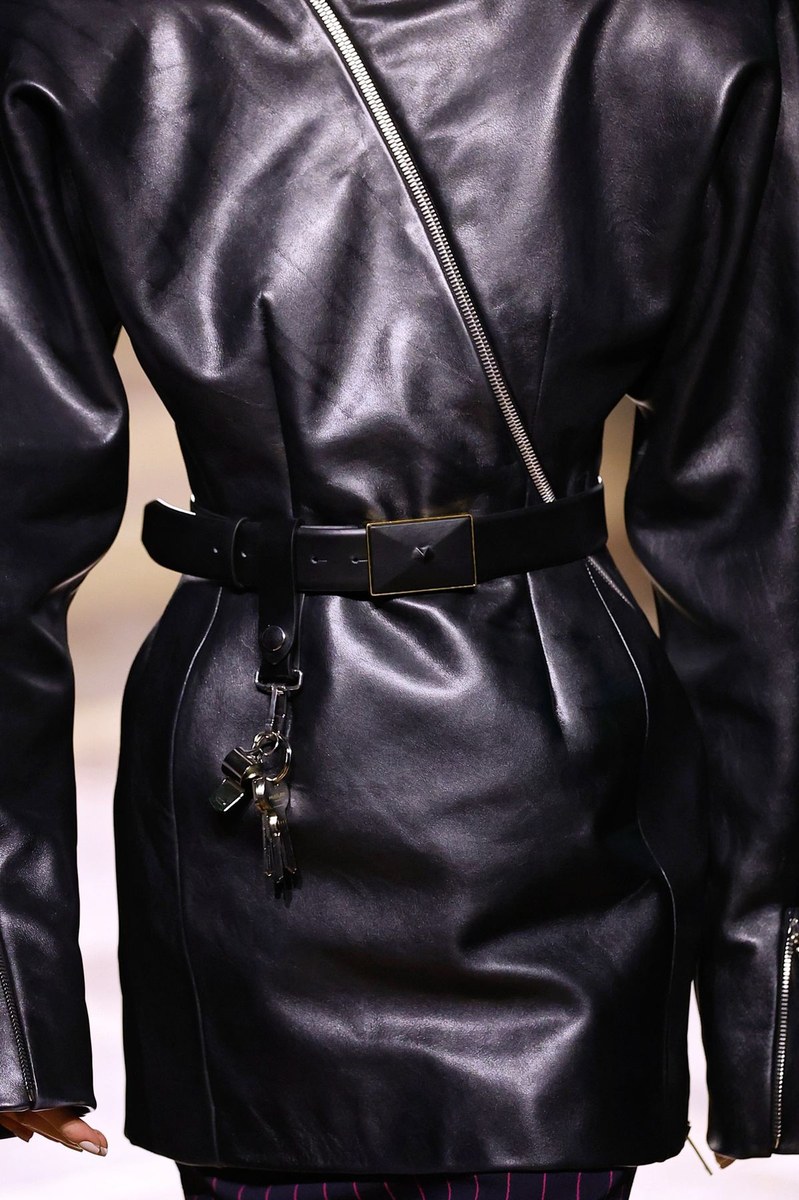
Detail 1 (Belt) A wide matte black leather belt cinched over a leather jacket carries a rectangular buckle with a subtly embossed angular logo and a key ring fob clipped at the hip, adding a utilitarian reference without breaking the belt's clean silhouette.

Detail 2 (Belt) A gunmetal chain-link mesh belt threaded through trouser loops on gray pleated trousers uses a wide rectangular buckle stamped with the Mugler name, with the metal body creating genuine visual weight against the soft fabric ground.

Detail 3 (Belt) The warm gold version of the chain-link mesh belt on olive trousers reads as the more wearable commercial option, with the gold tone bridging the gap between statement hardware and everyday luxury dressing.

Detail 3
Detail 3

Detail 4 (Belt) A wide matte charcoal leather belt with a gloss-finish rectangular buckle bisects a chartreuse leather safari coat, and the deliberate contrast between the yellow-green garment and the near-black belt demonstrates Mugler's color-blocking logic applied to accessories.

Detail 4
Detail 4

Detail 6 (Dress Detail) A black rectangular buckle belt identical in language to Detail 4 cinches a fuchsia metallic multi-pocket jumpsuit, confirming the buckle system as a house constant applied across radically different garment treatments.

Detail 6
Detail 6

Detail 7 (Dress Detail) A large rectangular gold-toned brooch with a rounded-corner frame houses a circular black cabochon set in a rhinestone bezel against a mirrored silver ground, sitting flush on the chest of a gray jersey turtleneck as a standalone focal statement.

Detail 7
Detail 7

Detail 8 (Dress Detail) Vertical channel quilting stitched in close parallel rows across the back panel of an oxblood leather jacket creates a ribbed surface that reads as both protective padding and anatomical mapping, a construction detail with direct relevance to leather goods and outerwear production teams.

Detail 9 (Headwear) A bone-colored smooth leather hat with a compressed, asymmetrically folded crown sits forward on the head, paired with narrow amber-tinted rectangular sunglasses that together create a coherent face-framing system rather than two separate accessory decisions.

Detail 9
Detail 9

Operational Insights

Belt buckle standardization: The rectangular Mugler-stamped buckle appears across at least four belt styles, indicating a unified hardware mold that buyers can use as a template for identifying house-consistent private label or licensed accessories programs.

Chain-link construction lead times: Metal mesh body belts require specialized chainmail or link-weaving production, typically with longer lead times than leather belts. Product managers should initiate supplier conversations early if planning analogous styles for resort floor sets.

Headwear as a franchise signal: The leather cowboy hat appearing in two distinct colorways across Details 9 and 10 suggests Mugler is building a repeatable headwear silhouette. Accessories directors at multi-brand retailers should evaluate whether this hat functions as a buyable fashion accessory or a press-only editorial piece before committing open-to-buy budget.

Quilted leather as a construction upgrade: Channel quilting in Detail 8 is a high-cost, high-impact technique that competes directly with outerwear and leather goods finishing standards. Buyers sourcing leather outerwear should flag this as a benchmark for quality tier conversations with manufacturing partners.

Color contrast as a styling system: Dark belts consistently pair against light or vivid garment ground colors throughout the belt category. Buyers can apply this pairing logic directly to floor styling guides, using belt color as a contrast tool rather than a match-to-garment default.

More Details

Detail 5
Detail 5
Detail 10
Detail 10

✦ This report was generated with AI — combining human editorial vision with Claude by Anthropic. Because the future of fashion intelligence is already here.