Mugler FW26 Shoes
Mugler FW26 Shoes Report
Mugler FW26 plants its footwear firmly in a pointed-toe, architectural heel language that splits across two distinct categories: covered mule and slingback pump, with boots as a tertiary volume play. Buyers and product managers should note that this collection gives the market a coherent commercial framework built around color-blocked caps and a recurring two-tone construction logic that can be adapted across price tiers.
Silhouettes and Construction
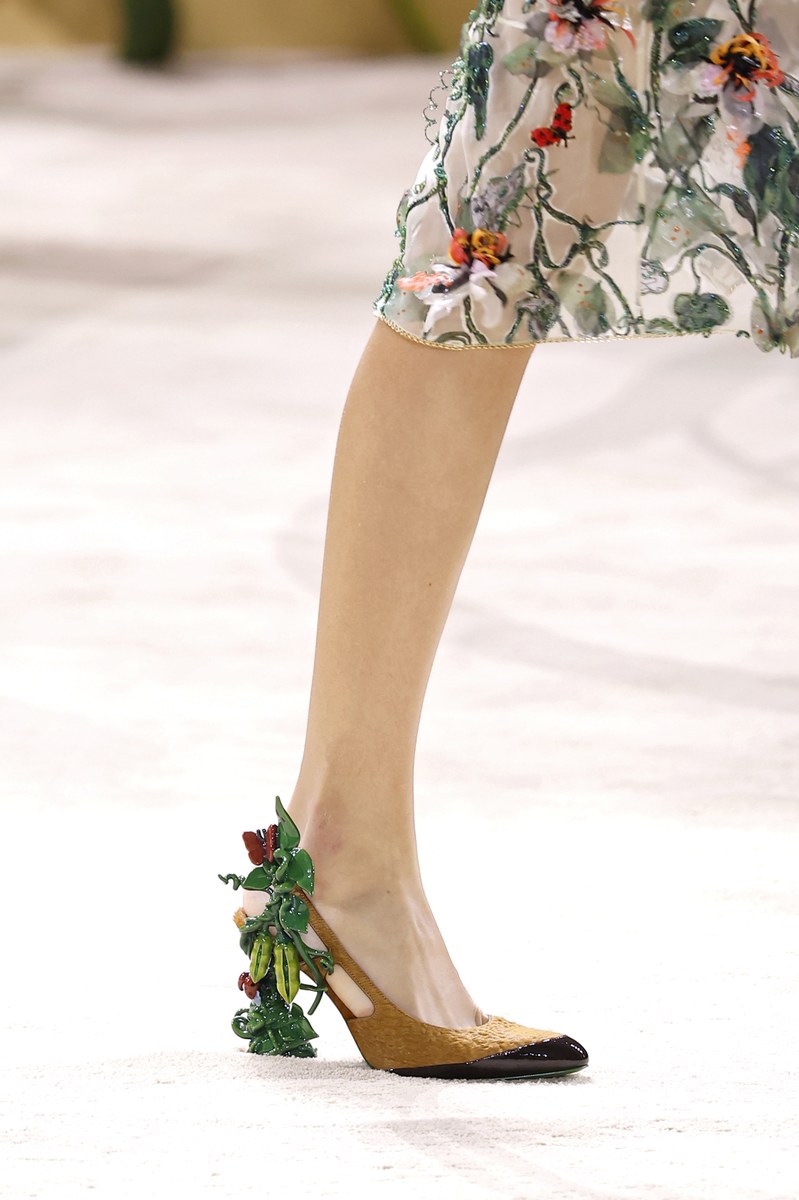
The pointed stiletto pump and pointed mule dominate the lineup, with heel heights reading consistently between 90mm and 110mm across most styles. Shoe 13 and Shoe 15 break from that language with a square-toe thong sandal silhouette sitting on a straight stiletto heel, signaling that Mugler is testing two distinct consumer mindsets within one collection. Shoe 3 and Shoe 7 pull in opposite directions: one goes over-the-knee with a flat riding-inspired construction, while the other lands at mid-thigh with a softer, slouched shaft on a low tapered heel. No platform soles appear in the collection. The proportion stays lean and the heel line remains clean throughout.
Materials and Finishes
Smooth leather and patent leather carry the majority of the pump and slingback styles, most visibly in Shoe 5, Shoe 8, and Shoe 16. Crushed or crinkled satin appears on Shoe 2 and Shoe 14 in olive and acid yellow respectively, with Shoe 10 deploying the same texture in a metallic pink foil leather that reads closer to a laminated finish than a true mirror patent. For the over-the-knee boot shaft, Shoe 3 uses soft, matte pull-up leather showing visible stretch and break at the ankle. Hardware across the slingbacks stays minimal, with slim bar buckles in silver or gold tone on Shoe 1, Shoe 5, Shoe 11, Shoe 12, and Shoe 16.

Color Direction
A core of neutral-adjacent tones anchors the palette: stone, putty, warm grey, and taupe visible across Shoe 1, Shoe 6, Shoe 12, and Shoe 16. Red functions as a recurring accent, appearing as a full upper in Shoe 5, as a contrasting cap on Shoe 7, and as the body color with a lavender-blue cap in Shoe 4. Metallic pink in Shoe 10, acid yellow in Shoe 14, olive-gold in Shoe 2, and white in Shoe 11 and Shoe 13 push the seasonal palette toward a saturated, almost synthetic brightness that contrasts deliberately with the neutral base. This dual structure gives retailers a clear buying route: neutrals for depth and volume, saturated or metallic accents as statement units.

Key Models and Details
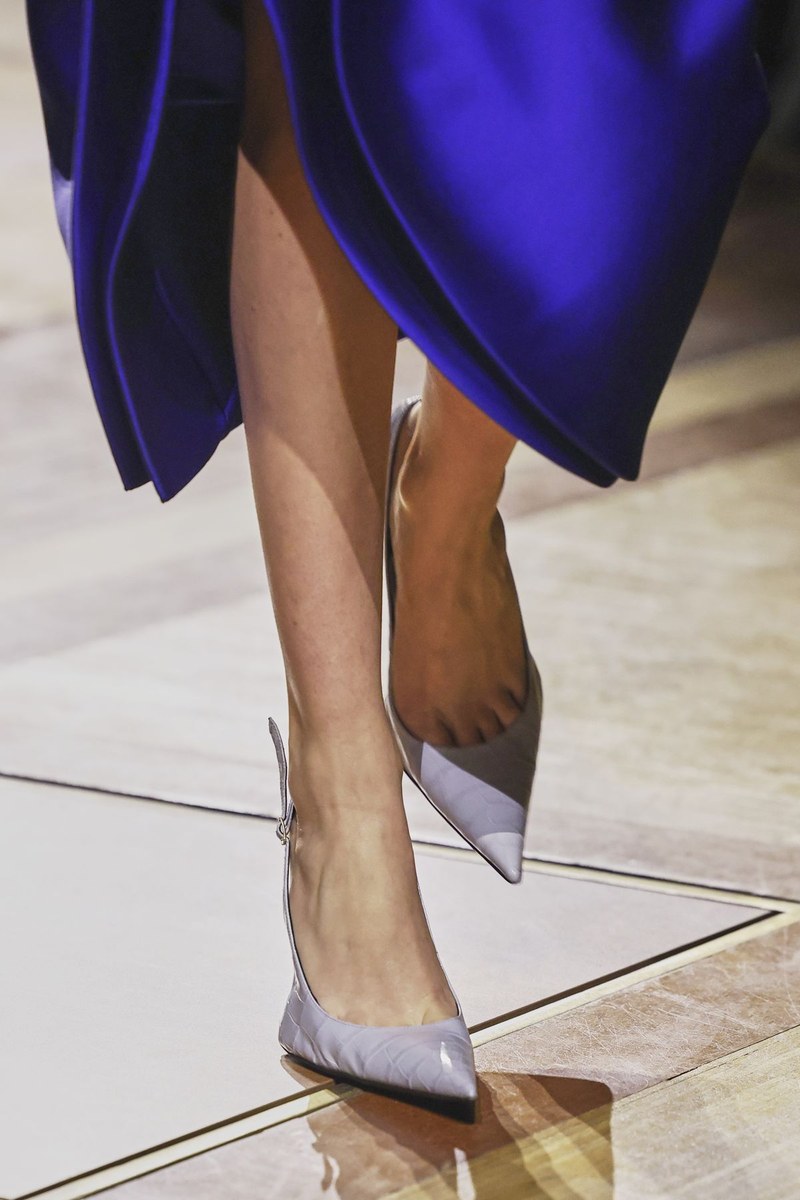
The slingback pump with a contrasting color-blocked toe cap emerges as the most commercially loaded model, appearing across Shoe 4, Shoe 7, Shoe 8, and by extension informing the tonal logic of Shoe 1. The pointed mule with a deep, curved upper throat represents the second hero silhouette, distinguished by its high vamp that covers much of the foot while leaving the heel entirely open. Shoe 2, Shoe 9, Shoe 10, and Shoe 14 all employ this shape. Shoe 9 adds a two-tone execution in navy and cream leather with a visible seam running down the center of the vamp, making it a strong candidate for small-run exclusives or capsule buys. Shoe 11 introduces a white ankle-strap pump styled over teal hosiery, turning the hosiery coordination into an explicit part of the product story rather than a styling afterthought.

Shoe by Shoe Highlights
Shoe 1 A lavender-grey patent slingback with a quilted or padded vamp panel and a slim bar buckle, positioned as the entry point for the color-blocked cap logic without going full contrast.
Shoe 4 A deep red body pump with a powder blue pointed cap and a black outsole. Three-color construction makes it the most complex and highest-risk buy in the lineup.
Shoe 7 A mid-thigh grey leather slouch boot with a red pointed cap. This is the single most editorial piece in the collection and the clearest indicator of where Mugler places the boot within a color-block framework rather than a monochrome one.

Shoe 8 A navy slingback with a periwinkle blue pointed toe cap and a clean heel line. This reads as the most wearable and commercially transferable color-block option for a broad wholesale buy.

Shoe 10 A metallic pink laminated leather pointed mule with a high curved vamp and no hardware. The finish is the statement and buyers should evaluate it as a single-SKU seasonal spike rather than a core style.

Shoe 13 A white square-toe thong sandal on a straight stiletto heel with an ankle strap. The square toe in this context is a deliberate structural departure from every other style in the collection and warrants its own targeted buyer conversation.
Shoe 3 An over-the-knee flat riding boot in brown pull-up leather with visible paneling seams and a rounded lug-adjacent sole. It sits outside the heel-driven narrative entirely and targets a separate cold-weather volume need.

Shoe 11 White pointed-toe pumps with ankle straps styled explicitly with teal hosiery as part of the look. Buyers commissioning this style should brief retail teams on the hosiery coordination as a sales tool rather than leaving it incidental.

Operational Insights
Color-block cap production: The contrasting toe cap construction on Shoe 4, Shoe 7, and Shoe 8 requires precise bonding or stitching at the cap seam line. Product managers should request seam reinforcement specs from factories early to avoid delamination in production samples.
Mule upper height: The deep curved vamp on Shoe 2, Shoe 9, Shoe 10, and Shoe 14 creates a fit variable that standard shoe lasts may not accommodate. Buyers should confirm last selection with factories before committing to volume, particularly on wider or narrower foot profiles.

Satin and crinkle fabric durability: The crushed satin used on Shoe 2 and Shoe 14 is a surface that scuffs and marks under retail handling. Product managers sourcing these styles should mandate protective packaging and limit floor display to boxed or covered units.
Boot segmentation: Shoe 3 and Shoe 7 serve entirely different end consumers and should not be bought as a coordinated boot pair. One targets a practical cold-weather buyer while the other targets an editorial or occasion-driven customer, meaning separate open-to-buy allocations are warranted.
Neutral-to-accent ratio: The collection skews approximately 60 percent neutral or tonal and 40 percent saturated or metallic. Buyers planning assortments should maintain that ratio or push it further toward neutrals, at 70 to 30, for markets where statement color carries higher markdown risk.
More Shoes


✦ This report was generated with AI — combining human editorial vision with Claude by Anthropic. Because the future of fashion intelligence is already here.