Mugler FW26 Women Looks Report

Mugler FW26 Women Looks Report
Mugler FW26 Women Looks Report

Paris Fashion Week

Under creative director Casey Cadwallader, Mugler FW26 builds its entire proposition around extreme architectural shoulders, body-conscious silhouettes, and an unapologetically maximalist color strategy that runs from electric violet to neon chartreuse. For buyers operating in a market where novelty-fatigue is real, this delivers a clear, codified visual identity that photographs immediately and translates directly into sell-through on statement pieces.

Silhouette and Volume

A sharp, padded shoulder that tapers aggressively into a cinched waist dominates across tailored coats (Look 1, Look 17), leather separates (Look 31, Look 49), and knit bodies (Look 43, Look 46). Volume sits almost exclusively at the shoulder, never at the hip. The lower body remains slim throughout, whether in cropped cigarette trousers, pencil skirts, or form-fitted column dresses, creating a consistent triangular power shape across all 50 looks. Look 37, a floor-length khaki wool column with rigid epaulettes, pushes this logic to its most monolithic extreme.
Look 1
Look 1

Color Palette

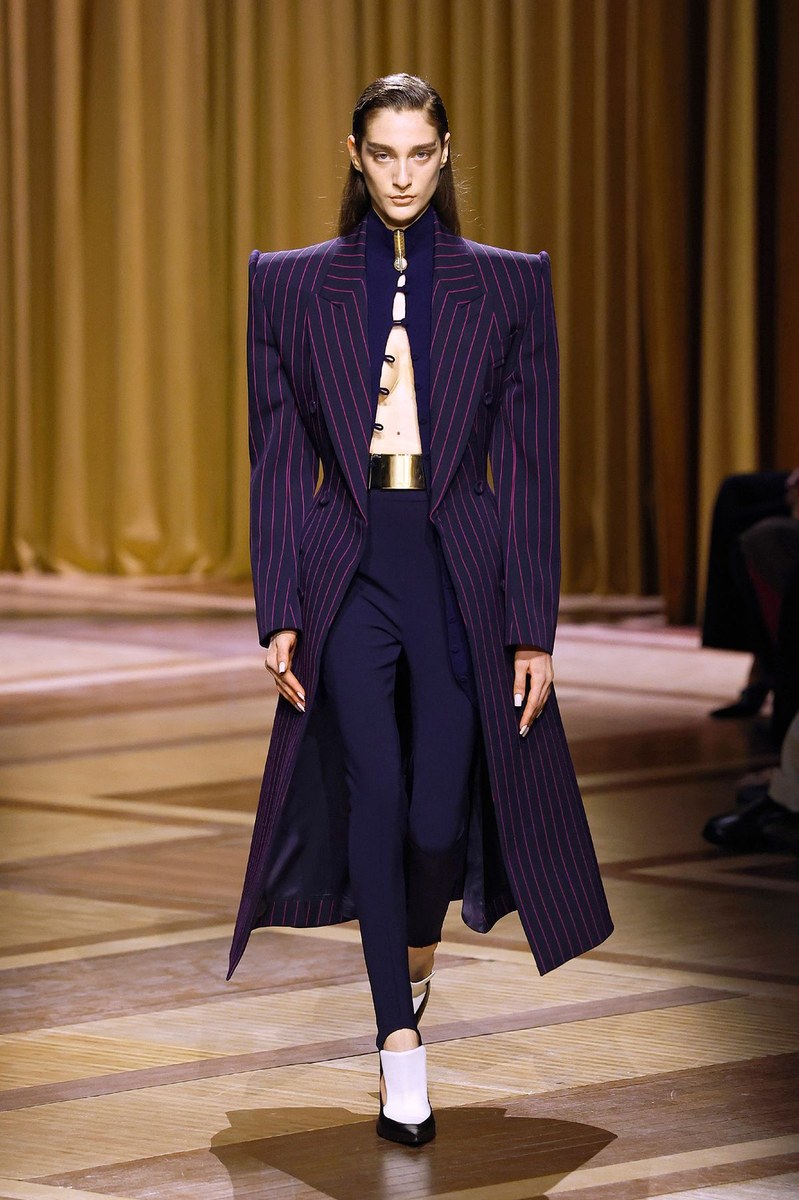
Violet and electric purple anchor the range, repeating across at least twelve looks in wool, crepe, satin, and leather (Look 2, Look 19, Look 25, Look 27, Look 43). Chartreuse green arrives as the second dominant accent, appearing in Look 36, Look 39, Look 40, and Look 42, and reads commercially viable against the season's broader appetite for acid tones. Deliberate color-block pairings also carry weight here: violet with black leather (Look 27), cobalt blue with gold lamé (Look 26), and orange with grey (Look 45, Look 46). Pinstripe navy holds the more conservative end in Looks 1, 2, 23, and 24, giving buyers a quieter entry point into the vocabulary.

Look 2
Look 2

Materials and Textures

Leather serves as the structural backbone, used in both matte and high-gloss finishes for everything from full coats (Look 49) to belted tunics (Look 3) to strapless sheath dresses (Look 28). Metallic lamé and pleated foil fabrics carry the eveningwear tier, with a gold pleated column in Look 34, a quilted diamond-pattern lamé coat in Look 13, and a crushed pink metallic dress in Look 30 that has the crinkle surface weight of sculpted packaging material. Knit constructions bring strong graphic energy through chevron and diagonal stripe patterns in Looks 42 and 46, with a medium-weight rib that holds the shoulder structure without collapsing. Faux and real fur appears in Looks 13, 22, 29, 48, and 50, used in large graphic quantities rather than as trim.

Look 49
Look 49

Styling and Layering

A turtleneck base layer functions as a consistent building block, worn under coats, leather jackets, and pinstripe suits as a colour-pop element in saturated violet, green, or blue. Belts function as load-bearing styling tools here, not decorative ones. Wide leather belts with gold hardware appear in at least fifteen looks, always cinching the waist and creating the signature hourglass break between an oversized top and a slim bottom. Long leather gloves in contrasting colors (green in Look 10, burgundy in Look 14, blue in Look 35) function as a recurring accent that extends the arm line and adds a second hue without adding a separate layer. Footwear splits between pointed kitten heels in tonal or contrasting colors and tall leather boots (Look 33, Look 39), with the kitten heel doing the most commercial work across the range.

Look 10
Look 10

Look by Look Highlights

Look 1 Combines a navy pinstripe double-breasted coat with structured shoulders over matching trousers and a beige button-front gilet with gold hardware, giving buyers a layered suiting story with three distinct sellable components.

Look 8 A black V-neck sleeveless column dress paired with opaque teal-green tights and two-tone white and teal ankle-strap shoes demonstrates how drama builds through hosiery and footwear rather than garment complexity, a low-cost differentiation strategy for product managers.

Look 8
Look 8

Look 26 A sky-blue leather military shirt with epaulette shoulders over a gold foil pencil skirt with a wide black belt represents the strongest day-to-evening colour contrast and one of the most immediately reproducible pairings for commercial adaptation.

Look 26
Look 26

Look 30 A crushed hot-pink metallic sleeveless dress with a wide silver-buckle belt worn over knee-high brown leather boots is the most directional single piece and will function as a hero image driver with strong editorial pull for style directors.

Look 30
Look 30

Look 34 A fully pleated gold lamé long-sleeve turtleneck column dress with structured shoulders and a slim black belt reads as both runway statement and a high-conversion eveningwear SKU for luxury department store buyers.

Look 34
Look 34

Look 38 A split color-block turtleneck sweater in chartreuse and cobalt blue worn as a body with grey opaque tights and mismatched gloves (yellow and blue) makes the color-block logic most legible and most accessible for a mid-tier price point.

Look 38
Look 38

Look 47 A pale blush pink leather military shirt with double chest pockets, epaulettes, and a gold-buckle belt over a high-gloss black leather cargo pencil skirt represents the most balanced commercial look, combining the military outerwear trend with leather skirt demand in one outfit.

Look 47
Look 47

Look 49 A floor-length black leather double-breasted coat with extreme sculpted shoulders and a magenta silk turtleneck visible at the collar reads as the strongest outerwear investment piece and the most likely candidate for pre-order performance.

Operational Insights

Shoulder hardware: An epaulette detail appears across leather shirts, coats, and dresses in at least eight looks. Buyers should treat this as a collection-defining hardware element and negotiate it as a signature trim rather than an optional construction detail when placing orders.

Color minimums: Violet and chartreuse green are the two highest-frequency accent colors. Style directors building a buy should anchor orders in these two tones before exploring the orange and cobalt entries, which carry higher markdown risk due to narrower customer appetite.

Leather tiering: At least twelve leather or leather-effect garments span shirts, skirts, coats, trousers, and dresses. Product managers should map these into three distinct price tiers: entry leather-effect, mid-range smooth leather, and top-end sculptural leather, to cover the full buyer spectrum without cannibalizing within the category.

Glove accessory program: Long elbow and shoulder-length leather gloves appear in contrasting colors across at least ten looks. This signals directly to accessories buyers that a standalone glove program can drive incremental attachment sales and extend the visual identity at a lower unit cost.

Faux fur volume: Look 22, a striped blue and white faux fur coat over a neon yellow faux fur skirt, along with Look 50, a pale pink fur column dress, point to oversized faux fur as a key volume category for the eveningwear and outerwear assortment. Buyers should prioritize fabrication sourcing for large-format faux fur early, given extended production lead times for this material category.

Look 22
Look 22

Complete Collection

Look 3
Look 3
Look 4
Look 4
Look 5
Look 5
Look 6
Look 6
Look 7
Look 7
Look 9
Look 9
Look 11
Look 11
Look 12
Look 12
Look 13
Look 13
Look 14
Look 14
Look 15
Look 15
Look 16
Look 16
Look 17
Look 17
Look 18
Look 18
Look 19
Look 19
Look 20
Look 20
Look 21
Look 21
Look 23
Look 23
Look 24
Look 24
Look 25
Look 25
Look 27
Look 27
Look 28
Look 28
Look 29
Look 29
Look 31
Look 31
Look 32
Look 32
Look 33
Look 33
Look 35
Look 35
Look 36
Look 36
Look 37
Look 37
Look 39
Look 39
Look 40
Look 40
Look 41
Look 41
Look 42
Look 42
Look 43
Look 43
Look 44
Look 44
Look 45
Look 45
Look 46
Look 46
Look 48
Look 48
Look 50
Look 50

Fashion Designer

Miguel Castro Freitas grew up in Santarém, a small historic city an hour outside Lisbon, in the mid-1980s. The only printed matter that came into his family's home was the TV guide, and he would go straight to the back pages, where full-color images from the Paris shows appeared. This was the original Mugler era, when Thierry Mugler was transforming runway shows into spectacles, and a young Miguel was cutting out the pictures and assembling them. At six he also started dancing, a discipline he kept for years, and one that gave him a physical understanding of the body that would never leave him.

The epiphany came in 1996 when he found a copy of i-D in his hometown, with Kate Moss on the cover. He read a short interview on the last page with Alexander McQueen, who mentioned Central Saint Martins. Galliano had also gone there. That was enough. He moved to London to study womenswear, graduating in 2004 into a moment when Hussein Chalayan, Margiela and Kawakubo were reshaping what fashion could mean. His first job after graduation was at Dior under John Galliano, a dream fulfilled directly. He stayed through the transition to Raf Simons, becoming head of tailoring: the same hands, a completely different language. From there he went to Yves Saint Laurent under Stefano Pilati, which he describes as the exact opposite of Dior, black to white. Then Lanvin under Alber Elbaz, where the team was small and the work intimate. Then head of womenswear at Dries Van Noten, where structure and intellectual precision became the grammar.

His first creative director role came at Sportmax between 2021 and 2024. His work there was sharp, body-conscious and quietly sculptural. He came to Mugler in April 2025 as an almost entirely unknown public figure: no social media presence, no profile. His debut collection for the house, his first full runway show as the singular creative voice of a major house, was presented in Paris in September 2025 for Spring/Summer 2026.

"I don't need to choose sides. I don't need to be a minimalist or a maximalist. Maybe I'm a purist maximalist or an excessive minimalist."

"You first need to master something in order to corrupt it. I'm interested in designers who rip the codes of tradition apart. They understood tradition and therefore were able to deconstruct it. Like Picasso."

✦ This report was generated with AI — combining human editorial vision with Claude by Anthropic. Because the future of fashion intelligence is already here.