N21 FW26 Women Looks Report

N21 FW26 Women Looks Report
Did you know? N21 was founded in 1999 by Alessandro Dell'Acqua as a menswear line before expanding into womenswear, establishing the brand's signature approach of blending playful irreverence with refined tailoring. The label became known for pioneering the use of unconventional fabric combinations and surrealist-inspired prints during the early 2000s, influencing a generation of designers to challenge minimalist runway aesthetics.

N21 FW26 Women Looks Report

Milan Fashion Week

N21 FW26 builds a wardrobe around the tension between restraint and excess, moving from all-black minimalism through crinkled metallic drama without ever losing a coherent commercial thread. For buyers, this reads as a confident dual-market proposition: wearable, repeatable daywear anchors one end, and high-impact occasion pieces with strong editorial pull anchor the other.

Silhouette and Volume

Lean, body-skimming tailoring and relaxed trouser cuts open the collection before expanding into deliberately exaggerated volumes, puffed sleeves, ballooned outerwear, and sculptural strapless bodices. Look 12 pushes volume to its most extreme point with a quilted, cloud-like zip-front coat cinched at the waist by a Western-style silver belt buckle. A sharp double-breasted military coat in Look 3 provides direct contrast. The shift silhouette reappears across multiple price tiers, in cotton twill at Look 2 and sequin-encrusted fabric at Look 9, making it the most commercially transferable shape in the line.
Look 12
Look 12

Color Palette

Black dominates the first two-thirds of the collection with absolute authority. At Look 15 and Look 16, the palette breaks sharply into warm charcoal grey and saturated crimson red, the latter appearing in houndstooth wool, liquid metallic fabric, and a standalone mini dress. Gold arrives as a final statement in Look 19, a crinkled lamé strapless dress with a sculptural side rosette. The limited palette signals deliberate focus rather than exhaustion of ideas. At the close, red-to-gold progression gives the collection a clear evening arc that buyers can use to build a floor story.

Look 15
Look 15

Materials and Textures

Within the black section, matte wool crepe, sheer knit jersey, black lace, fluid silk charmeuse, and large-disk paillettes rotate in controlled succession, keeping the eye engaged within a single color. Look 6 layers a sheer black chiffon cape over a black lace slip dress, stacking two lightweight fabrics for depth without adding bulk. In the red and gold section, crinkled foil-finish lamé catches light with a crushed quality rather than a smooth shine. Wool and heavy tweed carry the structural tailored pieces, and the contrast between those rigid surfaces and fluid evening fabrics forms the central material argument of the collection.

Look 6
Look 6

Styling and Layering

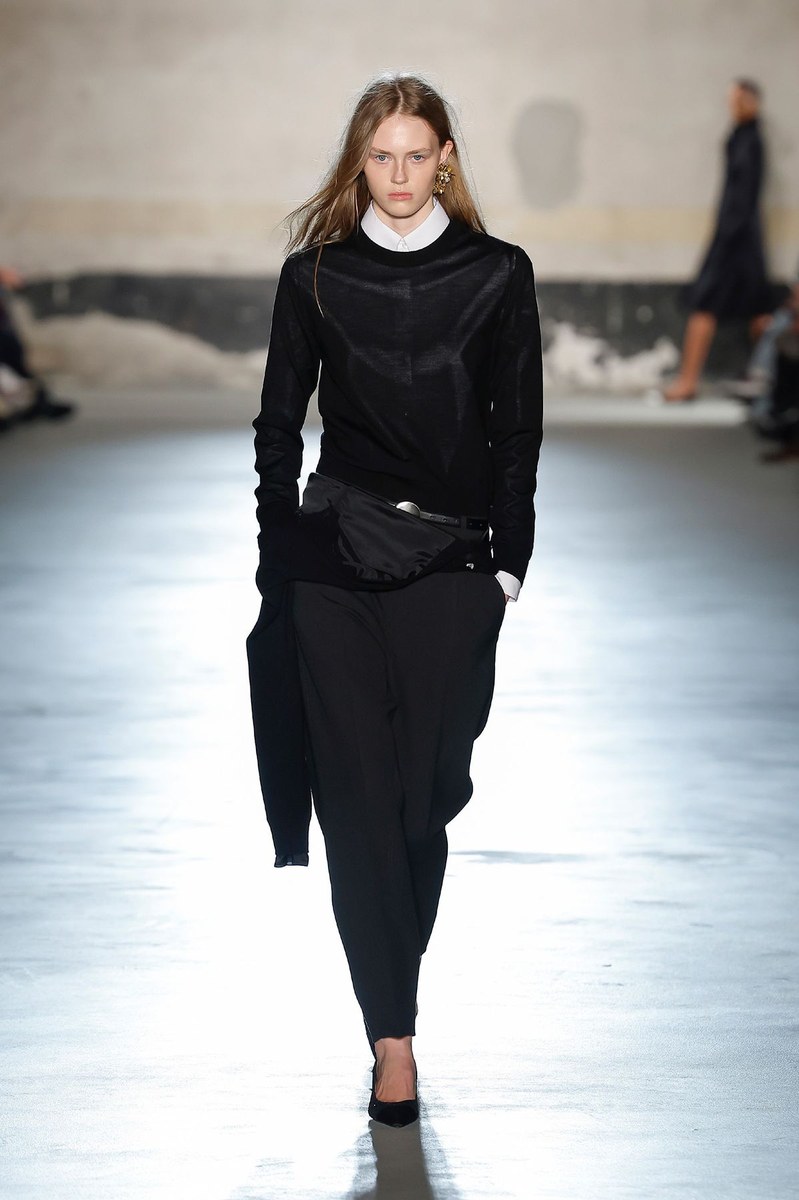
Pointed-toe kitten or low-block heel pumps in black appear consistently throughout, with silver kitten heels selected selectively under embellished skirts and metallic looks. This deliberate shoe choice keeps proportions elongated without competing with the garments. Accessories remain spare. A black satin belt bag appears in Look 1, a domed black leather top-handle in Look 13, and a soft white leather hobo in Look 18, functioning as category adjacencies rather than headline accessories. Long black knit gloves in Look 10 and grey ribbed gloves in Look 18 add a layering element that buyers in colder markets will find particularly useful. Individual pieces worn as standalone statements matter more here than requiring full head-to-toe looks.

Look 1
Look 1

Look by Look Highlights

Look 3 A structured double-breasted military coat in navy-black wool with ornate silver buttons and a beaded jewel-collar underneath. This represents a top-of-range outerwear option with strong red-carpet adjacency for eveningwear buyers.

Look 3
Look 3

Look 4 A strapless black taffeta midi dress with a sculptural side bow that falls into a long train. This is the clearest occasion buy in the early black section and a direct production target for special-occasion departments.

Look 4
Look 4

Look 9 A V-neck shift dress in black large-disk paillettes with a draped, bat-wing sleeve offers wearable eveningwear that sidesteps the formality trap and lands for contemporary and bridge-level buyers equally.

Look 9
Look 9

Look 12 The oversized quilted nylon coat with cape-like proportions and a silver concho belt ranks as the single most viral-ready look in the collection. Important for press orders and editorial pull even if sell-through sits with the tailored coats.

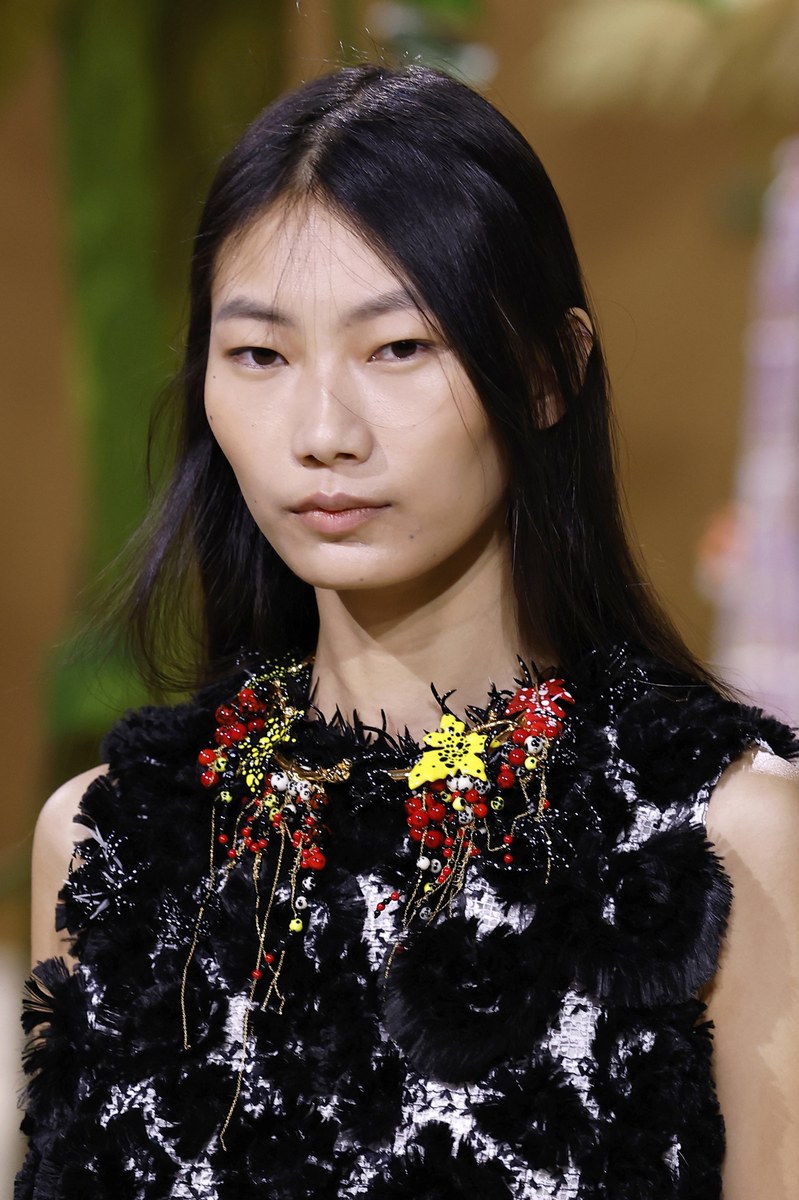
Look 14 A strapless column dress in black fabric embroidered with small multicolored gem-like floral clusters and a nude bustier panel at the chest serves as a mid-price embellishment option that translates easily across multiple dress categories.

Look 14
Look 14

Look 16 An oversized double-breasted coat in red textured wool with a black satin shawl lapel reads as a direct wardrobe hero for the season, strong enough to anchor a red-coat buy without accessories.

Look 16
Look 16

Look 18 The red crinkled foil mini dress with grey knit gloves and a soft off-white hobo bag collapses party dressing and casual ease into a single look, the most immediately shoppable styling proposition in the metallic chapter.

Look 18
Look 18

Look 19 A gold crinkled lamé strapless dress with an oversized side rosette closes the collection as a made-to-order signal, appropriate for luxury department store exclusives or capsule pre-order programs.

Look 19
Look 19

Operational Insights

Black as a commercial spine: The first fourteen looks build a fully viable black wardrobe across casualwear, tailoring, and eveningwear. Buyers can build deep in one color family with strong internal differentiation by fabric and silhouette.

The shift dress as a repeatable unit: Cocoon sleeves appear in cotton twill, wool jersey, and sequin fabric across Looks 2, 11, and 9 respectively. This makes it a core production template worth ordering across fabrications to hit multiple price points and departments.

Metallic lamé as a key evening fabric: Crinkled foil finish in both red and gold reads more directional than traditional sequin and positions well against current demand for textural evening fabric. Early fabric-sourcing conversations are warranted given lead time on specialty lamé finishes.

Outerwear as a margin opportunity: Look 3, Look 12, and Look 16 each represent a distinct outerwear category: military tailored, sculptural quilted, and oversized wool coat. Outerwear buyers have three distinct commercial tiers to work with from a single collection.

Accessories as an underplayed add-on: The belt bag in Look 1, the top-handle in Look 13, and the soft hobo in Look 18 are low-profile but consistent. This suggests a quiet accessories strategy that style directors can build out through private-label adjacencies or complementary brand buys without the N21 accessories line dominating the floor.

Complete Collection

Look 2
Look 2
Look 5
Look 5
Look 7
Look 7
Look 8
Look 8
Look 10
Look 10
Look 11
Look 11
Look 13
Look 13
Look 17
Look 17
Look 20
Look 20
Look 21
Look 21
Look 22
Look 22
Look 23
Look 23
Look 24
Look 24
Look 25
Look 25
Look 26
Look 26
Look 27
Look 27
Look 28
Look 28
Look 29
Look 29
Look 30
Look 30
Look 31
Look 31
Look 32
Look 32
Look 33
Look 33
Look 34
Look 34
Look 35
Look 35
Look 36
Look 36
Look 37
Look 37
Look 38
Look 38
Look 39
Look 39
Look 40
Look 40
Look 41
Alessandro Dell'Acqua

About the Designer

Alessandro Dell'Acqua was born on December 21, 1962, in Naples, and the city shaped him so completely that its traces are still visible in almost everything he has designed. As a child in the 1970s, he went to the cinema with his grandfather, developed a passion for Italian neorealism and Hollywood melodrama, and secretly wanted to become an actor. He was too shy. He spent his pocket money on fashion magazines, spent hours in the few upscale shops the city had, and watched the women of his family move through the apartment on summer mornings in their nude-colored lace slip vests, completely unselfconscious. Those specific garments, that specific quality of uninhibited southern femininity, have appeared in his work for thirty years. At thirteen he began apprenticing with a Neapolitan dressmaker. By the time he finished at the Accademia di Belle Arti in Naples, he had a portfolio of sketches and an address he had found in a newspaper.

He arrived in Milan at eighteen with a clarity of purpose that is unusual at that age. He talked his way into the showroom of Enrica Massei, one of the most forward-looking Italian designers of the period, and was hired immediately. What followed was a thorough and rigorous education in the industrial architecture of Italian fashion: the Marzotto Group, Byblos, Les Copains, Iceberg, and the knitwear specialist Pietro Pianforini, where he eventually became head designer overseeing hand-finished pieces made with Bolognese artisans. At twenty-three he was appointed creative director of Genny, where he worked alongside Gianni Versace. Roles at La Perla, Malo, Brioni, and Max Mara followed, each adding technical depth and commercial fluency to a sensibility already firmly his own. In 1996 he launched his eponymous label with a debut collection called "Punk on a Mediterranean Woman," which announced his signature immediately: layered transparencies, lingerie logic applied to ready-to-wear, tailoring used as a counterweight to softness.

The label grew into a successful international business worn by Winona Ryder, Gwyneth Paltrow, and Michael Jackson, for whose planned 2009 This Is It tour Dell'Acqua designed gold-sequined trousers. But creative disagreements with his production partners forced him to issue a public press release in 2009 disavowing two collections made without his approval, and walking away from the name entirely. He was forty-six. After a period in which, by his own account, every door was closed in his face, he started again from zero. In 2010 he launched N°21, named after his birthday. The brand was built on the exact things the previous label had taught him he valued most: knitwear expertise, unexpected material pairings, a femininity that draws from intimate dressing rather than ceremony. He subsequently served as creative director of Rochas from 2013 to 2015, fulfilling what he described as a long-held dream. N°21 has since expanded into menswear, accessories, and international distribution, and continues to show at Milan Fashion Week each season.

"I don't go for sexy; I love sensuality. An eroticism that cannot be seen. For me, it's the attitude that makes the difference."

"Perhaps we in the South have a strong desire to make it because we lack so much. There are not many ways to express yourself culturally. And the women there have a huge influence."

✦ This report was generated with AI — combining human editorial vision with Claude by Anthropic. Because the future of fashion intelligence is already here.