Nardos FW26 Details
Nardos FW26 Details Report
Nardos FW26 commits fully to hand-craft embellishment as the primary design language, routing every category through beadwork, appliqué, sequin work, and sculptural fabric manipulation at a consistently high artisanal register. For buyers and product managers, this signals a deliberate positioning at the upper tier of occasion and couture-adjacent dressing, where the construction detail itself becomes the commercial argument.
Category Overview
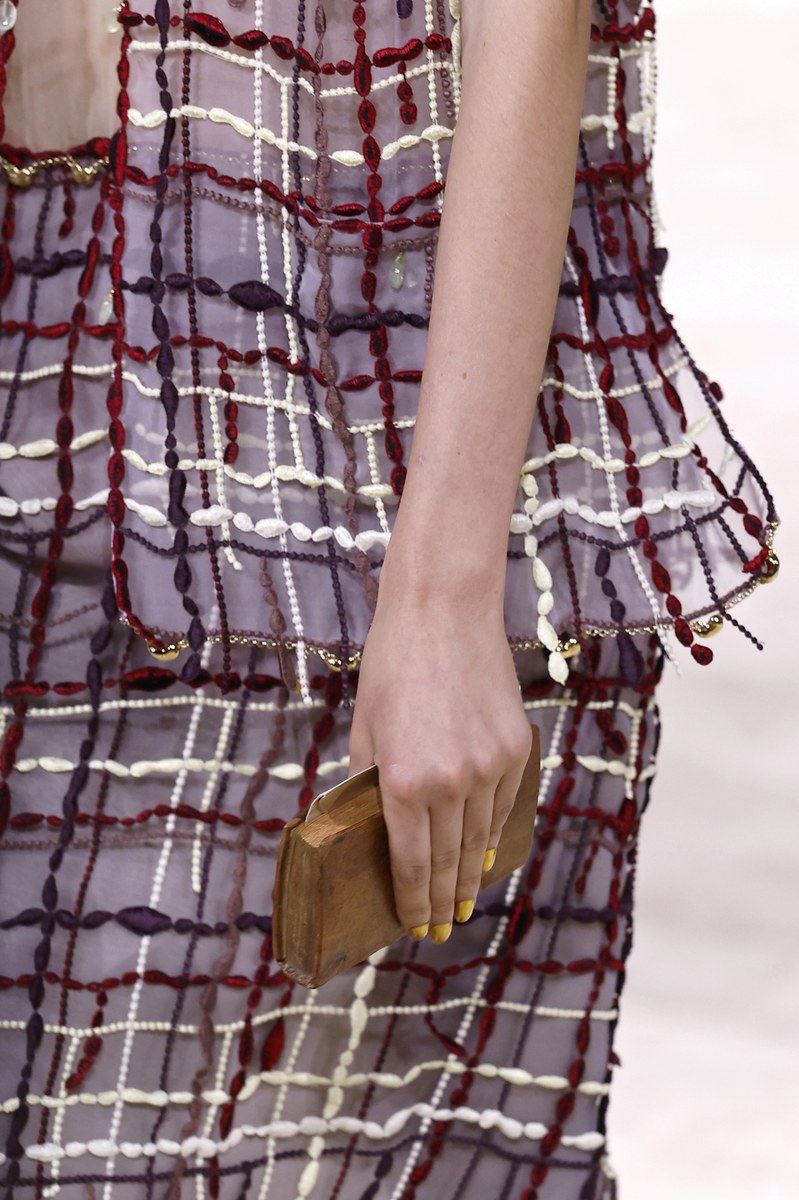
Two categories anchor the presentation: Dress Details, which dominate the lineup across eighteen entries, and Headwear, represented by two veil pieces. Surface treatment, not silhouette, carries the brand identity here. From heavy crystal scatter to tonal velvet appliqué, the Dress Detail category covers an exceptionally wide range of embellishment techniques. Both Headwear entries are restrained but precise, functioning as ceremony-ready finishers that align the collection with bridal and formal occasion markets. A house focused on the made object rather than the printed or dyed shortcut emerges across both categories.
Material and Construction
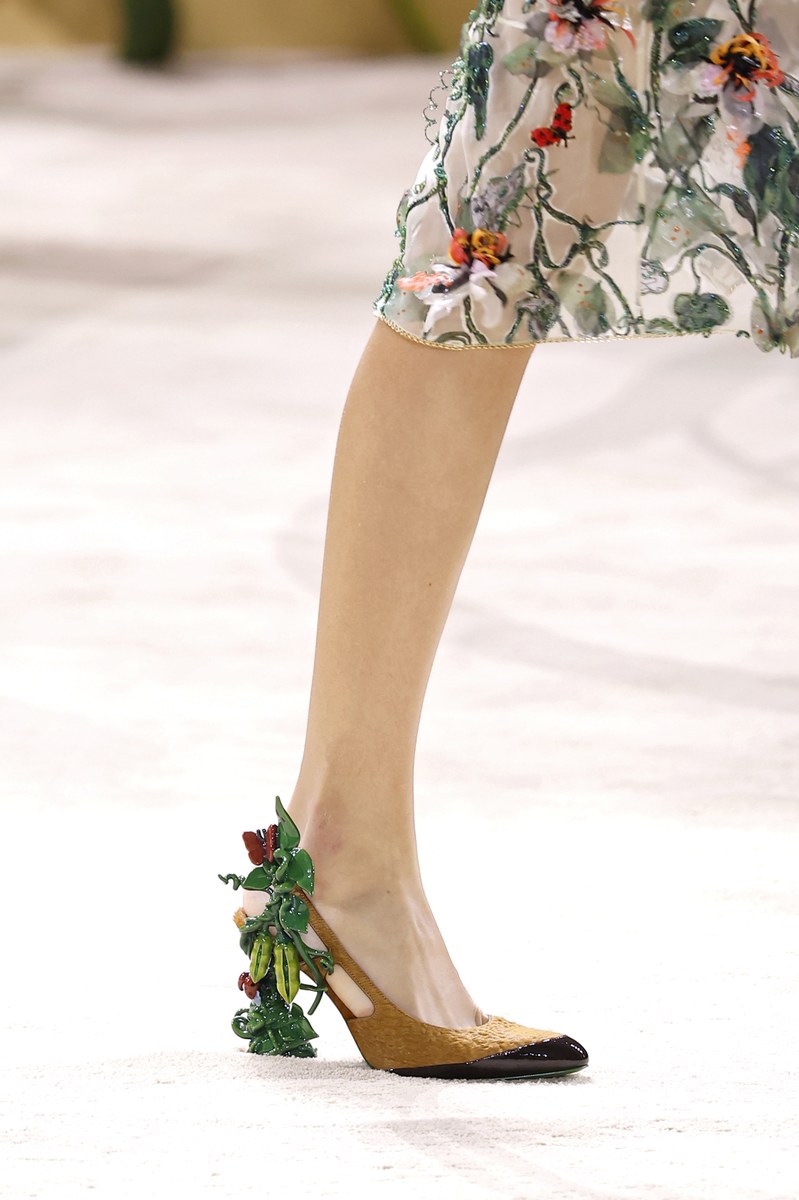
Silk satin, silk organza, and tulle serve as the primary base fabrics across the Dress Details, with velvet deployed in Details 1, 15, and 17 for tonal depth and textural contrast. Beadwork ranges from allover scatter grids, as in Detail 3 and Detail 10, to precision-placed individual motifs, as in Detail 14 and Detail 4. In Detail 2, appliqué work uses satin-faced fabric cut into rose petal and leaf shapes, outlined with silver metallic thread, sitting proud of the tulle ground. Fine black and ivory tulle form the veils in Details 19 and 20 respectively, with Detail 19 carrying individually worked silver wire ginkgo leaf motifs applied across the full veil surface.

Color and Finish Direction
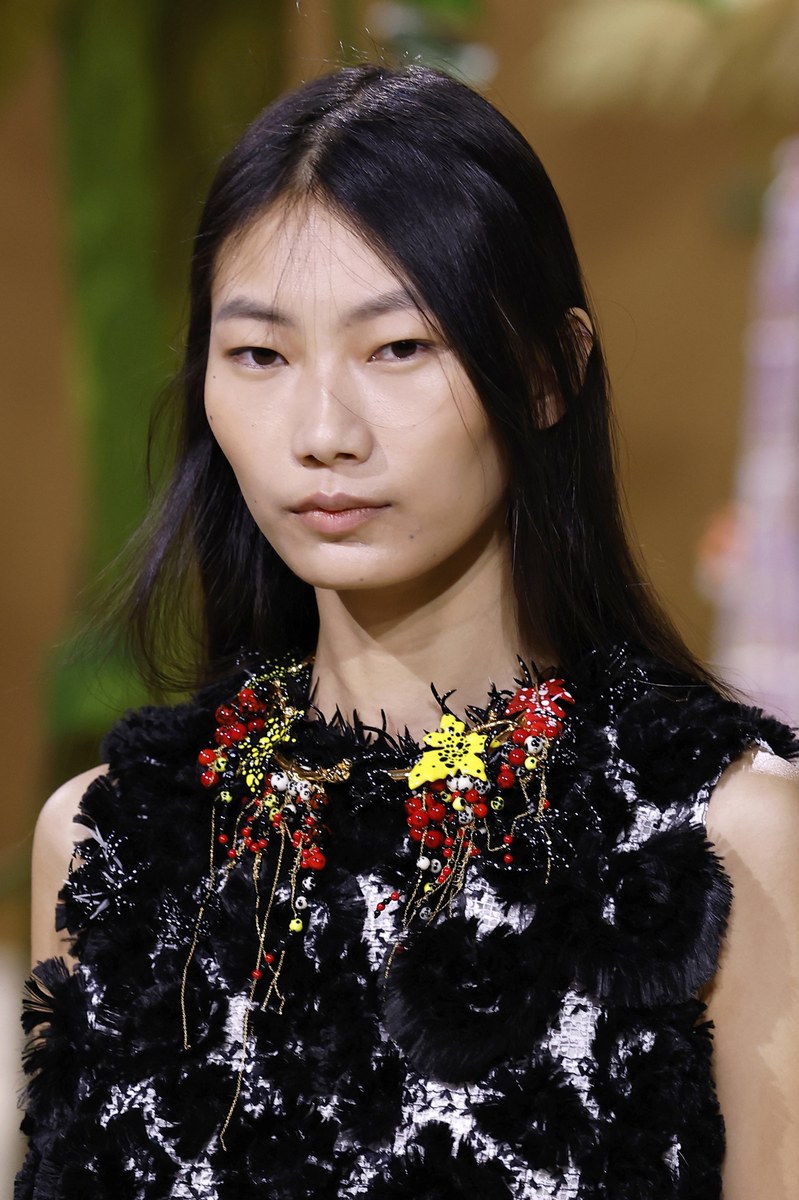
Three color registers divide the palette cleanly: neutrals anchored in ivory, blush, and warm nude, a blue family spanning powder blue through cobalt and periwinkle satin, and a dark register of all-black and near-black combinations. Silver metallic thread and crystal embellishment run as a consistent accent across the neutral and blue groups. Detail 14 introduces a burnt sienna base with red and gold hardware-style jewel clusters as the season's warmest contrast moment. Deep magenta rose-print jacquard paired against black Chantilly lace appears only in Detail 16, bringing the collection's single saturated non-blue chromatic statement. Metallic silver and crystal take priority in the finish direction overall, with gold appearing selectively in Details 4 and 8 as a warm highlight against lighter grounds.

Key Pieces and Details
Detail 12 is the commercial headline of the collection. Hand-applied three-dimensional pink fabric flowers, green beaded leaf clusters, silver paillettes, and scattered crystal points sit across a grey tulle base in a composition that reads as a complete textile artwork. Detail 8 presents a strong product story for buyers interested in novelty fabrication. Gold bugle bead lines define an irregular mosaic grid on the white ground, with blue and white floral clusters filling each cell and referencing Delft tilework directly. A repeating silver lurex bow motif works across the pale grey base of Detail 11, anchored at the waist by a large sequin appliqué bow in gunmetal, creating a single-item piece that needs no additional accessorizing to close the look.

Detail by Detail Highlights
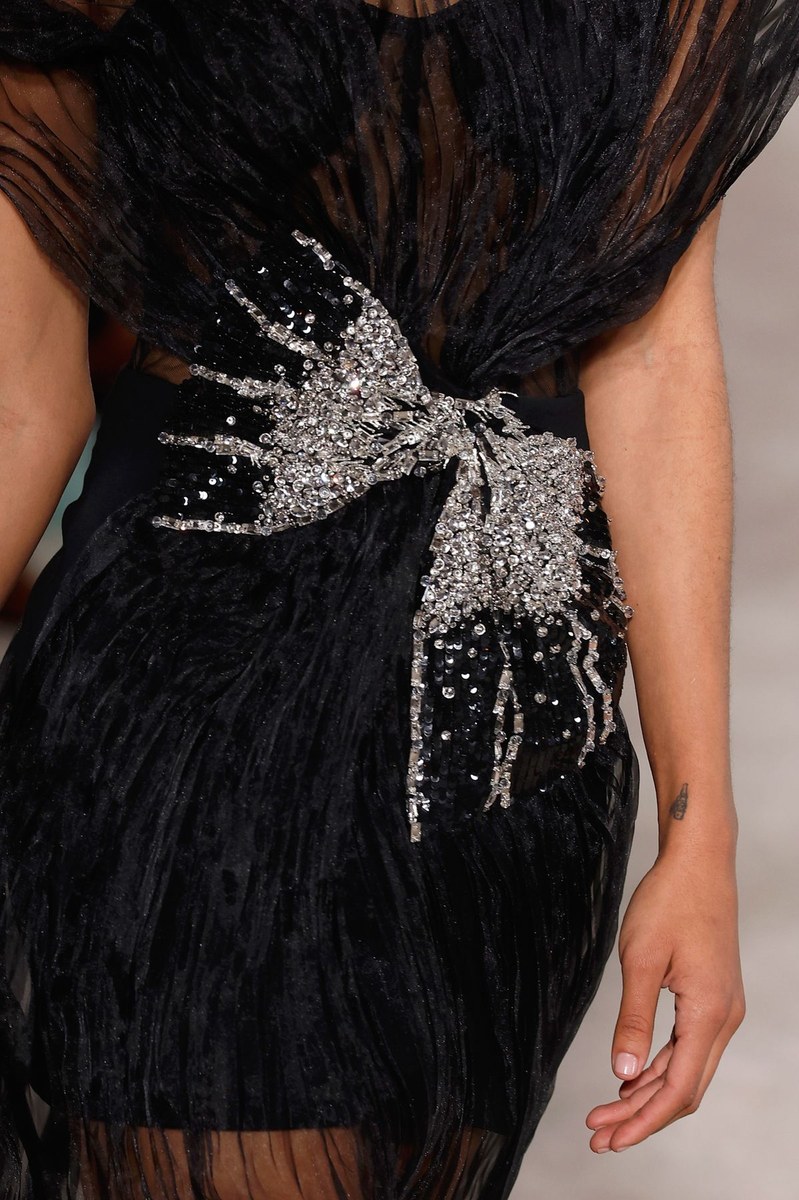
Detail 1 (Dress Detail) A black crushed velvet and sheer dress carries a central crystal brooch construction at the waist, with strands of pavé-set rhinestones radiating outward and downward in an exploding starburst silhouette.

Detail 2 (Dress Detail) Ivory satin rose and leaf appliqués, edged in fine silver metallic chain stitch, are mounted directly onto a sheer nude tulle torso panel above a silver lurex skirt, creating a bridal corsage effect built into the garment itself.

Detail 8 (Dress Detail) Gold bugle beads outline an irregular mosaic grid across a white structured strapless bodice, with each cell filled by a white sequin field and a blue and white hand-embroidered floral cluster referencing Delft ceramic pattern.

Detail 9 (Dress Detail) A royal blue embroidered slip dress is layered beneath a black polka-dot silk tulle high-neck overlay with fine horizontal pin-tuck pleating at the collar, pairing two opposed surface logics without either one receding.

Detail 12 (Dress Detail) Pink three-dimensional fabric blooms, green beaded leaves, silver mirror paillettes, and scattered crystal points cover a sheer grey base in an asymmetric climbing branch composition across the full torso and into the bishop sleeve.
Detail 15 (Dress Detail) An all-black off-shoulder gown uses velvet ribbon cut into leaf and petal shapes, applied flat onto a duchesse satin bodice, with the velvet off-shoulder bar as a single thick structural horizontal that anchors the organic appliqué below.

Detail 19 (Headwear) A black silk tulle chapel veil carries individually worked silver wire ginkgo leaf motifs scattered across the full surface, each leaf outlined in silver bugle beads and visible through the face-covering fall of tulle.

Detail 20 (Headwear) A plain ivory silk tulle veil with no applied embellishment drapes in clean multi-layer folds over a low chignon, relying entirely on volume and light diffusion for effect, positioned as the collection's bridal closer.

Operational Insights
MOQ and lead time: The hand-applied embellishment density across Details 12, 2, and 10 will require significant atelier hours per unit. Buyers should build minimum 16 to 20 week production windows into purchase orders and confirm sample lead times before placing.
Bridal adjacency: Details 2, 13, and 20 form a coherent ivory and blush bridal capsule. Accessories directors at multi-brand bridal retailers should evaluate these three as a pull-through set rather than individual SKUs.
Fabric sourcing risk: The silver lurex ground visible in Detail 2 and the gold bugle bead work in Detail 8 both depend on specialty suppliers with volatile lead times. Product managers should request material provenance disclosures and identify backup sources at contract stage.
Color family concentration: The blue and periwinkle group, spanning Details 5, 6, 7, 9, and 10, represents the largest single color story in the collection. Formal occasion and mother-of-the-bride buyers should read this as a directional confirmation that blue satin and blue embellishment will drive floor performance in FW26.
Embellishment as differentiation: The bow motif repeated in Detail 11 and echoed in the crystal burst of Detail 1 suggests a house-level signature that translates to accessories licensing. Style directors evaluating brand partnerships should flag the bow as a potential hero motif for co-branded jewelry or belt development.

More Details


✦ This report was generated with AI — combining human editorial vision with Claude by Anthropic. Because the future of fashion intelligence is already here.