Natasha Zinko FW26 Bags

Natasha Zinko FW26 Bags
Natasha Zinko FW26 Bags Report

Natasha Zinko FW26 treats the bag as a conceptual object built from the detritus of consumer culture, pairing fur pouches with transparent PVC carriers, branded grocery totes, scorched paper bags, and eBay-logoed cardboard clutches. Buyers and product managers should pay close attention here, as this work maps a commercially viable tension between luxury material codes and disposable packaging aesthetics that is already moving through streetwear and accessible luxury simultaneously.

Silhouettes and Shapes

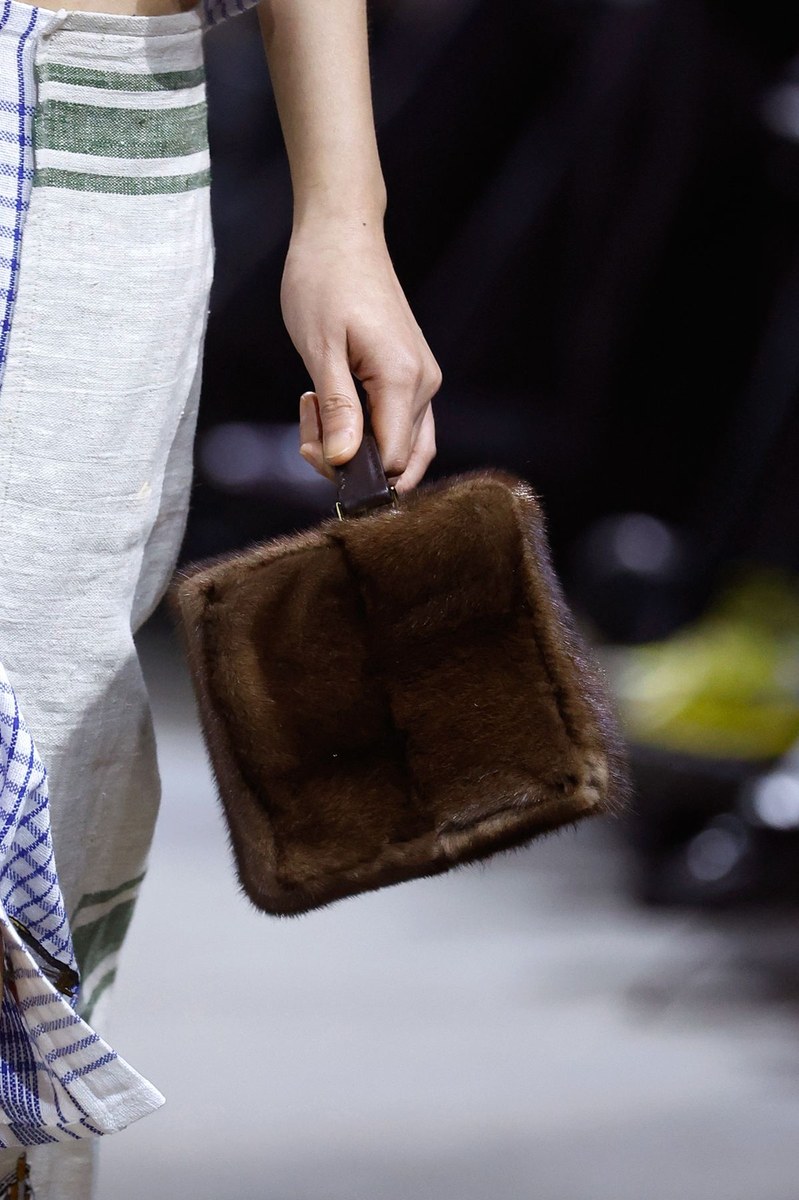
Two dominant forms emerge across the range. A compact square fur pouch with a single rigid top handle appears in Bags 1, 3, and 8. Then there are the oversized, wide-mouthed tote silhouettes, deliberately proportioned against the body in ways that command attention. Within the tote category, rigid box shapes sit alongside collapsed paper bag forms and wide-flared PVC carriers that open dramatically at the top. Volume is deliberately exaggerated in the PVC bags, which flare outward from the base and carry substantial visual mass even when lightly packed. Every silhouette here commits to either handheld utility or tote-scale carry. Nothing reads as a classic shoulder or crossbody construction.
Materials and Hardware

Dark chocolate brown mink or mink-adjacent short pile forms the primary shell on the compact pouch models in Bags 1, 3, and 8. PVC functions structurally in Bags 3, 5, and 8, presented as a clear outer carrier rather than a lining, with an untreated and uncoated finish that reads deliberately raw. Bags 2, 6, and 7 rely on textile and kraft paper constructions, with Bag 6 appearing to be a metallicized or wax-coated kraft paper that gives a gold foil-adjacent surface. Hardware stays minimal and low profile throughout. A single dark brown resin or lacquered wood short top handle anchors the fur pouch, with no visible metal closures, chains, or turn-locks anywhere across the collection.

Bag 6
Bag 6

Color Direction

Dark chocolate brown anchors the fur pouches and carries the most conventional luxury signal here. Natural kraft tan, achieved through paper and coated paper constructions in Bags 6 and 7, reads as a second dominant neutral. White and off-white dominate the grocery-print tote in Bag 2 and the scorched white canvas bag visible inside Bag 5, while the PVC bags are entirely transparent, allowing the contents to drive any color read. Restraint defines the palette, with unsaturated tones that position this work closer to archival Japanese minimalism than to streetwear maximalism, despite the conceptual provocation of the source materials.

Bag 2
Bag 2

Key Models and Details

The fur top-handle pouch anchors the collection as its luxury piece. It appears first as a standalone object in Bag 1, then reappears inside the transparent PVC carrier in Bags 3 and 8, suggesting the designer intends it to function both independently and as a nested inner bag within the PVC shell. Photorealistic printed fruit, fish, and packaged goods imagery covers the grocery tote in Bag 2, accompanied by the text "reusable. if it is still in good shape, use it again," a line that recurs across multiple bags as both a branding device and conceptual through-line. The cardboard clutch in Bag 4 reproduces eBay branding and parcel tape in what appears to be a structured fabric or paper shell, with plaid textile spilling out of the open top as a styling element that blurs the line between bag content and garment.

Bag 1
Bag 1

Bag by Bag Highlights

Bag 1 The dark chocolate fur top-handle pouch with a single rigid resin handle stands as the clearest standalone retail proposition in the collection. Compact enough for day carry and fur-forward enough to justify a premium price point.

Bag 2 Large printed canvas with photorealistic food illustration and bilingual sustainability text reads as an immediately licensable graphic. Buyers could adapt this across multiple price tiers without the original's conceptual weight.

Bag 3 A PVC carrier with the fur pouch nested inside makes a strong argument for two-in-one bag architecture. Layered retail story and higher perceived value per unit follow naturally from the design.

Bag 3
Bag 3

Bag 4 The eBay-branded cardboard box clutch executed in structured kraft material is the collection's sharpest commentary piece and its most trend-reportable item. Press and social traction should extend well beyond any commercial viability.

Bag 4
Bag 4

Bag 5 A transparent PVC tote containing a scorched, burned, and distressed white inner bag introduces deliberate damage as a design finish. For product developers tracking the growing market for pre-distressed luxury goods, this is highly directional.

Bag 5
Bag 5

Bag 6 The metallicized gold kraft paper tote with minimal branding and tight stitched seams is the most commercially transferable silhouette in the collection. Clean enough to sit in a contemporary department store without full conceptual context.

Bag 7 A crumpled natural kraft tote with the reversed Natasha Zinko logo stamp and visible wear marks commits to a lived-in paper bag aesthetic. Product teams could explore this through washed or enzyme-treated canvas as a lower-cost production alternative.

Bag 7
Bag 7

Bag 8 Close-up view confirms the fur pouch has a small eye-like detail visible on its surface. What reads as a simple material choice becomes a collectible object with stronger direct-to-consumer narrative potential through this figurative craft element.

Bag 8
Bag 8

Operational Insights

  • Modular bag architecture: The fur pouch and PVC carrier system in Bags 3 and 8 points to a modular drop strategy where the inner pouch retails separately from the outer carrier. Two SKUs from one design concept expand average transaction value considerably.
  • Sustainable messaging as surface design: The "reusable. if it is still in good shape, use it again" text appearing across Bags 2, 5, 6, and 7 functions as both a design motif and a sustainability signal. Product managers can use this to satisfy ESG reporting requirements without overhauling production infrastructure.
  • Fur adjacency and alternative materials: The brown fur pouch in Bags 1, 3, and 8 will generate animal welfare scrutiny in key European markets. Buyers placing orders should confirm whether this is genuine mink or a high-pile faux alternative and price accordingly, as the visual result is near-identical and the faux version opens significantly more doors with retail partners under fur bans.
  • Distressed finish as production spec: Scorched and burned detailing in Bag 5 and crumpling in Bags 6 and 7 require either a hand-finishing stage or a controlled distressing process. Both add labor cost, and product managers should build this into unit cost models before committing to volume.
  • Graphic licensing potential: The eBay parody in Bag 4 and the grocery illustration in Bag 2 carry real legal exposure if produced at scale without clearance. Accessories directors should treat these as directional references for original graphic development rather than production-ready designs.

✦ This report was generated with AI — combining human editorial vision with Claude by Anthropic. Because the future of fashion intelligence is already here.