Natasha Zinko FW26 Details
Natasha Zinko FW26 Details Report
Natasha Zinko FW26 constructs its accessories and garment details around a deliberate collision of domesticity, deconstruction, and body-conscious hardware, pulling references from workwear, lingerie, and sportswear into a single coherent provocation. For buyers and product managers navigating a market hungry for pieces with cultural legibility and physical tension, this collection delivers a clear blueprint.
Category Overview
These 20 shots break down into Dress Details and Headwear, with no Eyewear or Gloves in the edit. Dress Detail dominates and carries the full weight of the accessories strategy, treating garment construction itself as the accessory. Closures, embellishments, hemlines, and layering become the primary commercial proposition. Both Details 19 and 20 feature wrapped satin or coated silk scarves tied under the chin, reading as a single repeated signature rather than a varied category. Headwear appears sparsely here. What emerges is an accessories logic built from the inside out, starting with the body and the garment before reaching for add-ons.
Material and Construction
Leather, both matte black and deep navy, dominates Details 15 and 16, cut into oversized moto silhouettes with articulated shoulder armor panels and ribbed knee insets that mimic protective gear. Chantilly-style lace in cobalt blue with scattered crystal beading appears in Detail 11, constructed as a fully structured double-breasted mini coat with black resin buttons. Pink and lavender plaid fleece runs through Details 17 and 7, while Detail 6 shows towel-weight cotton and open-weave check cloth, pointing to a deliberate soft-materials palette alongside the harder fabrications. Raw frayed edges appear on the bomber in Details 13 and 14, and on the denim hem in Detail 12. Unfinished construction is a designed choice, not an oversight.

Color and Finish Direction
Black and off-white anchor the monochrome pieces in Details 1 and 5, where high-contrast pairing reads as graphic rather than minimal. Navy blue shifts between matte jersey, crystal-scattered lace, and smooth leather across Details 2, 11, and 15, demonstrating how a single hue can carry multiple material registers. Dusty pink emerges as the key accent, appearing in the lace robe of Detail 18, the plaid skirt of Detail 17, and the high-waist brief of Detail 8 against a floral brocade jacket in sage and pale yellow. Detail 10 offers the single most commercially isolated color moment, a saturated red heart appliqué on nude mesh, designed for immediate recognition.

Key Pieces and Details
The navy lace coat in Detail 11 stands as the single most production-ready statement piece, with its double-breasted resin button closure and structured shoulder line translating directly into luxury eveningwear or occasion capsules. Details 13 and 14 together present a gray nylon bomber with deliberately shredded seam allowances worn over houndstooth trousers. Two long braided hair extensions used as a belt or sash raise questions for buying teams about how to interpret and retail an accessory built from hair. Details 9 and 10 build a commercially viable two-piece intimates proposition, with the snap harness closure and rear appliqué functioning as the differentiation layer. For product managers, fleece plaid across Details 7 and 17 presents the strongest opportunity for accessible-price-point development, given the fabric cost structure and broad consumer appetite for this fabrication.
Detail by Detail Highlights
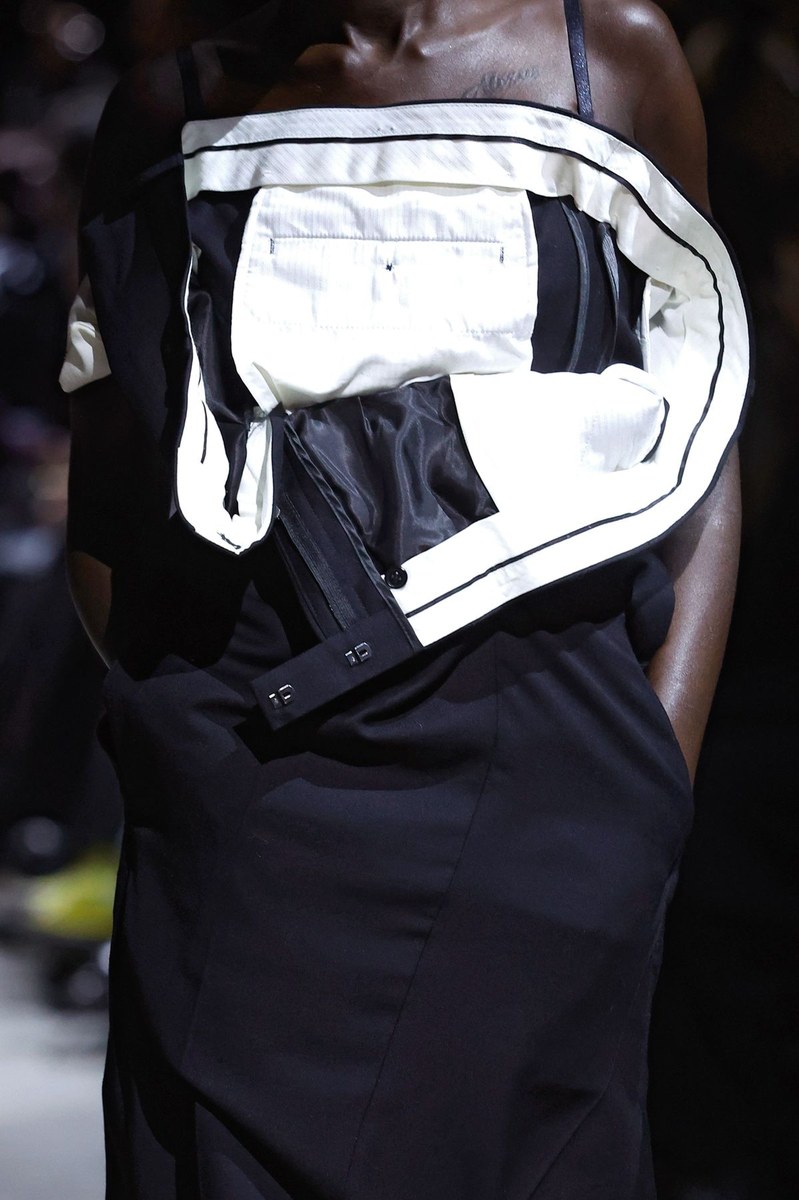
Detail 1 (Dress Detail) A pair of white shorts with black piping is strapped to the body of a black slip dress using black webbing clips, functioning as a constructed hybrid between outerwear and base layer.

Detail 5 (Dress Detail) A crumpled parachute-nylon garment in white with black trim is wrapped and draped across the torso above black jersey trackpants with an exposed diagonal zip that runs from hip to center front.

Detail 7 (Dress Detail) A lavender windowpane-plaid fleece bomber carries a large back appliqué of the letters N and Z rendered as balloon typography in powder blue and hot pink, attached by visible stitched outlines.

Detail 10 (Dress Detail) Nude mesh high-waist briefs with horizontal stripe printed lining feature a single oversized red heart appliqué centered on the rear, worn with a ribbed cream suspender harness fitted with flat black snap buttons at the chest.

Detail 11 (Dress Detail) A cobalt blue Chantilly lace coat with scattered clear crystal beading is fully lined in the same lace, structured with squared shoulders and fastened by eight black resin ball buttons in a double-breasted configuration.
Detail 15 (Dress Detail) A navy matte leather top with articulated padded shoulder and upper arm armor panels sits over matching leather trackpants with glossy leather knee patch inserts and ribbed horizontal stitching across the shin.

Detail 18 (Dress Detail) A pale pink Chantilly lace robe tied at the waist is worn over what appears to be printed packaging material used as an inner layer, and the model holds a roll of branded packing tape as a handheld prop standing in for a bag.
Detail 20 (Headwear) A slate gray coated satin scarf is folded into a tight headwrap and tied under the chin with a flat bow, worn alongside two thick braided extensions that fall to the chest, creating a single unified headframe composition.

Operational Insights
Lace outerwear production: Detail 11 requires buyers to identify lace suppliers capable of delivering structured, seam-stable Chantilly yardage at coat scale, with crystal heat-transfer or hand-application capacity. Source this fabric before committing to units, as lead times on embellished lace typically run 14 to 18 weeks.
Fleece plaid as a volume category: Details 7 and 17 confirm that soft plaid fleece is a sustained fabrication across the collection, making it viable for a tiered buying strategy that places logo appliqué or embroidered styles at a higher price point and plain fleece separates below. Lock in fleece yardage now given Q3 demand pressure.
Headwear minimum quantities: Details 19 and 20 present satin-finished wrapped headscarf silhouettes that require minimal construction and carry strong cultural resonance. These are low-cost, low-MOQ additions that accessories directors can use to round out a Zinko buy without significant inventory risk.
Raw hem as a production variable: Details 4, 12, 13, and 16 all use intentionally unfinished hems or frayed seam edges, which must be specified precisely in tech packs to avoid factory quality rejections. Product managers should confirm the finish standard in writing with Zinko's production team and photograph approved samples for QC reference.
Garment-as-accessory crossover: Details 1 and 5 both attach or layer secondary garments onto primary pieces, creating composite constructions that complicate returns, care labeling, and size scaling. Buying teams should clarify whether these are sold as single SKUs or separates, and request fit grading across at least three sizes before placing orders.
More Details


✦ This report was generated with AI — combining human editorial vision with Claude by Anthropic. Because the future of fashion intelligence is already here.