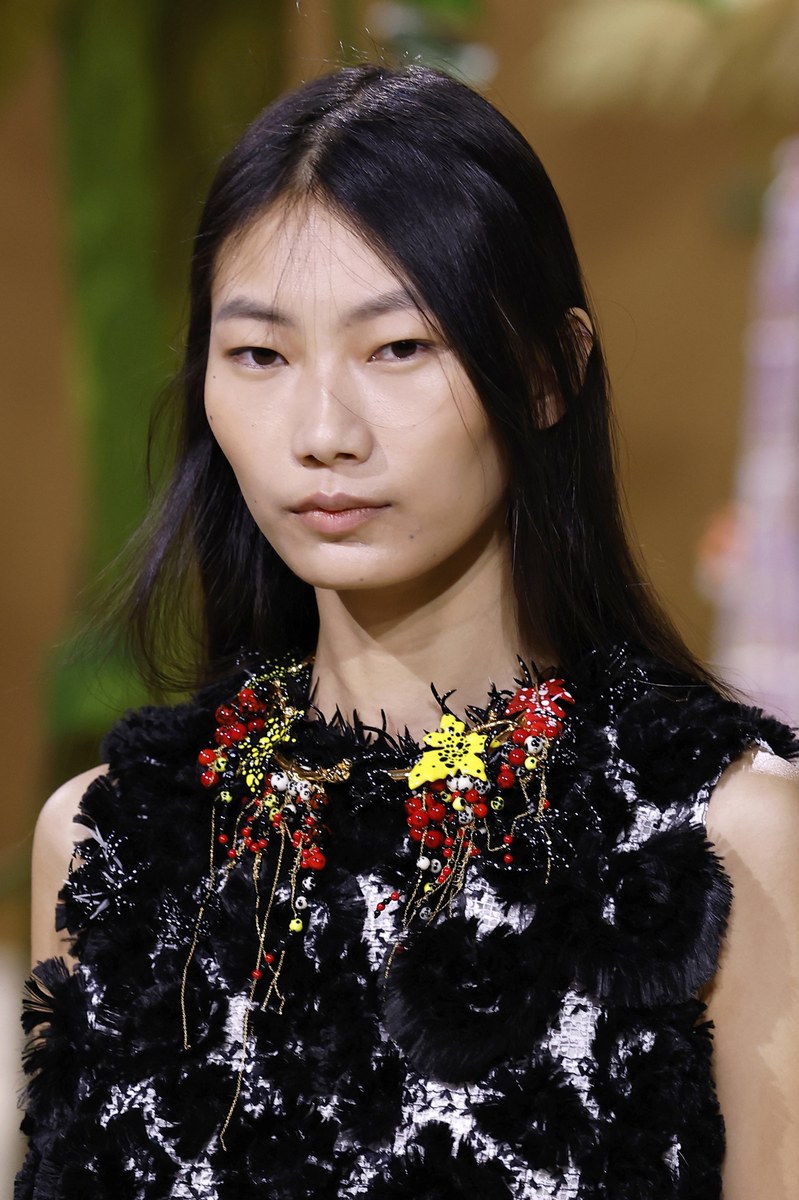
Niccolo Pasqualetti FW26 Women Looks Report

Niccolo Pasqualetti FW26 Women Looks Report
Niccolo Pasqualetti FW26 Women Looks Report

Paris Fashion Week

Pasqualetti builds this collection around the logic of accumulation, layering mismatched garment categories, fabrications and proportions onto a single body until the outfit reads as an archive rather than an outfit. For buyers navigating a market fatigued by minimalism and overcrowded by quiet luxury, volume and material tension emerge as the new commercial conversation.

Silhouette and Volume

Oversized cocoon coats, barrel-leg trousers and draped skirts with collapsed, gathered hems define the dominant shapes across the 20 looks. Nothing sits close to the body. The silhouette reads wide at the shoulder and tapers only loosely at the hem, as in the sculptural tulip skirt of Look 3 or the voluminous drop-crotch denim of Look 2. Look 13 and Look 18 push the volume furthest, wrapping the figure in blanketing layers that obscure all anatomical reference entirely.
Look 3
Look 3

Color Palette

Black and white open the collection, then the eye moves decisively into saturated deep burgundy, forest green and cobalt blue that dominate the second half. Burgundy paired with black recurs across Looks 10, 13, 15 and 17, building a consistent warm-dark mood that reads commercially viable for fall retail. A high-voltage burnt orange appears in Look 9 as the single warm bright, offset by olive and silver to keep it from reading casual. Rich without being ornate, the restraint in hue count makes cross-category buying coherent.

Look 9
Look 9

Materials and Textures

Leather, both matte pebbled and high-shine smooth, carries the structural weight of the collection, appearing in full coats, oversized bombers, wide-leg trousers and harness-style straps. Chunky textured knits in deep blue and cream add loft and surface contrast in Looks 11, 12 and 13. A crinkled jacquard or distressed open-weave fabric gives Look 7 and Look 8 a handcraft quality that reads artisanal against the harder leather pieces. Metallic silver panels in Look 20 and the foil-finish top of Look 2 introduce reflective surfaces that function as punctuation rather than theme. Woven suiting wool in grey and burgundy grounds the wilder textile choices in something wearable and seasonally appropriate.

Look 7
Look 7

Styling and Layering

Garment categories that do not conventionally belong together stack consistently throughout: a ribbed knit vest over a voluminous printed shirt over a midi skirt in Look 16, or a leather biker jacket over a draped inner vest over a dress in Look 6. Scarves, wraps and shawl-like panels function as structural layering pieces rather than accessories, as seen in Looks 7, 8 and 18. Footwear ranges between square-toe mules in grey suede, knee-high boots in brown or black suede and flat Oxford lace-ups, all sharing a low-key, intentionally unglamorous silhouette that grounds the volume above. Bags appear in sculptural cylindrical, crescent and elongated triangle shapes, all in the same palette as the clothing, reinforcing the idea that accessories are extensions of the outfit system rather than contrast points.

Look 16
Look 16

Look by Look Highlights

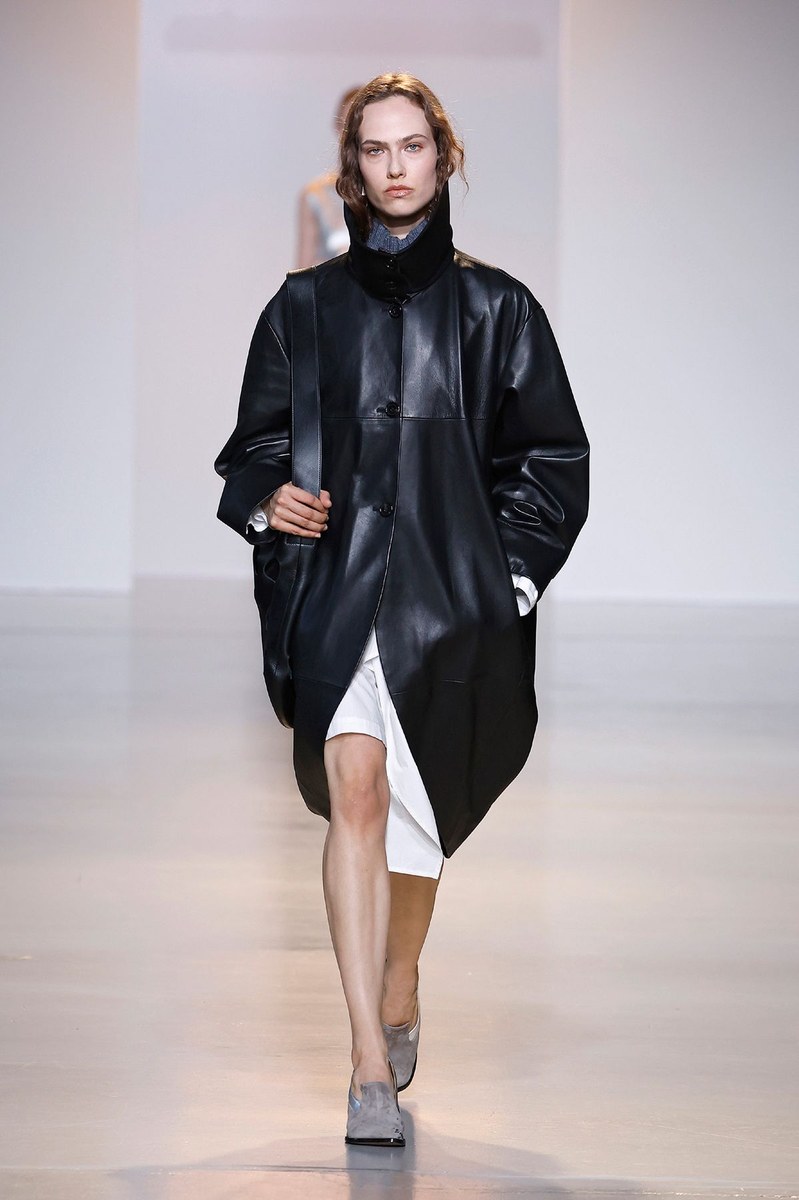
Look 1 The oversized black leather cocoon coat with a velvet-trimmed turtleneck collar over a white pencil skirt creates a strong entry-level commercial piece that pairs with both tailored and fluid bottoms for wholesale flexibility.

Look 1
Look 1

Look 2 Silver foil sleeveless top tucked into deep indigo wide-leg pleated denim with a brown leather belt is the collection's most immediately wearable separates proposition and the clearest candidate for strong retail sell-through.

Look 2
Look 2

Look 6 Layering a textured black ruffle dress under a khaki-lined black leather biker jacket with Mary Jane block-heel flats reads as the collection's most directional outerwear moment, combining three distinct garment codes in one commercial coat story.

Look 6
Look 6

Look 9 A burnt orange leather gilet worn over a matching orange dress inside an oversized olive field parka, accessorized with a silver pendant bag on a cord necklace, is the collection's boldest color and layering statement, built for editorial placement and visual impact at retail.

Look 13 A fully cobalt blue textured coat-dress with a voluminous black shearling collar and two-tone red and black suede knee-high boots is the strongest single-piece power look in the collection, with directional color and material contrast suited to a flagship or concept store environment.

Look 13
Look 13

Look 15 A black leather off-shoulder top with burgundy leather harness straps over a raw-hem grey wool skirt introduces a construction detail, the visible hardware strap as structural element, that has clear product development potential across bags and outerwear.

Look 15
Look 15

Look 17 A monochromatic burgundy draped trouser and blouse set cinched with a grommet leather belt and paired with a woven basketry-style shoulder bag is the most coherent head-to-toe color story in the collection and the clearest argument for a coordinated buying package.

Look 17
Look 17

Look 20 An oversized shaggy teddy bear coat with a silver metallic zippered chest panel grafted directly into its center front closes the show on a material contrast that is provocative enough for press but structured enough for a commercial coat buyer to adapt toward a less maximalist version.

Look 20
Look 20

Operational Insights

Outerwear as hero category Leather coats, shearling bombers and oversized parka-adjacent shapes appear across at least ten looks, making outerwear the clearest category anchor for buyers building a fall assortment around this collection.

Leather in multiple weights Five or more silhouette types use leather, from fitted harness straps in Look 15 to full floor-length trench proportions in Look 12, which means a leather goods or material supplier relationship is central to production planning for any licensee or wholesale partner.

Color sequencing for retail flow The progression from black and white in Looks 1 through 6 to the burgundy, green and blue palette in Looks 7 through 18 maps cleanly onto a two-drop delivery strategy, with the darker neutrals arriving first and the saturated colors following in a mid-season drop.

Separates buyability Looks 2, 4, 11 and 16 all break into commercially viable tops and bottoms that can be retailed individually, which gives style directors the option to buy partial looks and reduce commitment to the more experimental full-ensemble propositions.

Accessory program coherence Bags, boots and footwear share fabrication and palette logic tightly enough with the clothing that a coordinated accessories buy alongside the ready-to-wear would strengthen average transaction value and create strong visual merchandising stories on the floor.

Complete Collection

Look 4
Look 4
Look 5
Look 5
Look 8
Look 8
Look 10
Look 10
Look 11
Look 11
Look 12
Look 12
Look 14
Look 14
Look 18
Look 18
Look 19
Look 19
Look 21
Look 21
Look 22
Look 22
Look 23
Look 23
Look 24
Look 24
Look 25
Look 25
Look 26
Look 26
Look 27
Look 27
Look 28
Look 28
Look 29
Look 29
Look 30
Look 30
Look 31
Look 31
Look 32
Look 32
Look 33
Look 33
Look 34
Look 34
Look 35
Look 35
Look 36
Look 36
Look 37
Look 37
Look 38
Look 38
Look 39
Look 39
Look 40
Look 40
Look 41
Look 41
Look 42
Look 42
Look 43
Look 43
Look 44
Look 44

Fashion Designer

About the Designer

Niccolò Pasqualetti was born in 1994 in San Miniato, a medieval hilltop town in the Tuscan countryside sitting roughly equidistant between Pisa and Florence. He grew up as an only child in the rural landscape, in a family where no one worked in fashion, in a region dense with artisans and manufacturers whose trade he absorbed without yet knowing it was exceptional. As a child he became fascinated by his grandfather's collection of shells and minerals, objects whose organic geometry would resurface decades later in the shapes he carves into garments. At sixteen he started pulling his father's suits from the wardrobe and wearing them with skirts, bleaching his hair, assembling identities from what was already there. Fashion, he has said, was always about trying to find himself.

Before he understood design as a profession, he studied foreign languages and literature in secondary school, then briefly tried economics and management at university before recognizing the wrong direction. He went on to study at IUAV in Venice, spent time in Belgium, and completed an MA in womenswear at Central Saint Martins in London. His professional formation spanned three very different houses: The Row in New York, where he learned the discipline of construction and an appetite for material silence; Alighieri, the London jewelry label where craft and found objects were central; and Loewe in Paris, where the scale of building a large, multi-line collection gave him a structural education in how fashion operates as a system. In 2020, as lockdown collapsed the normal geography of his life, he returned to rural Tuscany and began building his own label, working with local artisans he had grown up around but never truly seen until he had seen them through the eyes of the international brands that had always sought them out.

His references are precise and non-fashionable: the sculptures of Jean Arp, Henry Moore, and Barbara Hepworth; the Arte Povera movement and its rehabilitation of humble, everyday matter; a vintage book of seashells catalogued on silver backgrounds. He produces everything in Italy using deadstock fabrics, working with Tuscan craftspeople to break open existing patterns rather than follow them. The central formal proposition of the brand is the union of opposites: stone's rigidity and water's give, masculine and feminine patterns combined in a single garment, the classic made strange by proximity to the disruptive. He has described this not as a statement about gender but as an expansion of who can find themselves in a piece of clothing. Since 2023 he has been on the official Paris Fashion Week calendar, and in 2024 he was named an LVMH Prize finalist, the only fully Italian-produced brand on the shortlist that year. In 2025 he was invited as Guest Designer at Pitti Uomo for his menswear debut.

"It was always about trying to find an identity through fashion."

"The pandemic period led me to live in close contact with my home region, Tuscany. From here I started again in building the Niccolò Pasqualetti brand. This means working with artisans who have been practicing their craft for years according to certain structures and patterns, and trying to make them break these patterns through continuous research"

✦ This report was generated with AI — combining human editorial vision with Claude by Anthropic. Because the future of fashion intelligence is already here.