Noir Kei Ninomiya FW26 Details
Noir Kei Ninomiya FW26 Details Report
Noir Kei Ninomiya FW26 constructs accessories and garment details as structural architecture, treating the body as a scaffold for laser-cut metal lattices, sculptural animal headpieces, wire cage frameworks, and densely layered three-dimensional flora built from cord, vinyl, and molded resin. For buyers and product managers navigating a market hungry for collectible, craft-forward statements, this collection defines the ceiling of wearable sculpture at the luxury end.
Category Overview
Dress Detail and Headwear carry the full conceptual weight here. Neither operates as embellishment in any conventional sense. Exoskeletal wire grids, vinyl flower clusters, and braided cord appliqué replace traditional surface decoration entirely on the dress details. Moving further still, the headwear pairs woven copper satin basket forms with cast-resin animal sculptures and crystal-studded face-encasing hoods that obscure identity rather than frame it.
Material and Construction
Vinyl and patent-coated materials dominate the dress details, cut into geometric star forms in Detail 1 and laser-etched rose motifs in Detail 3, then layered at volume to create dimensional surface relief. Powder-coated square-section wire frames appear in Details 12 and 13, bent by hand into irregular cage structures that suspend dark vinyl dahlia forms mid-air away from the body. Braided cord repeats throughout, stitched into looped four-petal flower motifs across grid-structured skirts in Details 9 and 10, and into a body harness appliqué in Detail 5. For the headwear in Details 14, 15, 16, 19, and 20, woven satin ribbon basketry combines with cast brown resin animal sculptures, the surface of the resin deliberately rough and hand-finished rather than polished.

Color and Finish Direction
Black commands the collection across almost every category, appearing in patent vinyl, matte cord, polished leather, and woven satin, each finish giving the same hue a different optical weight. Red fires through as a sharp accent in the bold-pile crochet overlay on the leather jacket in Detail 8, the cord flower appliqué on the cage skirt in Detail 9, and the tricolor flower embellishment of Detail 11 where black, red, and white fabric blooms sit against a jet beaded vine ground. Copper and amber tones occupy the headwear exclusively, the woven basket structures in Details 14, 15, and 16 carrying a warm oxidized-metal quality that reads as both archaic and industrial. Clear rhinestone scatter across black ruffled satin in Details 17 and 18 provides the only moment of reflective sparkle in an otherwise matte-dominant palette.

Key Pieces and Details
The wire cage constructions in Details 12 and 13 represent the most commercially provocative decision in the collection, attaching a rigid metal grid framework directly to the body as an outer silhouette layer. A structure that demands custom production partnerships and positions the pieces as exhibition or capsule objects rather than volume goods. Sculptural animal headpieces in Details 19 and 20, each mounting a leaping resin dog atop the woven basket base, function as the collection's most singular collectible proposition, directly relevant to accessories directors building runway-adjacent display or editorial-exclusive inventory. More accessible in scope, the braided cord cage skirt in Detail 9 sits at the other end of this spectrum, its grid construction reproducible in varying colorways with defined craft-skill requirements. Details 17 and 18, the rhinestone-covered face-encasing hood, opens a conversation about the boundary between headwear and mask as a product category, directly relevant to buyers watching the ongoing expansion of face-adjacent accessory markets.

Detail by Detail Highlights
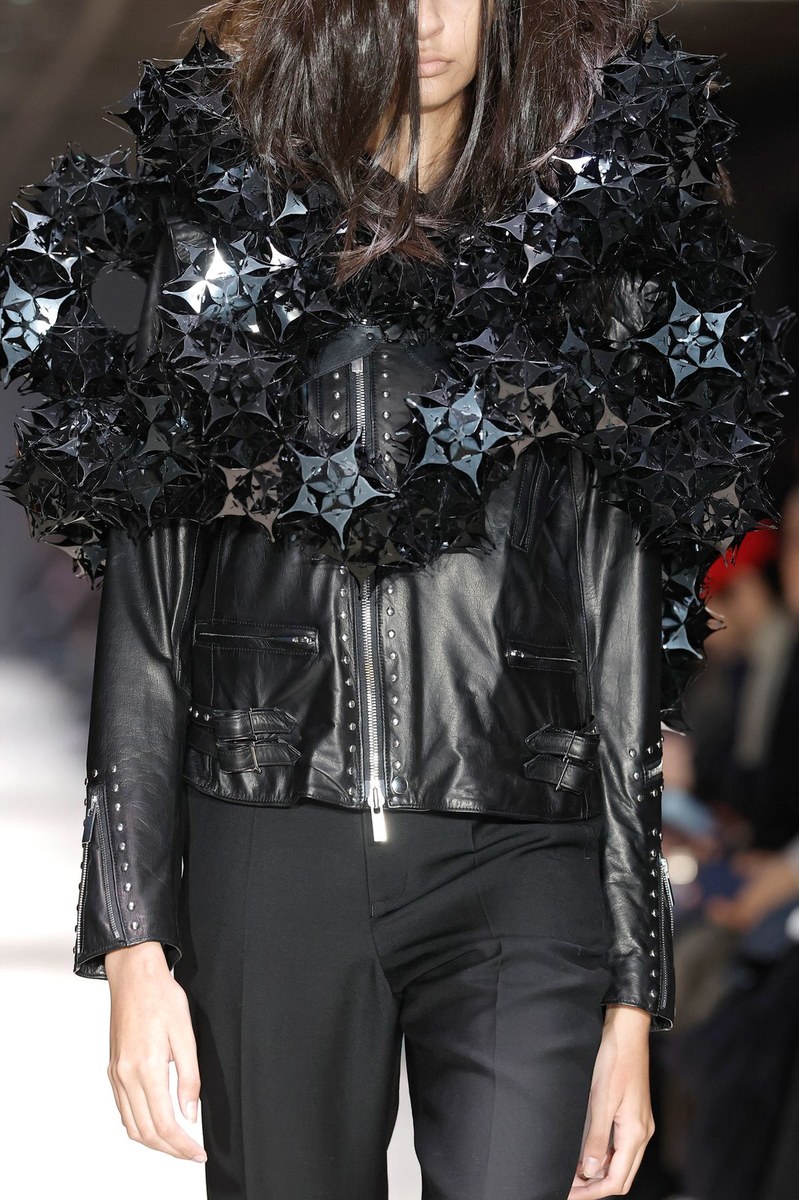
Detail 1 (Dress Detail) Black patent vinyl star-point forms, each approximately fist-sized, cluster across the upper body of a classic biker leather jacket, replacing a conventional collar or yoke with dense three-dimensional volume.
Detail 3 (Dress Detail) Laser-cut patent black panels printed with a continuous rose and leaf line motif are gathered, bent, and layered into a billowing overgarment that reads as dark metallic cloud from a distance and as graphic illustration up close.

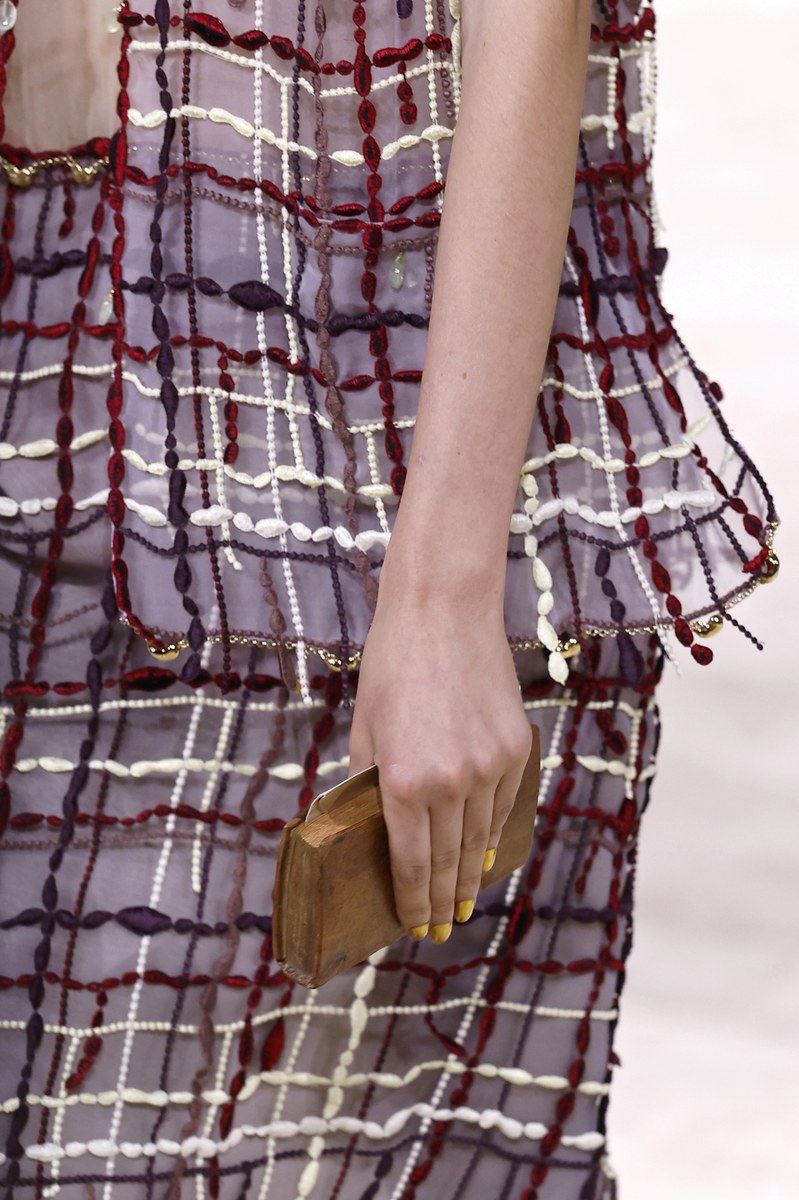
Detail 9 (Dress Detail) A structured black ribbon grid skirt, spaced at roughly four-centimeter intervals both vertically and horizontally, carries red braided cord flowers knotted at each intersection and drifting as loose vine forms across the surface.
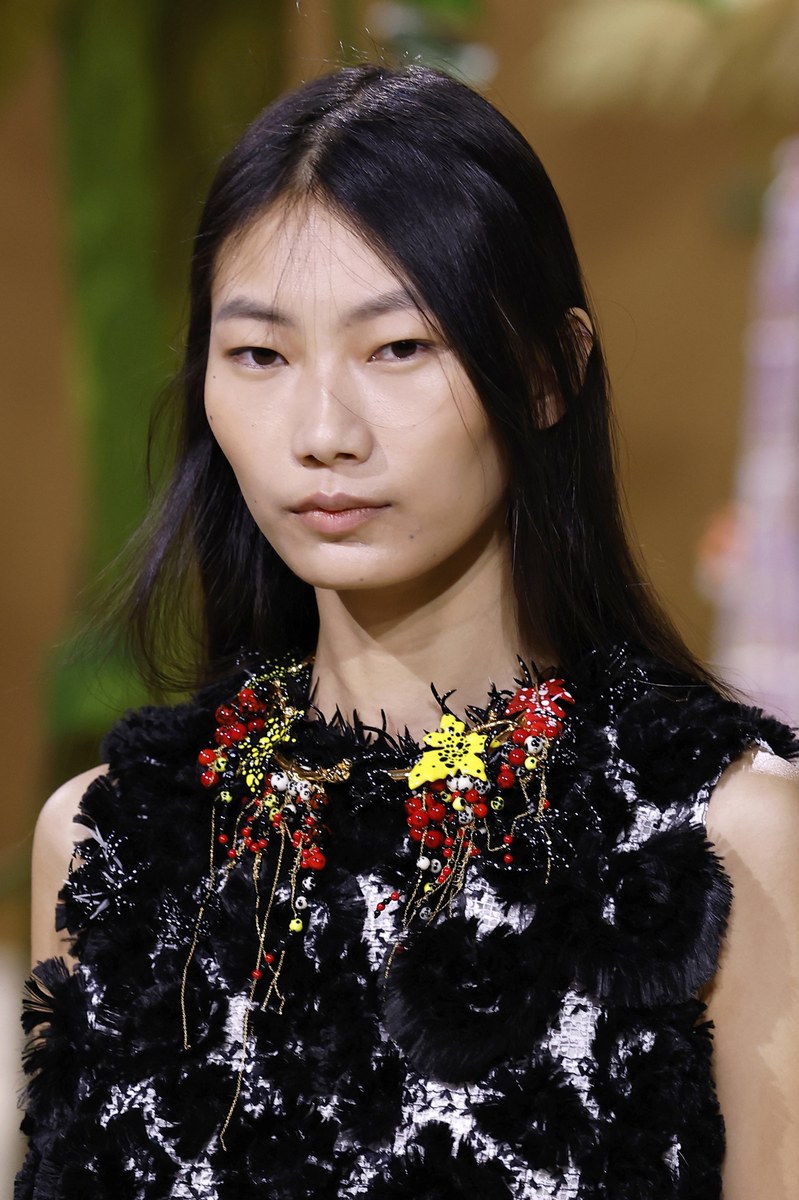
Detail 11 (Dress Detail) Red, white, and black gathered fabric blooms are stitched individually across a jet-black beaded scrollwork ground, creating a densely packed allover floral that requires significant hand-labor hours per unit and signals strictly limited production quantities.

Detail 12 (Dress Detail) Powder-coated square-wire frames, each roughly palm-sized, are assembled into a three-dimensional grid structure from which dark vinyl dahlia forms are suspended independently, the entire construction worn as a mid-body overpiece.

Detail 17 (Headwear) A full face-encasing hood in black ruffled satin with crystal rhinestone scatter and a central zip closure leaves only the eyes exposed, the opening edged with a gathered ruff that frames the gaze as a deliberate focal point.

Detail 19 (Headwear) A woven copper-tone satin basket cap anchors a hand-finished brown resin leaping dog sculpture on its crown, the animal posed mid-stride, the surface texture retaining visible tool marks that confirm non-industrial production.

Detail 5 (Dress Detail) Black braided cord is shaped into a four-petal flower repeat and riveted onto black leather harness straps that cross the chest of a khaki nylon bomber, the contrast between utilitarian outerwear and craft appliqué forming the central tension of the look.

Operational Insights
MOQ and production scale: Wire cage constructions in Details 12 and 13, and resin animal headpieces in Details 19 and 20, are physically incompatible with standard volume production runs. Budget for artist-studio minimums and factor extended lead times into any order calendar.
Craft labor costing: Details 9, 10, and 11 each require significant hand-finishing hours per unit, particularly the individually knotted cord flowers and the hand-sewn fabric blooms. Cost-per-unit projections must account for specialist craft labor at couture adjacent rates, not RTW assembly benchmarks.
Material sourcing: Patent vinyl used across Details 1, 3, and 12 requires sourcing from suppliers capable of consistent gauge and gloss uniformity, as surface inconsistency becomes visible at the scale of these cut and layered constructions. Accessories directors should establish dual-source agreements to protect against sheet shortages.
Retail positioning: Headwear in this collection, particularly Details 14, 15, 17, 18, 19, and 20, positions as collectible objects rather than seasonal accessories. Retail partners should plan editorial and display-led sell strategies over conventional sell-through KPIs, prioritizing cultural placement in art-adjacent retail environments.
Colorway development: Core construction vocabulary, cord flowers, vinyl shapes, wire grids, performs equally in monochrome black and in red-black contrast. Product managers should identify two to three pieces where an additional colorway test, specifically the red and copper tones already present in the collection, could expand commercial reach without compromising design integrity.
More Details


✦ This report was generated with AI — combining human editorial vision with Claude by Anthropic. Because the future of fashion intelligence is already here.