Off-White FW26 Women Looks Report
Paris Fashion Week
Off-White FW26 builds a wardrobe around the collision of workwear utility, 1970s velvet tailoring, and lingerie-coded lace, all pulled into a single commercial vocabulary under creative director Cameroonian designer Ibrahim Kamara. Buyers hunting for gender-fluid carry pieces alongside women's ready-to-wear with strong visual identity will find dense crossover inventory opportunity here.
Silhouette and Volume
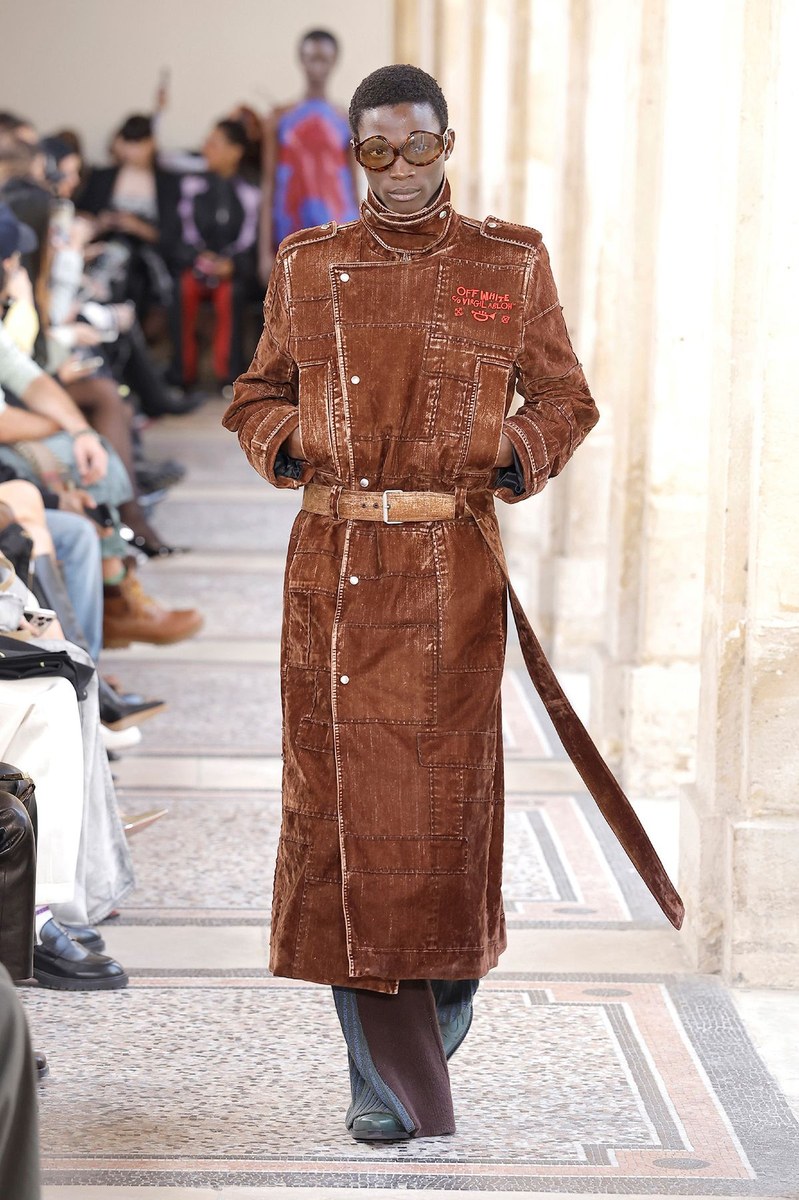
A long, structured column dominates the collection, appearing in floor-grazing coats (Looks 1, 13) with deep center-front slits that expose leg without compromising outerwear authority. Cropped bombers and boxy zip jackets (Looks 5, 18) counter the length by sitting high on the hip, creating a deliberate short-long tension throughout. Wide-leg flares recur on both men's and women's looks, grounding everything in a 1970s proportion that reads contemporary through the addition of hardware and patchwork panels.
Color Palette
Burnt brown, almost tobacco in tone, dominates the first half and serves as the anchor hue across velvet coats, corduroy suits, and suede-finish outerwear. Burgundy and cobalt blue enter together as a recurring pairing, most visibly in the vinyl-and-lace slip dress of Look 2 and the striped knit bodysuit of Look 8. This bruised jewel-tone tension photographs well for editorial placement. Acid yellow punctuates darker looks as a graphic accent rather than a ground color, appearing on knitwear and track jackets to lift otherwise deep palettes. Black closes the collection cleanly, gaining edge from white collar trim and silver eyelet hardware in Looks 10 and 20.

Materials and Textures
Crushed velvet and worn corduroy carry the highest frequency, finished with topstitching in contrasting thread that maps every seam as a design element rather than a construction necessity. Red vinyl and blue guipure lace appear in direct combination on Look 2 and in edited form on Look 5 and Look 7, giving the lace trim a hard, almost industrial quality when read against the slick vinyl ground. Patchwork leather in multi-panel configurations (Looks 4, 11, 12) uses color blocking across olive, grey, white, and burgundy sections, producing a structured weight that holds shape without internal boning. Look 19's grey draped jersey is the collection's lightest hand, cross-wrapped at the neckline and finished with yellow guipure at the hem to contrast the bodycon drape above.
Styling and Layering
Hoodies and ribbed knitwear worn under tailored outerwear points directly toward a sell-through strategy built on separates rather than head-to-toe looks. Visible across Looks 4, 9, and 14, this is the most actionable layering logic. Opaque black tights appear on nearly every women's look, treating legwear as a foundational layer rather than an afterthought. Styling directors should read this as a signal to build hosiery into visual merchandising plans. Footwear splits between lace-up kitten-heel ankle boots and low pointed cowboy boots, both in grey-green or black across multiple looks, keeping shoe investment focused. Large unstructured bags run in grey suede, black patent, and brown canvas with minimal hardware. They read as practical carry rather than status accessories.
Look by Look Highlights
Look 1 The tobacco brown patchwork velvet overcoat belted at the waist with a matching croc-embossed band is the strongest outerwear commercial proposition, workable across both women's and gender-neutral floors.

Look 2 Red vinyl slip dress with cobalt blue guipure lace overlay: this is the highest-risk, highest-reward piece in the lineup, built for editorial placement and a small, targeted special-occasion buy.
Look 7 A burgundy zip track jacket printed with a photographic car image over a matching lace-hem skirt closes the sportswear-to-dressed gap in a single look and has strong two-piece separates potential for buyers building capsule assortments.

Look 8 The cobalt and burgundy striped ribbed turtleneck bodysuit with circular mirror hardware details sends the collection's clearest signal on the eyelet and grommet trend, translating directly into a high-volume knitwear option at mid-price retail.

Look 10 Black velvet longline jacket with white lapels and silver eyelet embellishment over micro shorts is the most structurally tight look in the collection and carries clear potential for evening capsules or fashion-forward workwear buys.

Look 13 The brown suede duster coat with snap closures and a high center slit worn over a matching bodysuit reads as a full look with strong western-luxury market appeal and minimal styling input required at retail.

Look 15 Black military coat with quilted down sleeves is the most accessible hybrid outerwear piece, balancing tailoring and technical fabrication in a way that will resonate with buyers serving cold-climate markets.

Look 19 Grey stretch jersey wrap dress with yellow lace hem is the sole move toward formal occasion dressing and merits a small, targeted buy for buyers who carry cocktail-adjacent product.

Operational Insights
Velvet and corduroy yardage: Move early on tobacco and black crushed velvet orders. The material anchors at least six key looks and will face competition across multiple houses this season.
Lace trim as a recurring unit driver: Cobalt guipure lace reappears across four looks in different applications. Sourcing this trim as a shared component across a mini capsule of dresses, skirts, and shorts will reduce unit costs while building visual cohesion on the floor.
Gender-neutral crossover: Patchwork leather trousers, corduroy flares, and velvet suiting all read wearable across genders without alteration to pattern or fit grading. Plan cross-floor placement from the outset at multi-gender retailers.
Eyelet and grommet hardware: Circular mirror hardware details appear on knitwear, denim, and outerwear. Flag this as a trim investment worth building into private label development for mid-market interpretation.
Tights as a merchandising layer: Consistent use of opaque black tights across women's looks signals strong visual merchandising potential. Pairing hosiery bundles with key dress and skirt styles at point of sale will lift average transaction value and keep looks editorially coherent on the floor.
Complete Collection


Fashion Designer

About the Designer
Ibrahim Kamara, known as Ib, was born in Sierra Leone in 1990 and spent his earliest years surrounded by the vivid colors and natural abundance of West Africa before war tore that world apart. At seven years old, the civil conflict forced his family to flee, and he moved between Guinea, the Gambia, and other neighboring countries, spending years separated from his mother, crossing borders by boat, watching death become ordinary. He has said that living through that period of violence left him not traumatized but toughened, with a stronger instinct to keep moving and dreaming larger. In the Gambia, without access to the saturated imagery of Western pop culture, he and his friends made their own toys, invented their own visuals, trained an imagination that didn't wait to be fed. The family had wanted him to become a doctor, and when he arrived in London at sixteen, settling in Thamesmead in southeast London, that was still the plan. He spent three years studying sciences before recognizing that he was headed in the wrong direction.
He enrolled in an art and design foundation course at Westminster Kingsway College, then studied fashion communication at Central Saint Martins, where he graduated and began assisting stylists from the generation that had defined image-making in the previous era: Barry Kamen, Simon Foxton, and Judy Blame, all figures who operated outside the mainstream and built entirely recognizable visual worlds. That quality, the instantly distinct world of an artist or director, became his own standard for ambition, and he has named Hans Zimmer, Quentin Tarantino, and Diana Vreeland as the references he holds in mind when working, not for their medium but for the unmistakable signature of everything they made. He came up in London's nightclub scene as much as in any studio, crashing shows in Paris, building a language through music and club culture and the hunger of someone for whom access had never been assumed. His dyslexia, he has acknowledged, pushed him toward images as a primary language. In 2016 he curated an exhibition at Somerset House titled "2026," photographed in Soweto on street-cast models in secondhand clothing, which investigated Black African masculinity and what menswear might look like a decade ahead. It introduced him to the world of Dazed, where he eventually became editor-in-chief in 2021.
Virgil Abloh found him on Instagram, as he found many people, and a working relationship deepened into genuine friendship over shared music in the Off-White studio. By 2021, Abloh had brought Kamara onto the Off-White team as a stylist; months later, Abloh was gone. In April 2022 Kamara was named Art and Image Director of Off-White, and in February 2024, following his debut runway collection titled "Black by Popular Demand," he was confirmed as its Creative Director, the first Black African creative to lead the brand. He presents the collections in Paris and, in September 2024, staged the house's first New York Fashion Week debut, drawing on a visit to Ghana and on his own layered geography of Sierra Leone, the Gambia, London, and the image of America that Africa projects back across the Atlantic.
"Off-White is the brand that is supposed to take risks and be inventive and have a new point of view all the time. I think I'm finding my point of view in Virgil's universe, but there is me in there too."
"I hope I inspire people of all colors and backgrounds to unapologetically express themselves. That's the outsider's legacy. You do your own thing, then hopefully the world catches up to it one day."
✦ This report was generated with AI — combining human editorial vision with Claude by Anthropic. Because the future of fashion intelligence is already here.