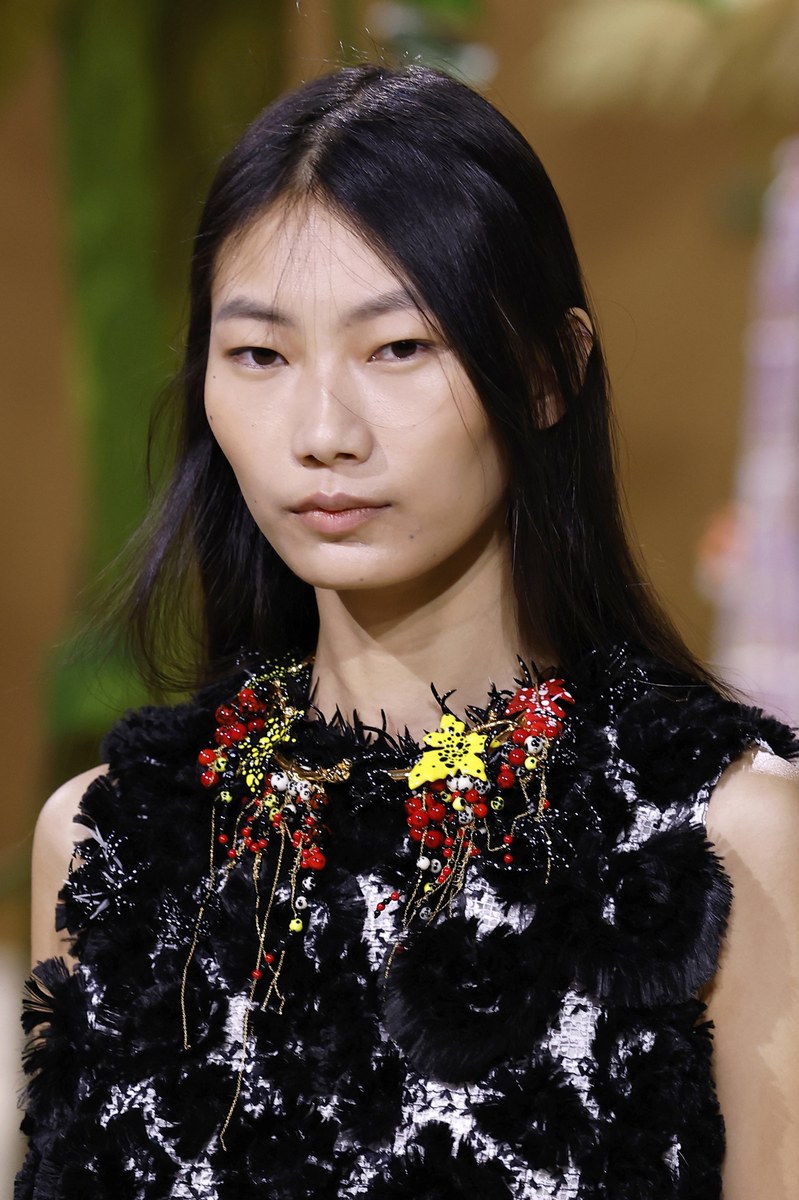
Onitsuka Tiger FW26 Women Looks Report

Onitsuka Tiger FW26 Women Looks Report
Did you know? Onitsuka Tiger was founded in 1949 by Kihachiro Onitsuka as a basketball shoe company in post-war Japan, making it one of the earliest athletic footwear manufacturers to emerge from the region during industrial reconstruction. The brand's signature curved side stripe, which became a design hallmark later adopted by Asics, was originally engineered to provide lateral ankle support and reinforce the shoe's structure during basketball play.

Onitsuka Tiger FW26 Women Looks Report

Milan Fashion Week

Onitsuka Tiger FW26 builds a wardrobe around the collision of 1970s sportswear nostalgia and deliberate gender fluidity, running womenswear and menswear through the same design vocabulary without resolving the tension between them. For buyers, this positions the brand squarely in the growing market for gender-neutral luxury sportswear with a distinct archival reference point that competitors are not yet occupying at this price tier.

Silhouette and Volume

The collection splits between two dominant shapes: a cropped, boxy jacket paired with a short pleated skirt, and a wide, dropped-crotch trouser paired with a fitted or loosely layered top. Both silhouettes read as oversized relative to the body, but the skirt looks (Looks 1, 3, 6, 17) keep the hemline high enough to prevent the volume from reading as shapeless. Look 9 stands apart with its structured, floor-grazing military coat that anchors the collection's range.
Look 9
Look 9

Color Palette

Olive, warm taupe, mustard yellow and off-white form the backbone of the palette, with dusty blush pink and rust terracotta appearing as accent tones across several looks. A strong neutral base emerges in the gray melange of Look 1 and the nearly identical gray flannel of Look 5, one that will perform commercially regardless of the more adventurous pairings. Fuchsia magenta recurs as a bag color across Looks 4, 10 and 15, functioning as a deliberate pop accent that ties men's and women's looks together. Muted and autumnal, the mood delivers warmth rather than darkness.

Look 1
Look 1

Materials and Textures

The collection layers several distinct fabric weights and surfaces within single looks. Double-faced wool appears in the cream military coat (Look 9) and the gray and taupe tailored suits (Looks 1, 5), giving those pieces a flat, dense hand with visible contrast topstitching as the primary surface detail. Shearling and faux fur operate in two registers: as the primary outerwear fabric in Look 3's cow-print jacket and Look 19's black leather duffel coat, and as the boot shaft construction seen across Looks 2, 13 and 14. Cut or woven fringe techniques in ivory and straw yellow appear on the fringe dress in Look 8 and fringe skirt in Look 16, adding movement and tactile contrast to otherwise simple underlayers.

Styling and Layering

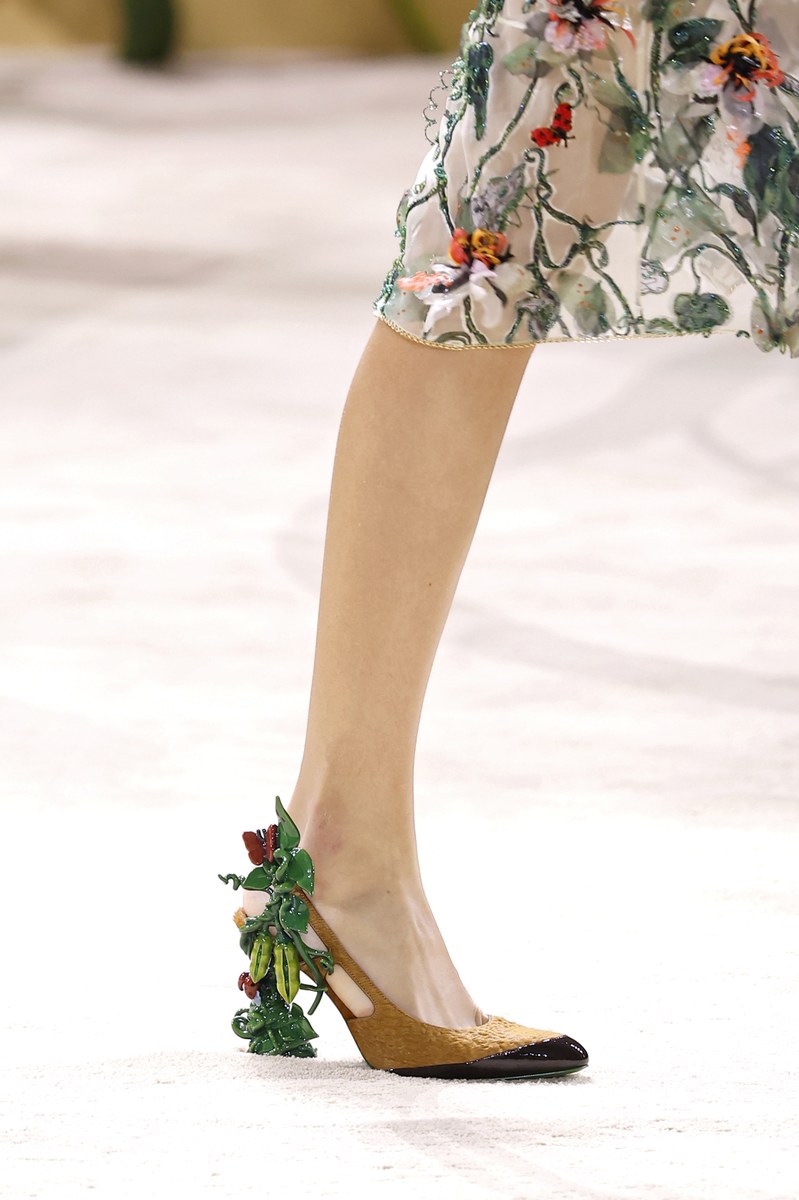
A printed or textured underlayer consistently sits beneath a structured outer piece, most legibly in Looks 15 and 18 where a plaid ruffled shirt opens beneath a quilted ski jacket or single-button blazer. Socks worn visibly over tights or pulled up to mid-calf appear in almost every women's look, functioning as a unifying styling device rather than an afterthought. Footwear divides into three recurring types: lace-up tall boots in fur (Looks 2, 13, 14), lace-up boots in leather or suede with graphic lacing (Looks 3, 17, 19), and yellow pointed-toe embroidered flats that cross multiple looks (Looks 7, 8, 9). Rope or whip-stitch handle details appear on bags across all looks where accessories are featured, creating a consistent hardware language.

Look by Look Highlights

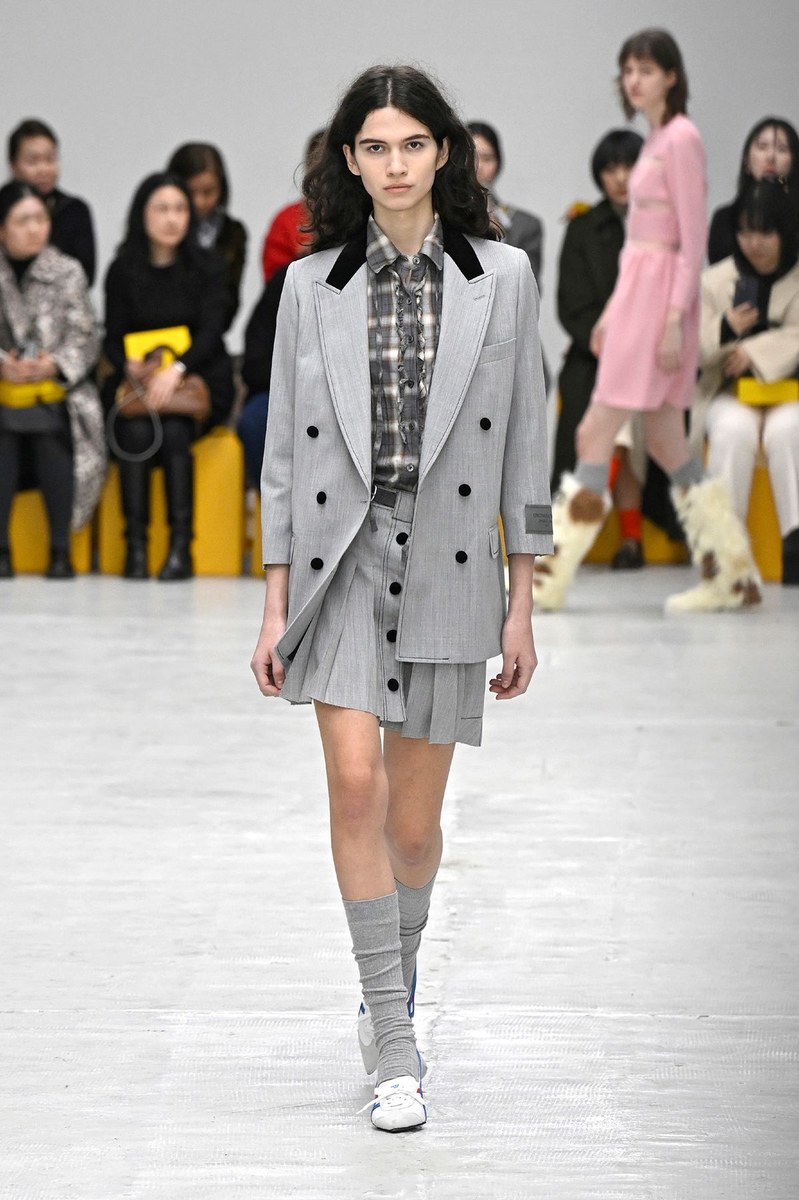
Look 1 A gray melange double-breasted blazer and pleated mini skirt with velvet collar detailing establishes the collection's core commercial proposition, a coordinated set that functions as a high-conversion ready-to-wear unit.

Look 3 The cream and tobacco cow-print shearling jacket over a Breton stripe top and black leather pleated skirt is the most immediately licensable outerwear piece in the lineup, combining three strong trend directions in a single look.

Look 3
Look 3

Look 4 An ivory bouclé-effect fleece bomber with large-scale rose embroidery signals a direct production investment, translating artisanal embroidery craft into a wearable, gender-neutral outer layer with broad demographic appeal.

Look 4
Look 4

Look 9 The cream double-faced wool military coat with black button rows and contrast topstitching is the collection's clearest elevated outerwear candidate, structured enough for formal retail adjacency and distinct enough for a fashion-forward department store floor.

Look 11 A multicolor patchwork cardigan in red, orange, purple, black and yellow over wide gray flannel trousers reads as the collection's most viral-ready look, combining pattern maximalism with a grounded trouser base that makes it commercially viable beyond editorial use.

Look 11
Look 11

Look 13 The mint green quilted ski puffer with brown and orange stripe blocking, layered over a mesh dress and white shorts with fur-shaft boots, compresses the entire collection's sportswear-meets-fantasy logic into one silhouette that will perform strongly in a ski-adjacent or resort retail context.

Look 13
Look 13

Look 16 A green plaid ruffled shirt tucked into a straw yellow fringe midi skirt with a pale blue ribbon belt is the collection's strongest feminine archival reference, a direct production opportunity for buyers sourcing statement skirts with tactile surface interest.

Look 16
Look 16

Look 19 The black leather duffel coat with white shearling trim, toggle closure and hood is the most wearable menswear crossover piece in the collection, with a proportion and finish that positions it for both men's and women's outerwear floors.

Look 19
Look 19

Operational Insights

Coordinated sets The blazer-and-pleated-skirt formula appears in at least four colorways (gray in Look 1, taupe in Look 5, olive in Look 17, and implied in the background of Look 5), making it a clear candidate for a core replenishment set rather than a one-season fashion piece.

Footwear as a margin driver Lace-up fur-shaft boots and embroidered yellow flats appear across enough looks to signal that Onitsuka Tiger is positioning footwear as a full-margin category anchor, not a styling accessory. Buyers should negotiate footwear alongside apparel in any wholesale conversation.

Embroidery investment Rose and floral embroidery appears across Looks 4, 6 and 15 in varying scales and techniques. Product managers sourcing outerwear should evaluate domestic versus import embroidery cost structures early, as hand-embroidery at this density will compress margins at mid-tier retail price points.

Gender-neutral SKU planning Men's and women's models move through the same silhouettes, fabrics and colorways, which means style directors can plan a reduced SKU count by building gender-neutral options rather than duplicating styles across two separate buying budgets.

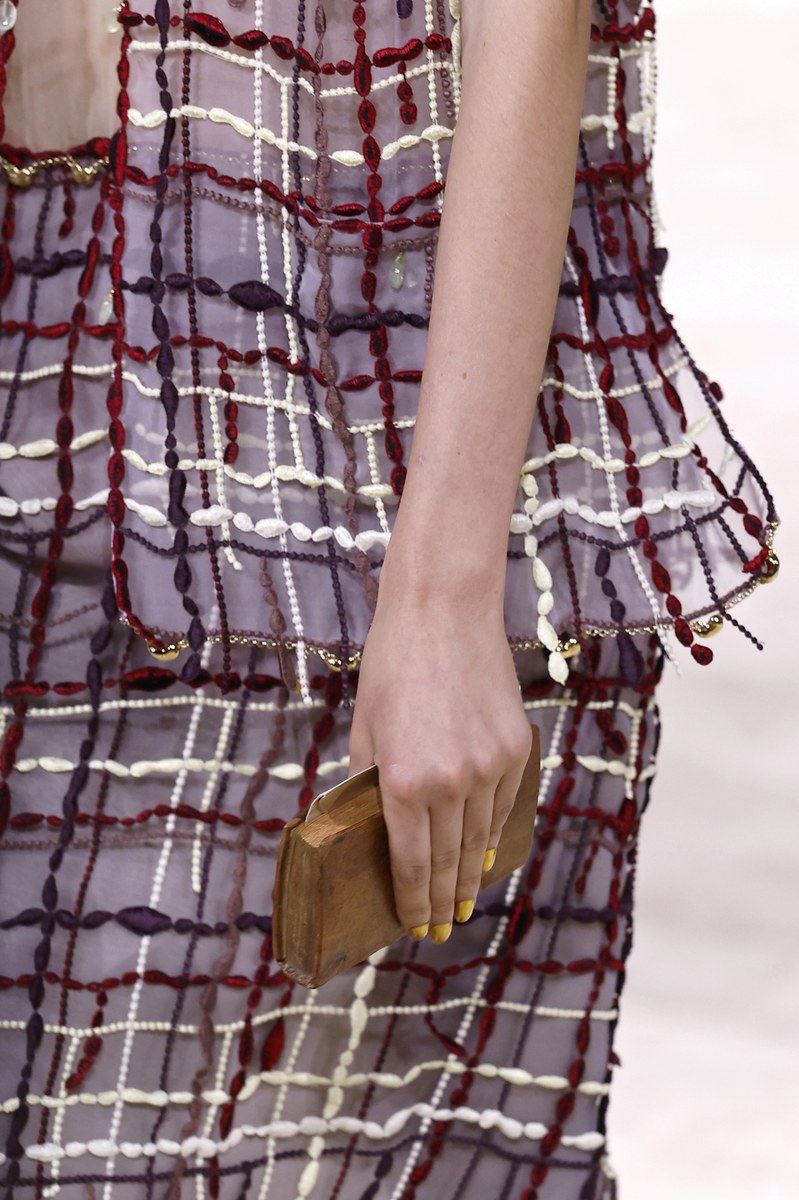
Bag hardware consistency The rope handle and whip-stitch detail recurs across every accessory in the collection, from the fuchsia backpack to the dark burgundy tote in Look 6, suggesting that Onitsuka Tiger is building a recognizable hardware signature. Buyers should treat this as a brand identifier when presenting to retail partners.

Look 6
Look 6

Complete Collection

Look 2
Look 2
Look 5
Look 5
Look 7
Look 7
Look 8
Look 8
Look 10
Look 10
Look 12
Look 12
Look 14
Look 14
Look 15
Look 15
Look 17
Look 17
Look 18
Look 18
Look 20
Look 20
Look 21
Look 21
Look 22
Look 22
Look 23
Look 23
Look 24
Look 24
Look 25
Look 25
Look 26
Look 26
Look 27
Look 27
Look 28
Look 28
Look 29
Look 29
Look 30
Look 30
Look 31
Look 31
Look 32
Look 32
Look 33
Look 33
Look 34
Look 34
Look 35
Look 35
Look 36
Look 36
Look 37
Look 37
Look 38
Look 38
Look 39
Look 39
Look 40
Look 40
Look 41
Look 41
Look 42
Look 42
Look 43
Look 43
Look 44
Look 44
Look 45
Look 45
Look 46
Look 46
Look 47
Look 47
Look 48
Look 48
Look 49
Look 49
Look 50
Andrea Pompilio

About the Designer

Andrea Pompilio was born in 1973 in Pesaro, a mid-sized city on the Adriatic coast of the Marche region, into a household that made creativity feel like the natural state of things. His father was an architect; his mother painted. His grandmother owned and ran clothing boutiques in the city, and he spent large portions of his childhood inside them, absorbing the logic of how clothes were chosen and displayed and worn. But his deeper aesthetic formation came from two grandfathers with opposite registers: one a refined local gentleman, reputed to be the most elegantly dressed man in town; the other a military officer, austere and precise, his uniform bearing large gold buttons that the young Pompilio found both intimidating and beautiful. Tailoring and military codes have remained central to his design language ever since, the civilian and the regimented held in productive tension. By the time he was eight, he had already told his grandmother he intended to be a fashion designer.

He completed a diploma in fashion design at Pesaro's Istituto d'Arte, then pursued a Master in Fashion Design at Istituto Marangoni in Milan, graduating in 1995. The professional education that followed was thorough and deliberately international: he worked at Alessandro Dell'Acqua, then at Prada in Milan, then at Calvin Klein in New York, then at Yves Saint Laurent in Paris. Each posting added a different vocabulary, a different understanding of how tailoring and proportion communicate. In January 2010 he launched his eponymous menswear label, which gained rapid traction: he won Vogue Italia's Who's On Next competition in 2011, and in 2013 debuted at Milan Fashion Week with the support of Giorgio Armani, presenting at the Armani Teatro, the first emerging designer to be given that opportunity. Between 2014 and 2016 he served as creative director of Canali.

His relationship with Onitsuka Tiger began in 2013 as a co-branded collaboration and deepened progressively until he was appointed full creative director in 2017, taking on everything from footwear and ready-to-wear to retail design and global presentations. The match is not an obvious one on paper: an Italian pret-à-porter designer working with a Japanese sportswear brand founded in 1949 by a former basketball coach and military officer. But the collaboration has proved unusually generative, each side educating the other. His collections for the brand treat Tokyo as a source of formal rigor and the European rave and street scenes of the 1990s as energy, pulling the two into a single coherent vocabulary. He shows regularly at Milan Fashion Week, with the FW2025 collection presented in February 2025 under the title "Yellow Collection," built around the idea of Tokyo's particular brand of urban duality.

"My concept is always to start from the history of the brand that invented and developed sportswear, but without ever presenting something too sporty, because Onitsuka Tiger is not an athletic brand but a fashion brand."

"As a designer, I always get my inspiration from people, from everyday life. We do not live in the movies; we live in real life, every one of us."

✦ This report was generated with AI — combining human editorial vision with Claude by Anthropic. Because the future of fashion intelligence is already here.