Oscar Ouyang FW26 Women Looks Report
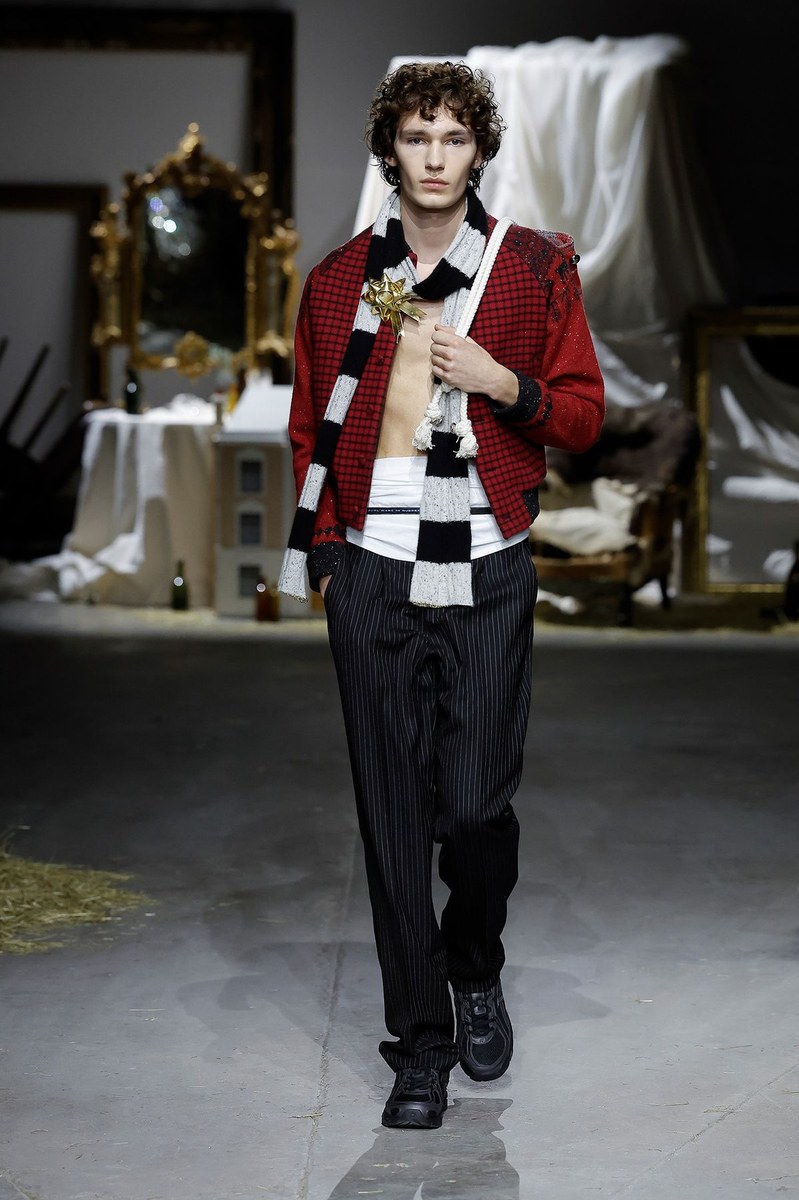
London Fashion Week
Oscar Ouyang FW26 builds a wardrobe around the tension between aristocratic excess and studied dishevelment, pulling baroque staging, fur trim, fairisle knit, and distressed denim into a single genderless framework. For buyers, this arrives at a moment when the market is actively hunting for menswear-rooted women's product with clear narrative authority and accessible entry points across categories.
Silhouette and Volume
Wide, floor-grazing trousers dominate from the first look to the last, consistently paired with cropped or mid-length outerwear to create a deliberate top-heavy proportion. Shoulders are structured in the cape-collar pieces of Looks 4 and 7, then dissolved into oversized knitwear in Looks 3 and 5. Wrapping the waistline in visible elastic, layering sash detailing, or leaving it entirely undefined gives each look its own breathing room. Volume stays low and wide rather than inflated, keeping the silhouette grounded and commercial without losing its editorial edge.
Color Palette
Black and white anchor everything, appearing together in Look 7's cropped ivory bouclé jacket over grey marl sweats, and splitting cleanly across Look 16's black glitter turtleneck against cream wide-leg trousers. Red arrives as a punctuation color, in the bomber of Look 1, the turtleneck underlayer of Look 4, and the horizontal stripe scarf of Look 15. Grey tweed and grey marl form a quiet mid-register that connects the louder pieces. The mood reads as winter nocturne with occasional warmth, controlled and desaturated except where red or ecru forces contrast.

Materials and Textures
Bouclé and tweeds with visible fleck and sparkle thread carry significant weight through the looks, appearing in Looks 6, 9, 12, and 13 with a surface quality that reads as handcrafted but structured. Fur trim, used as collar framing in Looks 2, 3, 6, and 12, is always grey-toned and dense, functioning as a textural counterweight to sleeker jersey and knit bases. Distressed denim in Looks 2, 11, and 19 reads worn and irregular, with deliberate fading and tear placement. White trouser fabrics range from fluid silk-adjacent weights in Look 16 to stiff cotton in Look 13, meaning trousers that read as the same color carry distinctly different commercial propositions.

Styling and Layering
Every look is built in at least three visible layers, and the logic is consistently torso-first, with the outerwear left open to expose whatever sits beneath. Bare midriffs appear in Looks 1, 11, 12, 15, and 18, not as a moment of exposure but as a structural layer gap, the absence of a shirt treated as a deliberate styling decision rather than an oversight. Footwear is almost uniformly chunky dad-style trainers in white, grey, or black, with Look 19 adding a lace cuff over the shoe opening. Accessories carry the collection's theatrical register: antler masks in Look 8, masquerade eye masks in Looks 6, 7, and 19, oversized fur ushanka hats in Looks 9 and 13, and cable-knit fingerless gloves in Looks 3, 11, and 12.

Look by Look Highlights
Look 3 delivers the most commercially complete proposition, pairing a fairisle knit in black and white with black velvet wide-leg trousers, a grey fur collar, and cable fingerless gloves in a way that translates directly to premium knitwear and accessories buying.

Look 4 is a strong outerwear statement, with the double-breasted black cape-shoulder jacket layered over a red top and white wide-leg trousers creating a tricolor graphic that photographs well at retail.

Look 7 reads as a white-on-white capsule entry point, the cropped ivory bouclé jacket over grey sweats and split-toe trainers sitting at the accessible end without losing the brand's proportion logic.
Look 13 carries the most costume-forward energy, with the white embroidered waistcoat, white wide-leg trousers, and floor-trailing fur ushanka hat forming a unit that buyers for concept retail or editorial-led boutiques should flag immediately.

Look 14 is the clearest luxury outerwear piece, a fitted white leather or heavy satin bomber with grommet hardware at the cuff paired with dark speckled wide trousers, presenting a clean season-defining jacket silhouette with production appeal.

Look 17 stands apart through its all-over printed dark charcoal pajama set layered under a white cropped bouclé jacket, making it the most print-forward entry and an easy candidate for buyers sourcing graphic separates with elevated context.

Look 6 operates as a strong grey layering reference, the tweedy fur-collar bomber over a white pinstripe shirt and white wide trousers combined with the lace eye mask suggesting a dressing-up language that is controlled enough for mainstream luxury retail.

Look 19 closes on a high-contrast note, the black textured cape coat over a red turtleneck and light-wash blue jeans pulling in the most accessible color story of the show while the lace boot cuff adds a single luxury detail that justifies margin.
Operational Insights
Trouser program: The wide-leg trouser is the backbone and appears in no fewer than 15 looks across white, black pinstripe, grey marl, dark tweed, and cream knit iterations. Buyers should consider this the anchor category for any range build, with clear differentiation in fabric weight and formality across skus.
Fur trim scalability: Grey fur collar trim appears across at least five looks and functions as a modular detail rather than a full fur commitment. Product managers sourcing knitwear or outerwear with this detail should plan for faux fur alternatives in markets with fur restrictions, as the grey tone is distinctive enough to carry in synthetic pile.
Accessories as margin drivers: Fingerless cable gloves, oversized fur hats, masquerade masks, and brooch stars appear throughout and carry strong editorial weight. Style directors should treat these as collectible add-on categories rather than season afterthoughts, as they sustain the collection's identity at lower price thresholds.
Layering architecture for visual merchandising: The open-coat, bare-torso layering logic is consistent enough to become a VM directive. Retailers should plan for three-piece display builds, outer layer open, mid layer visible, waistband or base visible at hem, to communicate the proportion on the floor.
Color entry strategy: Red appears in only four looks but always as a single high-visibility element within an otherwise monochrome outfit. Buyers who need a gateway color should prioritize the black and white base pieces first, then position red as a reorder or accent capsule once the core palette has established its presence in-store.
Complete Collection


About the Designer
Oscar Ouyang emerged from Beijing's Haidian district, where academic pressure and creative boundaries defined his childhood landscape. Born in Guangdong but raised in Beijing from age three, he grew up surrounded by structured lessons—piano, violin, art classes—while secretly sketching clothes onto paper dolls and flipping through his mother's fashion magazines. His queer identity set him apart in a city where other boys played football, but he found solace staring at magazine covers on stands, dreaming of belonging to that world. At 16, he secured his first taste of the fashion industry through an internship at Harper's Bazaar China, initially considering journalism before realizing design could become his livelihood.
The path to fashion began in earnest when Ouyang moved to London at 17 to study at Central Saint Martins. He completed his foundation, then chose knitwear over the more obvious routes of womenswear or menswear, drawn to the medium's fundamental possibilities. After finishing his BA in Fashion Design with Knitwear in 2020, he continued with an MA in Fashion with knitwear specialization, graduating in 2023. Rather than rushing to the runway like many CSM graduates, he took a pragmatic approach, first securing an order from Dover Street Market London and methodically building his business infrastructure.
His aesthetic draws from an eclectic well of influences. Studio Ghibli films, particularly Princess Mononoke and Nausicaä of the Valley of the Wind, provide narrative frameworks, while 15th-century Italian manuscripts discovered in the Met's digital archive translate into pixelated Fair Isle patterns. Japanese designers like Jun Takahashi and Number (N)ine shape his approach to utility and irregularity. Street photography from Chris Killip, Thomas Rousset, and Wolfgang Tillmans informs his understanding of how real people dress, while medieval folklore and anti-war demonstrations add conceptual depth. His work balances fantasy with function, creating what he calls "everyday clothing" that carries hidden meaning.
Now 28 and based in London, Ouyang serves as Creative Director of his own label, which launched properly after his 2023 graduation. The brand gained recognition through the British Fashion Council's Newgen program and made its official runway debut at London Fashion Week in September 2025. His pieces are stocked globally, from Dover Street Market locations to boutiques across Asia and the US, with 14 stockists for the Spring 2026 season alone.
"If you think of womenswear and menswear as painting on a canvas, knitwear is like building the canvas from the base," Ouyang explains. "London can be a dodgy place. Dressing can be a form of self-protection. Especially as a queer person, you sometimes dress to be invisible. This collection plays with that."
✦ This report was generated with AI — combining human editorial vision with Claude by Anthropic. Because the future of fashion intelligence is already here.