Ottolinger FW26 Women Looks Report
Paris Fashion Week
Ottolinger FW26 builds its identity around the collision of utilitarian outerwear codes and exposed, body-conscious underpinnings, treating the gap between them as the actual design statement. For buyers, this tension between protective shell and deliberate vulnerability maps directly onto a customer who wants clothes that read as both armored and raw.
Silhouette and Volume
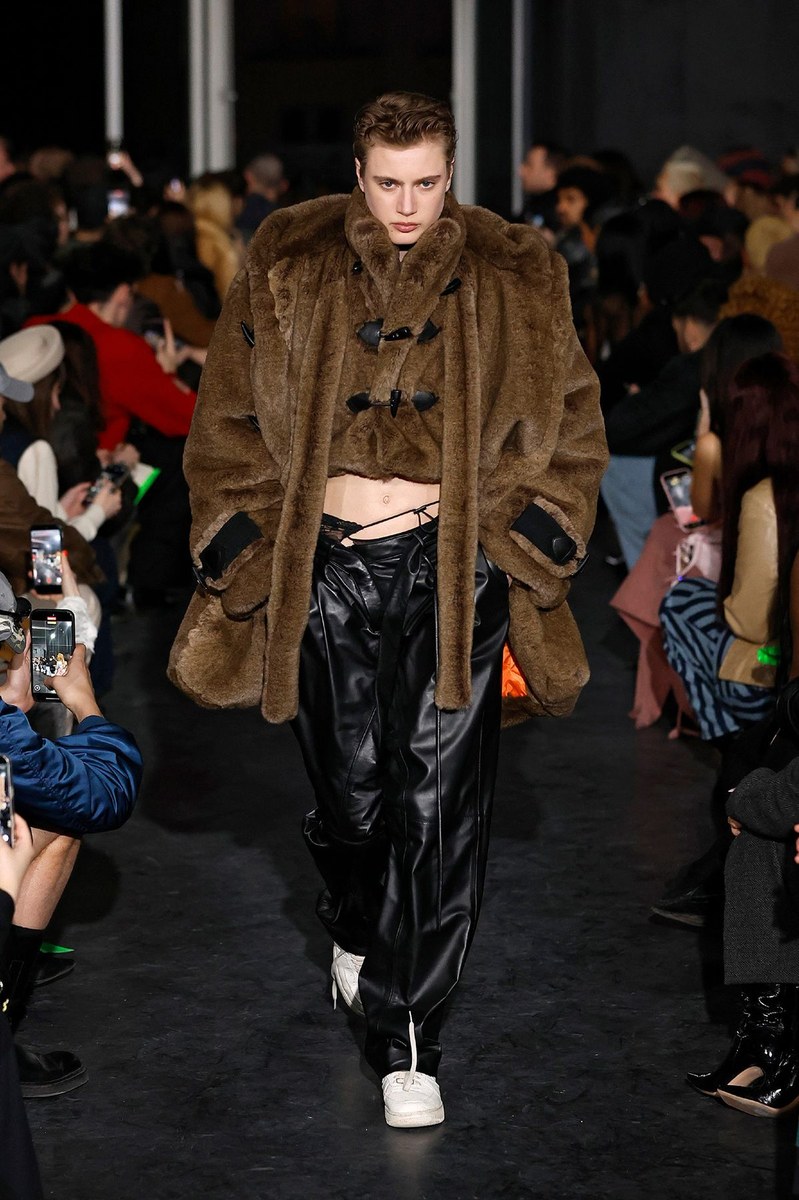
The collection opens with extreme shoulder-to-hem volume in faux fur and oversized toggle coats before tightening dramatically into body-skimming leather and sheer suiting. That shift from bulk to compression is the structural logic of the entire show. Looks 1 through 4 feature cropped jackets cut above the navel, creating a recurring interrupted silhouette where the garment ends and the body becomes part of the outfit. Below, flared and straight-leg trouser shapes anchor the lower half consistently, giving the eye a calm vertical against the turbulence above.
Color Palette
Tobacco brown dominates the opening third, appearing in faux fur, shearling, and knit across Looks 1, 2, 3, 4, and 20, creating a warm, almost animalic opening act. Black then carries through in an extended run, ranging from matte jersey and slick leather to quilted nylon and sheer lace, sustaining the collection through its middle and closing sections. Look 17 breaks the sequence with a high-visibility orange puffer that functions as a deliberate chromatic disruption. Ivory satin appears in Look 10 and the trousers of Look 18, adding a cooled, almost ceremonial contrast against the surrounding black.

Materials and Textures
Dense, mid-pile faux fur carries significant visual weight in the opening looks and reads as the collection's most commercial outerwear proposition. Leather, both matte and lightly buffed, runs throughout in trouser, jacket, skirt, and full-coat form, always cut with enough structure to hold a strong shape without stiffening. Sheer fabrics introduce a different register entirely. Barbed-wire-printed mesh in Looks 19 and 20 and floral lace in Looks 4 and 5 sit against skin with nothing underneath or only briefs, which makes the surface quality the entire point of those garments. A crinkled, textured black knit appears in the toggle jacket of Look 16, introducing a compressed, almost quilted hand that contrasts the smoother fabrications around it.

Styling and Layering
Throughout the collection, layering logic relies on deliberate mismatches of weight and formality, pairing a structured or bulky outerwear piece over something either intimate or transparent. Footwear splits between chunky white sneakers, worn with looks that skew streetwear, and strappy lace-up or open-toe heeled sandals, worn with the more body-exposed looks, signaling two distinct customer end-uses within the same collection. Toggle and duffle closures recur as a hardware signature across faux fur, woven, and satin jackets, creating a connective thread across categories. Accessories stay spare, limited to a small patent tote in Look 10, a mesh bag in Look 15, and embellished ear clips in Looks 10 and 12, keeping focus on garment construction rather than add-ons.

Look by Look Highlights
Look 1 The oversized tobacco faux fur coat over a cropped toggle jacket and black leather wide-leg trousers establishes the volume-to-skin ratio that defines the collection's commercial outerwear story.

Look 3 Ivory shearling toggle jacket with dangling belt straps over a white unitard and red-detail sneakers, this is the collection's most wearable gender-neutral piece and the strongest candidate for a crossover buy.

Look 7 Head-to-toe black leather biker jacket and leather trouser combination, finished with white sneakers. This is the most direct ready-to-market look in the lineup and will perform across multiple retail channels.

Look 10 Ivory satin mini blazer dress with toggle closures and a black pinstripe oversized scarf knotted at the chest, worn over black leather leggings and a patent tote, emerges as the collection's most complete and immediately sellable single outfit.
Look 15 A sculpted black nylon bomber with orange satin lining worn open over a black leather asymmetric skirt, lace-up heeled sandals, and a mesh utility bag reads as a direct collaboration between activewear and club-ready dressing with clear retail crossover potential.

Look 17 High-visibility orange down puffer with a cinched waist toggle belt over black fluid trousers and strappy heeled sandals delivers the collection's loudest single product. Buyers wanting one statement piece for visual merchandising should prioritize it.
Look 18 Long black duffle coat with keyhole chest opening over champagne satin wide-leg trousers operates as the collection's most polished and wardrobe-extendable proposition for a luxury contemporary customer.

Look 19 Full-length barbed-wire-print sheer mesh catsuit worn with only briefs underneath and strappy black heels is a directional editorial piece that anchors press coverage and drives aspirational visibility for the brand even if sell-through volume will remain limited.

Operational Insights
Toggle hardware: Duffle and toggle closures appear across faux fur, woven, satin, and knit fabrications, making this the collection's primary hardware signature. Buyers should treat it as a brand-building detail worth committing to across multiple categories rather than isolating it to one product tier.
Outerwear entry points: The cropped tobacco faux fur jacket from Look 2 and the ivory shearling version from Look 3 offer lower price-point outerwear alternatives to the full coats, broadening the range's accessible entry tier without diluting the aesthetic.

Leather depth: Leather appears in at least eight looks across trousers, jackets, skirts, and coats, suggesting that a buyer can build a coherent leather sub-assortment from this collection alone. Product managers should map fabrication sourcing early given current leather supply lead times.
Sneaker versus sandal split: The collection moves between chunky white sneakers and strappy heeled sandals as its two footwear registers. Style directors should use that binary to define two distinct floor presentations or editorial directions when placing the range in retail.
Sheer and lace as a carryover category: Barbed-wire mesh and lace fabrications in Looks 5, 19, and 20 continue a broader industry drift toward exposed layering that has moved from runway to mid-market over the past two seasons. Buyers with a younger contemporary customer should assess these pieces for early-adoption positioning before the silhouette reaches saturation.
Complete Collection


Fashion Designer

About the Designer
Christa Bösch and Cosima Gadient grew up in Switzerland, in landscapes that left their mark in opposite ways. Bösch was raised on a small biological farm in the mountains, in a village of around four hundred people where no one worked in the arts and fashion existed only as a distant abstraction. She studied law in Zurich before she understood what she actually wanted to do, and it was only there, among people connected to art and design, that a different path became imaginable. She applied to fashion school after graduating and was accepted. Gadient, by contrast, grew up with a strong internal life and a particular need to externalise her imagination, drawn from early childhood to the process of making something out of nothing, the movement from blank space to new form. Both came from a world shaped by proximity to nature and a fundamental orientation toward the practical and the handmade.
They met while studying at the Basel School of Design, drawn together by a shared interest in the surreal and the science-fictional, and a mutual instinct for material experimentation that didn't fit comfortably within conventional luxury fashion. After graduating, each took a different path briefly: Bösch moved to Antwerp and interned at a fashion house, where she was told that being allowed to use the copy machine beside the head designer was considered a major privilege. She called Gadient within minutes. They decided to launch their own brand instead, without a clear picture of what they were getting into and by their own admission without much money and with mistakes ahead of them. They named the label after their studio neighbor in Berlin, where they relocated. Ottolinger's first major visibility came through VFILES in 2016, and within two years they were LVMH Prize semi-finalists.
Their technical vocabulary is specific: garments burned with lighters, cut with acid, slashed, wrapped in tape, or assembled from fabric manipulated until it behaves like a different material entirely. They treat destruction as a form of construction, working with industrial methods and couture-level precision simultaneously so that the finished pieces are at once raw and rigorously controlled. The references are not fashion-historical but visual and cinematic: alien landscapes, Sigourney Weaver in Ridley Scott's Alien, post-apocalyptic science fiction, the body in motion and stress. Nature itself, the landscape both grew up within, runs through the work as a counterpoint to the industrial methods. Since 2016 they have presented collections in New York and Paris, collaborated with Diesel, Camper, and Acne Studios, and built the label into an independent research and creative studio based in Berlin, where they continue to design and direct all collections together.
"Probably the innocence of being a kid and a teenager, just doing things without questioning them too much. We try to always keep some of that. Go by your instincts and ideas. Don't let your critical mind interrupt the outpouring."
"If you know what you are getting into, you wouldn't dare start. Mistakes can be useful. A mistake reveals a different future. It leads you in a different direction. If you just know exactly what you are doing all the time, you would never end up anywhere interesting."
✦ This report was generated with AI — combining human editorial vision with Claude by Anthropic. Because the future of fashion intelligence is already here.