Paul Costelloe FW26 Details

Paul Costelloe FW26 Details
Did you know? Paul Costelloe was one of the first Irish designers to establish a luxury ready-to-wear business in Paris during the 1980s, bringing Irish craftsmanship techniques to haute couture production. His label became known for integrating traditional Irish linen and tweed into high-fashion silhouettes, bridging heritage textile production with contemporary design aesthetics.

Paul Costelloe FW26 Details Report

Paul Costelloe FW26 builds its accessories narrative around sculptural volume, heavy-gauge hardware, and a consistent tension between utilitarian structure and decorative excess. Buyers and product managers should pay close attention because the collection maps directly onto a market moment where customers are spending on statement accessories rather than quiet basics.

Category Overview

Four categories carry the collection's visual weight: Dress Detail, Eyewear, Glove, and Headwear. Architectural fabric manipulation and embossed gold hardware function as accessories in their own right within Dress Detail rather than finishing touches. Eyewear runs as a consistent black acetate frame across nearly every look, creating a branded backbone that anchors the more expressive jewelry choices below it. A single Glove entry and two Headwear pieces complete a cold-weather accessories suite that reads as commercially complete for a continental winter market.
Material and Construction

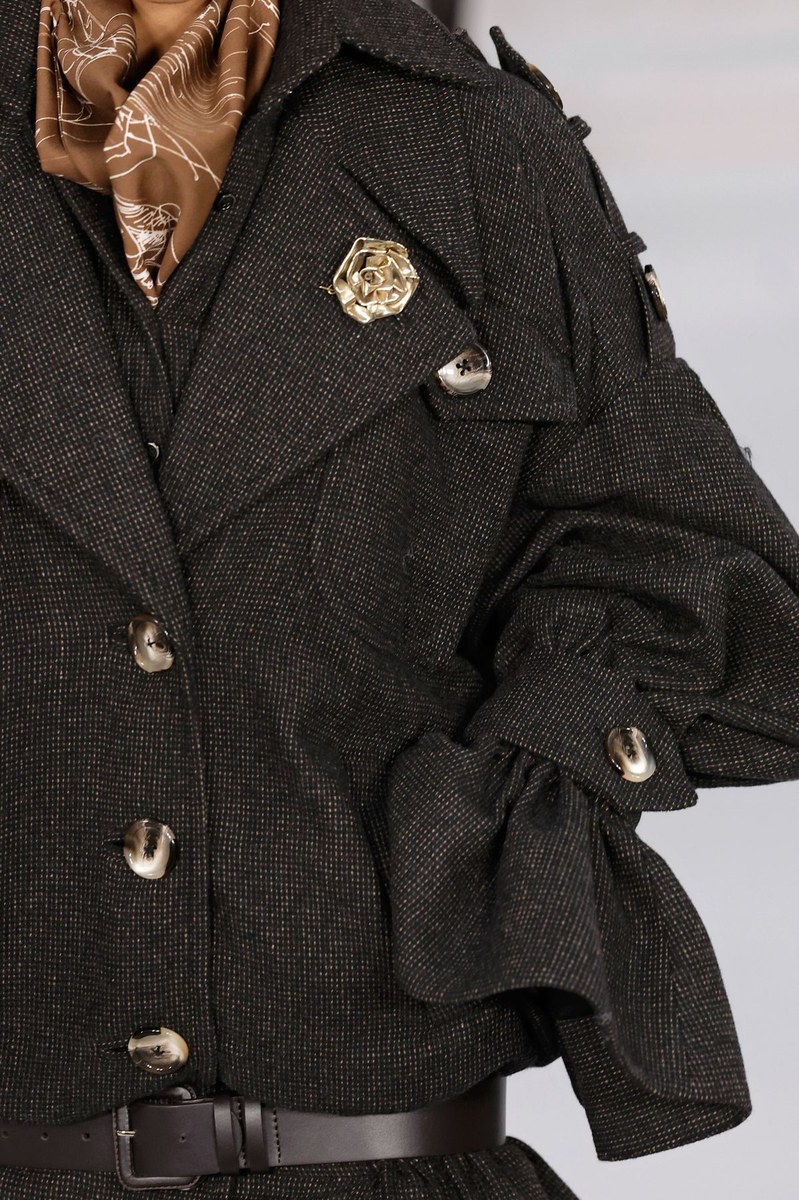
Tweed, wool plaid, and mohair blend dominate the fabrication story, appearing in Detail 1, Detail 10, and Detail 12 respectively. Detail 1's gold-toned rose appliqué button is cast metal, not stamped, and carries enough dimension to read clearly at retail scale. Detail 2 presents a champagne silk taffeta rose constructed from concentric coiled fabric strips, a technique that requires significant sample-room skill and commands a higher production cost than bonded alternatives. Matte chocolate calfskin appears in the leather glove of Detail 10, held closed with a chunky gold-link chain closure that bridges the gap between functional and ornamental.

Detail 1
Detail 1

Color and Finish Direction

Dark espresso, tobacco brown, and warm black anchor the palette, with champagne gold serving as the primary accent tone across hardware and Detail 2. Plaid fabrics in Details 3, 4, 5, 6, 10 introduce muted brick red and olive as secondary woven tones, preventing the palette from reading as flat or monotonal. Jewelry finishes split between aged gold, polished silver, and oxidized gunmetal, with each finish appearing to be assigned by look rather than mixed within a single outfit. A deliberate shift away from the cool greys that saturated FW25 buying points toward richer, earthier warm tones for the coming cycle.

Detail 2
Detail 2

Key Pieces and Details

The oversized black acetate sunglasses worn across Details 3 through 9 represent the clearest commercial proposition in the collection. Wide, flat-topped, and consistent across models, the frame suggests a house-specific design that could function as a signature SKU for wholesale. Detail 2, the champagne silk taffeta fabric rose, signals where the brand is willing to invest in craftsmanship as a differentiator and stands as the most production-intensive piece visible. Most immediately giftable and retail-friendly, the knitted mohair hood in Detail 12 is worn as a head-wrap over a matching ribbed turtleneck within the headwear category.

Detail by Detail Highlights

Detail 1 (Dress Detail) A dark heather tweed jacket carries multiple cast gold-tone rose buttons across the chest and sleeve, with ruffled sleeve vents adding volume at the forearm that echoes the decorative hardware weight.

Detail 2 (Dress Detail) A large-scale champagne taffeta fabric rose is constructed from tightly coiled concentric petals directly at the shoulder seam, functioning as the garment's primary structural and decorative focal point simultaneously.

Detail 3 (Eyewear) The flat-top black acetate sunglasses pair with amber resin drop earrings carrying a textured, irregular surface, setting the quietest and most wearable jewelry combination in the entire eyewear series.

Detail 3
Detail 3

Detail 6 (Eyewear) The same black frame sits above large matte gold petal-form clip earrings and a gold chain-link choker set with clear stones, making this the most maximalist and editorial jewelry pairing in the collection.

Detail 6
Detail 6

Detail 9 (Eyewear) Gunmetal disc and pavé drop earrings hang in a three-tier stack against a dark slate jacket, the silvered finish creating a strong tonal contrast that positions this look at the directional end of the commercial spectrum.

Detail 9
Detail 9

Detail 10 (Glove) A matte chocolate leather pouch glove closes with a gold multi-link chain draped across the wrist, worn half-inside a plaid sleeve as if tucked rather than buttoned, adding an effortless layering reference relevant to styling teams.

Detail 10
Detail 10

Detail 11 (Headwear) A white wool hood draped and pinned close to the face pairs with a pearl and crystal bib necklace plus a single mabe pearl pendant, creating a look that reads simultaneously monastic and embellished.

Detail 11
Detail 11

Detail 12 (Headwear) A deep chocolate mohair ribbed hood wraps tightly around the head and merges with the cowl neck of the garment beneath, making the boundary between headwear and knitwear deliberately ambiguous and commercially clever for bundled retail.

Detail 12
Detail 12

Operational Insights

Frame standardization: The black acetate sunglasses appear in at least seven looks with minimal variation, signaling that a single frame model could serve as the collection's anchor eyewear SKU, simplifying production minimums and wholesale range planning.

Hardware as hero: The cast gold rose button in Detail 1 carries enough brand identity to be developed as a standalone hardware element for bags or belts, and buyers should discuss cross-category licensing or carry-over potential with the design team.

Fabric rose MOQ risk: The silk taffeta rose in Detail 2 demands skilled handwork and is not well-suited to high-volume production runs, so buyers planning this piece for mid-tier retail should request a detailed construction breakdown and sample-room time estimate before committing to quantities.

Jewelry finish segmentation: Earring finishes split clearly across aged gold, polished silver, and oxidized gunmetal without mixing them within looks, giving multi-door buyers a clean framework to select finishes by market demographic rather than carrying the full jewelry range at every door.

Hood category opportunity: Details 11 and 12 present hooded headwear as a commercial category separate from hats and scarves, and given current consumer appetite for cold-weather layering pieces that photograph well, accessories directors should evaluate whether hood-specific SKUs merit their own fixture or shop-in-shop placement.

More Details

Detail 4
Detail 4
Detail 5
Detail 5
Detail 7
Detail 7
Detail 8
Detail 8

✦ This report was generated with AI — combining human editorial vision with Claude by Anthropic. Because the future of fashion intelligence is already here.